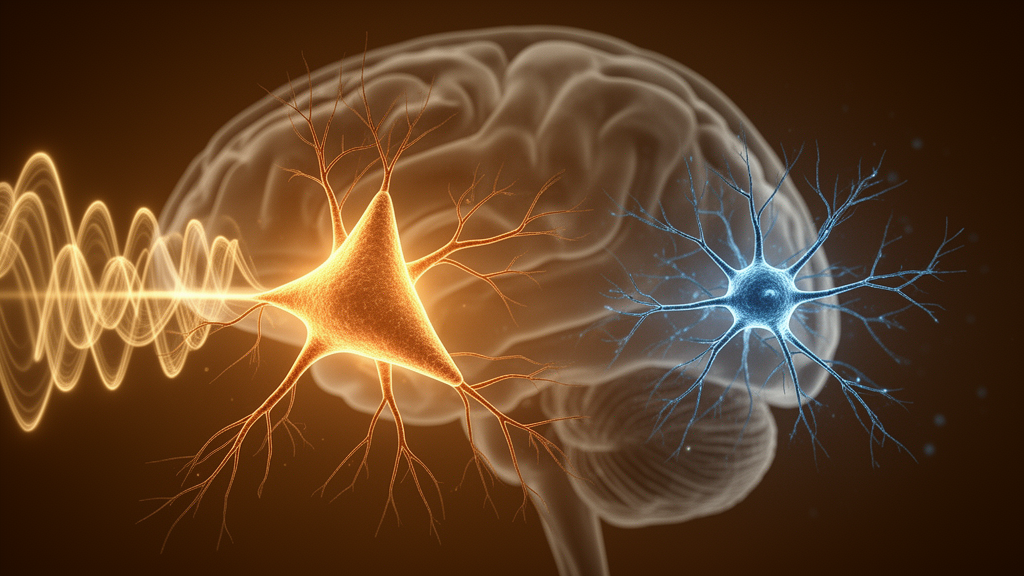
A modeling study of single neurons has found that the brain's main cell classes respond in markedly different ways to transcranial electrical stimulation (tES) depending on stimulation frequency. Using a large database of biophysically detailed neuron models, the researchers showed that pyramidal cells, the principal excitatory neurons, respond strongly to low-frequency stimulation but that their responses drop sharply as frequency increases. Inhibitory neurons behave differently: their responses decline less steeply with frequency, and above roughly 60 hertz they become, on average, more responsive than pyramidal cells.
The work addresses a central obstacle for tES, a non-invasive, safe and inexpensive method whose therapeutic value has been demonstrated but whose effects are highly variable. Conditions including Alzheimer's disease, Parkinson's disease, depression and epilepsy create an urgent need for better treatment options, and tailoring tES to specific conditions and individual patients requires a better understanding of how the technique modulates neural activity. The neural response to tES is highly complex, and the parameter space involved in optimizing treatments is daunting, which has made general insights difficult to obtain.
A key challenge lies in the cell-type-specific and frequency-dependent nature of these responses. To move beyond case-by-case simulation, the team applied a reciprocity theorem, demonstrating that the effect of tES on a given cell type is proportional to the frequency-dependent current-dipole moment that determines that cell type's contribution to the EEG signal. This link connects two quantities at different scales: the sensitivity of individual neurons to externally applied electric fields and the population-level signals recorded non-invasively from the scalp.
The researchers also derived an analytical formula for idealized neuron models that approximately predicts the tES sensitivity of different cell types at any given frequency, providing an efficient and accurate method for characterizing and comparing the responses of different neural populations across the frequency spectrum without running full biophysical simulations for every candidate protocol. Morphology emerged as a central determinant of these responses. Counterintuitively, total cell length had frequency-dependent and even opposing effects: longer neurons were more sensitive to tES at low frequencies, but at high frequencies increased length could reduce sensitivity instead.
These findings characterize the joint role of morphology and stimulation frequency in determining the responses of single cells. By clarifying how cell type, morphology and frequency together govern neuronal responses, the study represents an important step toward a better fundamental understanding of tES. The results also point toward a practical route for optimizing treatments: because the parameter space for tailoring stimulation is daunting, having a predictive, cell-type-resolved framework makes it feasible to design protocols aimed at selectively targeting specific neural populations.
Such cell-type-specific targeting could facilitate optimizing tES for particular neurological conditions, where the current variability of effects remains a major obstacle to realizing the technique's full therapeutic potential.
Subject of Research: Cell-type dependence of effects from transcranial electric brain stimulation
Article Title: Cell-type dependence of effects from transcranial electric brain stimulation
Article References: Dahle, S., Einevoll, G. T., & Ness, T. V. (2026). Cell-type dependence of effects from transcranial electric brain stimulation. PLOS Computational Biology, 22(10), e1014895. https://doi.org/10.1371/journal.pcbi.1014895
Image Credits: AI Generated
DOI: 10.1371/journal.pcbi.1014895
Keywords: Cell-type, dependence, effects, transcranial, electric, brain, stimulation, scientific research
News Source: Cassandra Pierce. (October 23, 2026). Pyramidal and Inhibitory Neurons Respond Differently to Brain Stimulation Frequencies. Scienmag.