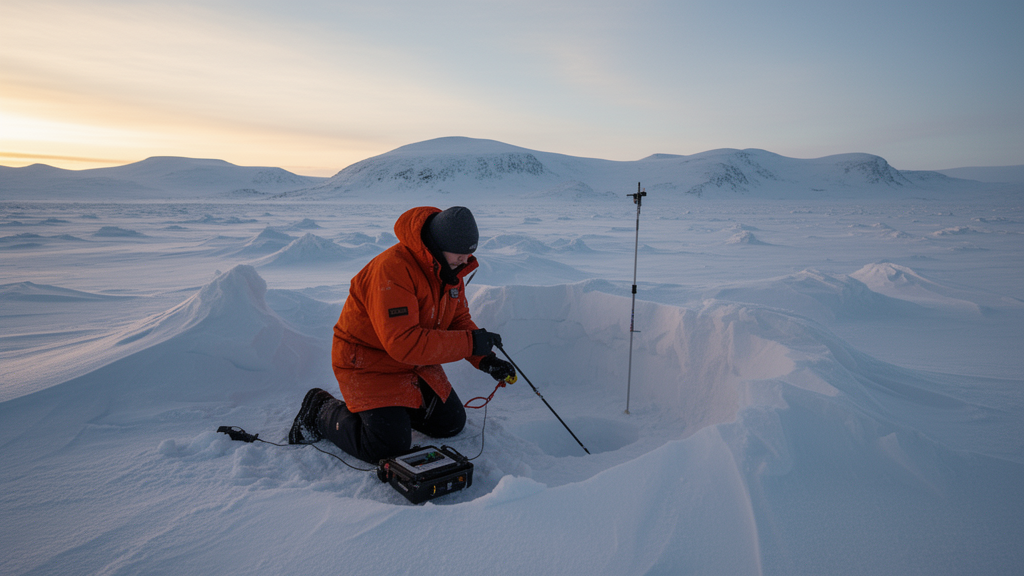
Winter in the western Canadian Arctic looks lifeless, but beneath the snow, soils keep breathing. A new study published in Biogeosciences has mapped, metre by metre, how much carbon dioxide and methane escape from frozen tundra soils through the snowpack at Trail Valley Creek, a research station roughly 45 kilometres north of Inuvik in the Northwest Territories. The measurements, taken in late March 2024 near the seasonal peak of snow accumulation, show that winter greenhouse gas fluxes vary dramatically over distances of just tens of metres, driven largely by how deep the snow lies and how warm the soil surface stays beneath it.
The research team, led by Gabriel Hould Gosselin of Northumbria University with colleagues at Université de Montréal and Wilfrid Laurier University, laid out five roughly 100-metre sampling transects across contrasting vegetation types: shrub tundra, mixed shrub and tussock terrain, a tussock field, a sparsely wooded black and white spruce stand, and a heterogeneous lakeside inlet. Along each transect, they measured snowpack gas concentrations and snow physical properties at microsites spaced 10 metres apart, collecting 119 co-located profiles in total. At each microsite, air was drawn from successive depths within the snow through a graduated probe to a portable infrared gas analyser, while a Snow Micropenetrometer recorded density profiles at sub-millimetre resolution.
The method rests on a well-established physical principle. Microbes in the soil produce or consume carbon dioxide and methane, creating concentration gradients between the soil surface and the atmosphere. The snowpack acts as a porous intermediary layer through which gases diffuse, and under steady-state conditions the flux can be calculated with Fick’s first law of diffusion, using the measured vertical concentration gradient together with snow porosity and tortuosity derived from density profiles. The team deliberately sampled only during calm conditions, with wind speeds below 3.5 metres per second and no pronounced surface relief or ice lenses, so that wind-driven pressure pumping could be treated as negligible and the flux reduced to its purely diffusive form.
The results reveal a striking spatial patchwork. Carbon dioxide fluxes were positive at every microsite, meaning soils were emitting the gas throughout the study area, but the rates differed significantly between surface covers, ranging from 0.8 to 100 milligrams of carbon per square metre per day. The lowest emissions occurred in the tussock transect, where snow was shallowest and soil surface temperatures coldest, with a median basal temperature of minus 9.5 degrees Celsius and median snow depth of 44 centimetres. The spruce-forested transect, by contrast, combined the deepest snowpacks, a median of 128 centimetres, with the warmest soil surfaces near minus 2.7 degrees Celsius, and produced fluxes an order of magnitude higher than any other cover type.
Across all microsites, carbon dioxide flux followed an exponential relationship with soil surface temperature, with the model explaining 79 percent of the variance. Snow depth and basal temperature were themselves tightly correlated, with a Pearson coefficient of 0.90, underscoring how strongly the insulating blanket of snow controls winter soil biology. Deeper snow traps more heat, keeping soils warm enough for heterotrophic microbes to keep decomposing organic matter even when air temperatures remain below minus 10 degrees Celsius. The authors note that their dataset fills a gap in previous pan-Arctic syntheses by including many measurements at soil temperatures between minus 6 and minus 0.5 degrees Celsius, a range insufficiently represented in earlier compilations, which tightened the fitted temperature-response curves.
Methane told a different and arguably more surprising story. Fluxes ranged from minus 0.04 to 0.08 milligrams of carbon per square metre per day, and in the forested transect the team measured persistent net uptake, meaning the soil was consuming atmospheric methane throughout the measurement period. This uptake occurred in soils warmer than about minus 6 degrees Celsius beneath deep snow, and its magnitude, roughly one order of magnitude below peak summer consumption rates recorded at the same site, indicates that methanotrophic bacteria remain active in aerobic soil layers even in mid-winter. The uptake rates were significantly but weakly related to concurrent carbon dioxide emissions, consistent with the idea that respiration serves as a proxy for the biological activity and oxygen diffusion needed for methane oxidation.
Elsewhere the methane picture was messier. The shrub and tussock transects, all with soils colder than minus 6 degrees Celsius, showed very little exchange, though two microsites in the coldest transect emitted methane at rates ten times the transect median. The inlet transect was the most variable of all, containing both the site’s highest emitting microsites and several profiles of net uptake, with fluxes showing almost no correlation to snow depth or soil temperature. The authors suggest this heterogeneity reflects a mosaic of saturated microsites where latent heat released during freeze-up sustains anoxic methanogenesis, alongside drier spots where oxidation dominates, and possibly physical trapping of methane beneath ice-occluded soil layers that decouples deep production from surface exchange.
One of the study’s most practical findings concerns measurement efficiency. Because gas concentrations rose linearly from the soil-snow interface to the snow surface at nearly all microsites, independent of the snowpack’s internal layering of dense wind crust and porous depth hoar, the full vertical profile turned out to be unnecessary. Fluxes calculated from just two measurements, one at the snow base and one near the surface, or even a single basal measurement combined with ambient air above the snow, matched full-profile estimates almost exactly, with coefficients of determination above 0.99. This means future winter flux surveys could slash the sampling burden per site, opening the door to landscape-scale campaigns that pair basal gas measurements with remotely sensed snow properties.
The team also quantified how many samples are needed to capture the variability within each surface cover, a question central to upscaling point measurements to the grid cells used in terrestrial biosphere models. Using a bootstrap resampling approach, they found that about 12 or more sampling sites generally sufficed to reproduce the median carbon dioxide flux of a homogeneous cover, though the tussock transect required more than 25, and methane medians needed more than 20 samples in most transects and failed to stabilise at the site scale. The heterogeneous inlet transect, spanning both a wind-scoured slope and a wet drainage channel, proved hardest to characterise, suggesting that future upscaling should use data-informed spatial interpolation rather than simple averaging.
The implications extend to climate modelling. Terrestrial biosphere models currently carry large uncertainties in cold-season carbon fluxes, partly because they use grid-cell mean snow depths and imperfect snow thermal conductivity, which biases simulated soil temperatures cold and underestimates winter respiration. The Trail Valley Creek measurements provide empirical bounds for the temperature sensitivity of winter fluxes and demonstrate that sub-grid heterogeneity in snow insulation matters enormously: models that average over deep-snow, warm-soil hotspots and shallow-snow cold spots will miss the disproportionate contribution of the former. The persistent winter methane uptake in forested soils likewise suggests that model schemes for methane production and oxidation need better calibration at sub-zero temperatures. As Arctic winters warm faster than the global average and expanding shrubs trap ever deeper drifts of snow, quantifying this hidden winter carbon exchange becomes not a seasonal footnote but an essential piece of the Arctic carbon budget.
Subject of Research: Fine-scale spatial variability of winter CO2 and CH4 fluxes through Arctic tundra snowpacks
Article Title: Fine-scale spatial variability of winter CO2 and CH4 fluxes in Arctic tundra derived from snowpack gradient measurements
Article References: Hould Gosselin, G., Rutter, N., Mann, P. J., Marsh, P., & Sonnentag, O. (2026). Fine-scale spatial variability of winter CO 2 and CH 4 fluxes in Arctic tundra derived from snowpack gradient measurements. Biogeosciences, 23(20), 7447-7467. https://doi.org/10.5194/bg-23-7447-2026
Image Credits: AI Generated
Keywords: Arctic tundra, winter carbon fluxes, snowpack, carbon dioxide, methane, permafrost, soil respiration, methane oxidation, Trail Valley Creek, terrestrial biosphere models, snow depth, greenhouse gases
News Source: Sloane Callahan. (October 23, 2026). Snowpack surveys reveal hidden patchwork of winter carbon emissions in Arctic tundra. Scienmag.