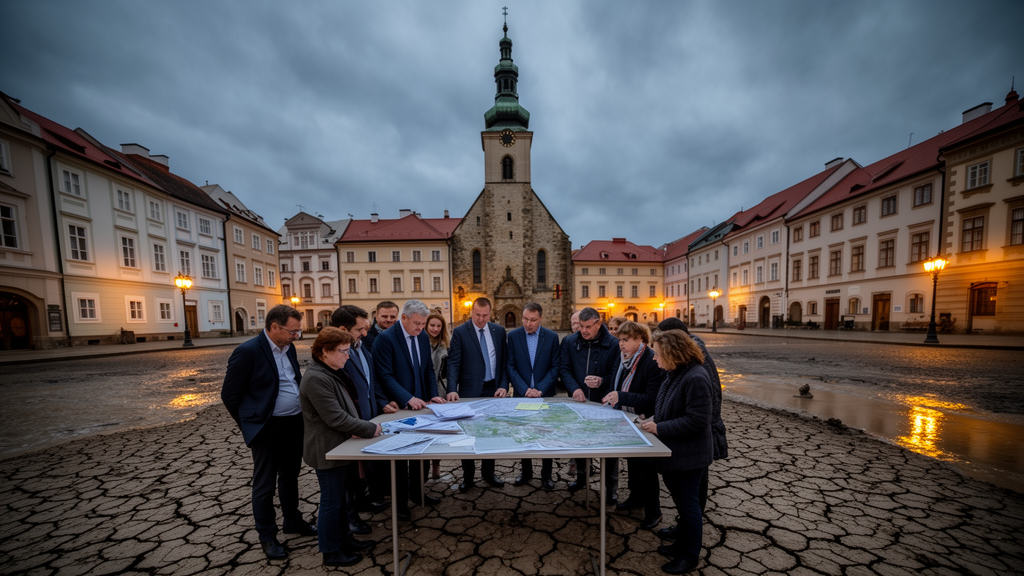
A sweeping survey of Czech local governments has produced the first comprehensive ranking of the threats that municipalities themselves consider most dangerous to their future. In a study combining a questionnaire sent to nearly 91 percent of all Czech municipalities with an expert focus group, researchers found that population ageing, economic crisis and financial instability, climate change, and the disruptive effects of the transition to a low-carbon economy top the list of concerns. Terrorism, by contrast, ranked lowest, and social threats such as inequality and migration barely registered among the worries of local officials.
The research, conducted in 2024, addresses a level of public administration that scholars describe as local micro-resilience: the capacity of towns and villages to absorb shocks, adapt and recover. While the resilience of states and regions has received sustained attention, the municipal level remains one of the least researched tiers, largely because each municipality is unique and comparable public data are scarce. In the study’s framing, municipal resilience is the active ability of a local government to defend itself, adapt, cope with and even overcome negative impacts of threats that are mostly exogenous, random and unpredictable, and which threaten the established standard of living in the community.
Methodologically, the team contacted 5,636 municipalities plus 57 municipal districts of Prague, out of 6,254 self-governing units existing at the end of 2023. A total of 284 towns and municipalities completed the questionnaire, a return rate of 5 percent, a limitation the authors acknowledge as a potential source of non-response bias. Respondents rated predefined threats across seven categories: environmental, societal, economic, health, municipal leadership and strategy, infrastructure and services, and security. Answers on a five-point Likert scale were converted into a coefficient ranging from 200 to minus 200, where higher values indicate greater perceived urgency. The survey ran from late November 2023 to mid-January 2024, and the results were statistically tested using confidence intervals and repeated-measures analysis of variance, with a Greenhouse-Geisser correction applied after Mauchly’s test rejected the sphericity assumption.
The questionnaire results show that the single highest-scoring threat was the undesirable impact of the transition to a low-carbon economy, with a coefficient of 110. In their open-ended answers, municipal officials described a lack of an energy concept, financially and procedurally demanding requirements for new buildings, the burden of maintaining and reconstructing existing facilities, and the technical and technological unpreparedness of small municipalities, alongside requirements for excessive reinvestment. Ageing of the population in the context of healthcare followed closely at 105.6, reflecting worries about financing social and health services, delivering meals and transport to elderly residents, supporting doctors and pharmacies, and shrinking hospital and long-term care capacity.
Climate change and natural disasters ranked third among specific threats at 88.8, with respondents citing torrential rains, floods, prolonged droughts, gusty winds, local tornadoes, soil erosion and groundwater loss. Such events are difficult to predict, can affect large areas, and cascade into education, transport, the energy network and public health. Economic crisis and financial instability scored 76, with officials repeatedly highlighting dependence on the tax budgeting system, declining revenues, and frequent, unsystematic changes in tax and subsidy policy that make planning unpredictable. Rising energy prices and waste management costs added to the financial anxiety, as did dependence on a single energy source or a dominant local economic sector.
At the other end of the scale, terrorism and war conflict received a strongly negative coefficient of minus 87.7, which the authors attribute to the high level of internal security in the Czech Republic. Inadequate traffic infrastructure and accessibility scored minus 22.9, insufficient basic infrastructure minus 14.7, and lack of protection from diseases and pandemics minus 14, with respondents noting that pandemics of national scale are handled by higher administrative institutions and government. Social threats also scored negatively: population instability and ageing as a social issue registered minus 4.0, and social inequality and conflicts minus 11.5, with only homelessness and growing hostility among citizens mentioned as specific concerns.
To complement the survey, the researchers convened a focus group on 19 April 2024 with 28 participants, including 18 deliberately selected experts from academia, practice and public-sector stakeholder groups. Each expert ranked nine general threats from most to least severe. The experts placed population ageing first with an average score of 6.39 on a nine-point scale, followed by economic crisis and financial instability at 5.72 and climate change at 5.67. High bureaucracy came fourth at 5.17, ahead of the low-carbon transition at 4.78, insufficient civic amenities at 4.61, environmental pollution at 4.50, cybersecurity at 4.28 and low citizen participation at 3.89.
Because the two instruments used different scales, the team converted both sets of results into rankings and averaged them with equal weight, treating the survey as the broad perspective and the focus group as the deeper expert assessment. The final prioritisation places population ageing first. Economic crisis and financial instability, climate change and the low-carbon transition share second place. High bureaucracy ranks third, insufficient civic amenities, environmental pollution and cybersecurity share fourth, and low citizen participation ranks last. The authors note one divergence: the questionnaire ranked the low-carbon transition first while the focus group placed it fifth, so the averaged ranking differs from the expert assessment on that item. Notably, bureaucracy, a threat largely created by state-level institutions, emerged as a significant concern, with respondents criticising complex systems, discontinuous procedures and the unpredictability of national strategies toward municipalities.
Aggregated into categories, the questionnaire shows that environmental and economic threats dominate municipal concerns, followed by health threats, while security and social problems rank lowest. Perhaps the most sobering finding concerns preparedness: half of the responding municipalities had never dealt with the topic of resilience at all, and only 57 municipalities, about 20 percent, reported being in some way prepared to face threats within a resilient system. On a more hopeful note, nearly 70 percent said they are planning or already implementing measures to prevent or counter actual or potential threats in the near future, confirming that resilience remains a relatively new concept for Czech local governments.
The authors argue that the ranking matters less for individual municipalities, which should know their own vulnerabilities, than for regional and national policy. The findings offer an inductive-deterministic direction for economic and subsidy policy aimed at promoting municipal resilience, pointing to the need for systematic action against the effects of ageing, climate change, financial insecurity, technological unpreparedness for the low-carbon transition and high bureaucratisation. The study’s limitations are explicit: the sample covers roughly 5 percent of Czech municipalities, respondent location and municipality size were not collected, and results are bound to the time and place of the research. Because no comparable comprehensive multi-threat study was found in the literature for the Czech Republic or other countries, the authors could not conduct a standard confrontational discussion, positioning the work as a baseline for future research into municipal resilience, including planned analysis of smart, risk-preventing examples of good practice.
Subject of Research: Prioritisation of threats to municipal resilience in the Czech Republic based on a questionnaire survey and expert focus group
Article Title: Resilience of municipalities: prioritisation of threats based on the example of the Czech Republic
Article References: Turečková, K., Nevima, J., Majerová, I., Lebiedzik, M., & Varadzin, F. (2026). Resilience of municipalities: prioritisation of threats based on the example of the Czech Republic. Heliyon, 12(16), Article e45579. https://doi.org/10.1016/j.heliyon.2026.e45579
Image Credits: AI Generated
DOI: 10.1016/j.heliyon.2026.e45579
Keywords: municipal resilience, Czech Republic, population ageing, climate change, low-carbon transition, economic crisis, cybersecurity, bureaucracy, questionnaire survey, focus group, public administration, threat prioritisation
News Source: Beatrice Stafford. (October 23, 2026). Czech Municipalities Rank Ageing, Climate and Economic Shocks as Top Threats to Local Resilience. Scienmag.