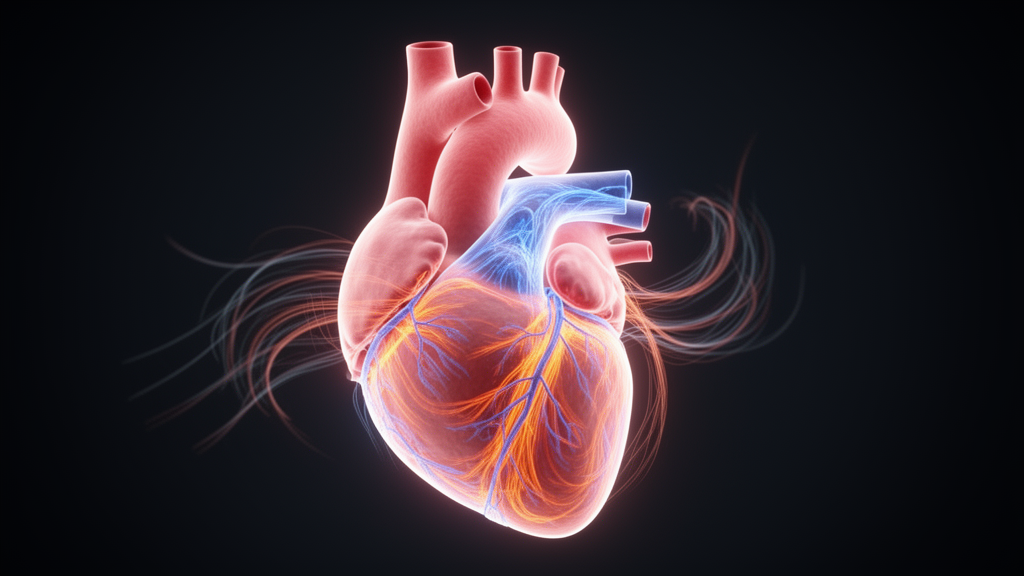
Researchers have developed a computational framework that can efficiently model the fluid and solid stresses inside porous, sponge-like tissues, with a focus on the developing embryonic heart. The work, by Christine Miller Buffinton and James W. Baish, targets the critical stages of chamber and valve formation, when trabeculation—folds of muscle that fill much of the ventricles—creates an intricate architecture where blood flows through and around porous tissue.
During these stages, the trabeculated heart wall is the site of complex mechanotransduction processes, in which mechanical forces influence tissue development. Accurately estimating the fluid and solid stresses within such intricate geometries is difficult, and explicit simulations of every pore are computationally expensive. The new framework addresses this through three levels of modeling and verification.
First, the team imaged E12.5 mouse ventricles using confocal microscopy and reconstructed them in three dimensions. These images guided the creation of explicit pore-scale finite element simulations with fluid-solid interaction. Idealized and image-derived unit cells were then analyzed to determine hydraulic permeability.
Permeabilities obtained from the unit cell simulations followed trends predicted by Kozeny-Carman solid-pore and fiber theory for the rigid case. Simulations in which the unit-cell material was treated as hyperelastic quantified the effects of tissue elasticity, capturing how deformation of the heart wall changes flow through it.
Next, the researchers solved a multi-pore representation of the ventricular wall using full fluid and solid equations. They then replaced the explicit pore structure with a continuum model based on the Brinkman equations, and evaluated how sensitive the results were to permeability in terms of fluid flow in both the open channel and the porous region.
Comparing the continuum and explicit model results showed that the Brinkman equation, which incorporates the diffusion of shear stress from flow in the free fluid into the porous media but does not explicitly include inertial effects, could significantly improve the accuracy of continuum models compared with Darcy’s law, the simpler classical description of flow through porous media.
To demonstrate the technique on realistic anatomy, the team built a three-dimensional model of blood flow through the ventricles of the developing mouse heart. The model showed locations of peak solid and shear stress and produced physiologically reasonable flow, indicating that the approach can capture meaningful mechanical conditions in the embryonic heart.
The researchers also developed methodologies to estimate local wall shear and solid stress from continuum-based calculations. Because the continuum approach avoids the need for computationally expensive explicit pore modeling, it can enable efficient, whole-organ parametric analyses of fluid flow, allowing researchers to explore how variations in tissue properties and geometry alter the mechanical environment of the developing heart.
Subject of Research: Computational modeling of fluid and solid stresses in the trabeculated embryonic heart
Article Title: A computational framework for modeling fluid and solid stressesin porous tissues with application to the trabeculated embryonic heart
Article References: Buffinton, C. M., & Baish, J. W. (2026). A computational framework for modeling fluid and solid stressesin porous tissues with application to the trabeculated embryonic heart. PLOS Computational Biology, 22(10), e1014896. https://doi.org/10.1371/journal.pcbi.1014896
Image Credits: AI Generated
DOI: 10.1371/journal.pcbi.1014896
Keywords: computational modeling, embryonic heart, trabeculation, fluid-solid interaction, Brinkman equations, hydraulic permeability, mechanotransduction, ventricle, finite element analysis, porous media, computational, framework
News Source: Drew Townsend. (October 23, 2026). Computational framework maps fluid and solid stresses in the embryonic heart. Scienmag.