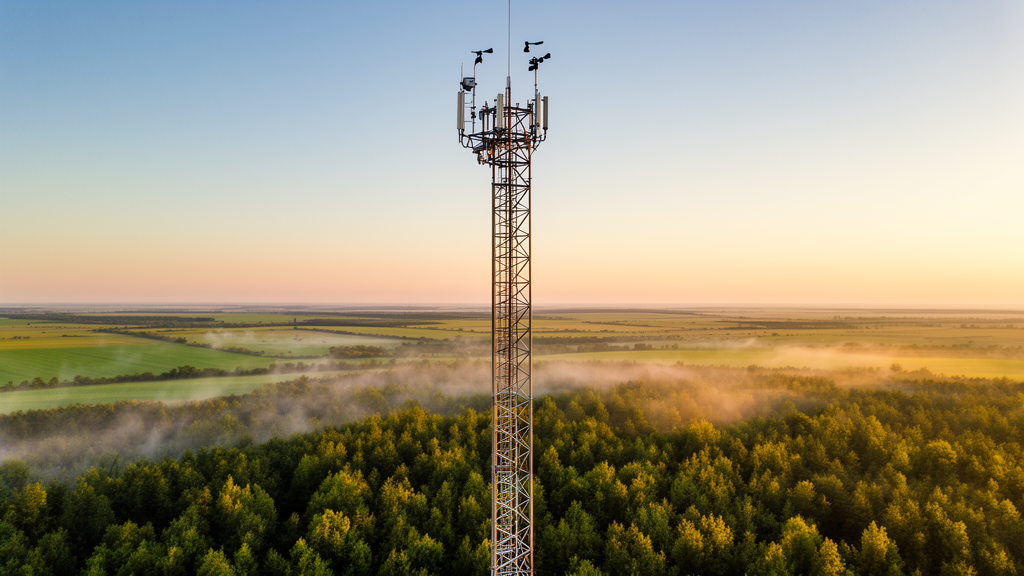
A ten-year record of carbon monoxide measurements from a 117-meter television tower in rural western Hungary has delivered the first long-term, regionally representative picture of how this important trace gas moves between the land surface and the atmosphere in Central Europe. The study, published in Atmospheric Chemistry and Physics, analyzed hourly eddy covariance flux data collected between July 2015 and June 2025 at the Hegyhátsál tall-tower monitoring station, and its findings carry an uncomfortable twist: measured carbon monoxide emissions from the region’s small villages substantially exceed what official emission inventories predict, by factors of two to four.
Carbon monoxide is far more than a household poison. In the atmosphere, it is oxidized by the hydroxyl radical, the molecule often called the atmosphere’s detergent, and that reaction consumes roughly forty percent of all hydroxyl radicals available. Because the same radical is responsible for destroying methane, the third most important greenhouse gas after water vapor and carbon dioxide, any change in carbon monoxide abundance alters methane’s atmospheric lifetime. The oxidation also produces hydroperoxyl radicals, key ingredients in ground-level ozone formation. This is why carbon monoxide is treated as an indirect greenhouse gas, and why pinning down its sources and sinks matters for climate science even though the gas itself does not warm the planet directly.
What makes the new dataset unusual is its scale and duration. Most previous studies of land-atmosphere carbon monoxide exchange relied on chambers or short towers of two to four meters, and typically ran for only days to about two years. Those studies, conducted over grasslands in Denmark, Canada, Scotland, Ireland and Finland, over an Arctic peatland in Sweden, and in tropical Brazilian rainforests, returned contradictory verdicts on whether soils and vegetation act as net sources or sinks. A tall tower changes the equation: mounted at 82 meters, the eddy covariance system at Hegyhátsál samples air whose flux footprint can extend up to ten kilometers, integrating emissions from a heterogeneous landscape of corn and wheat fields, forest patches, and small villages, an area that can approach one hundred square kilometers.
The technical achievement required considerable ingenuity. Air is drawn from the tower through roughly one hundred meters of tubing to an analyzer recording five times per second, and the research team had to correct for the lag this introduces, for spectral losses along the tube, for flow distortion caused by the tower’s own steel structure, and for periods when nighttime temperature inversions decouple the instrument from the surface below. Using a footprint model, the team calculated which patches of upwind terrain contributed to each hourly measurement, then combined this with a high-resolution land cover map to separate fluxes from populated areas and from vegetation-dominated land. After rigorous filtering, 25,917 hours of data survived for analysis out of more than 87,000 recorded.
The separation revealed a landscape of stark contrasts. Emissions from the populated grid cells, dominated by the villages of Hegyhátsál and nearby Nádasd, followed a dramatic seasonal cycle, with monthly means ranging from 12 to 110 nanomoles per square meter per second, lowest in July and highest in January. Winter values ran an order of magnitude above summer ones, and the summer baseline of about 14 to 16 nanomoles per square meter per second was itself roughly 85 percent below the winter figure. Since traffic emissions change little through the year and the region hosts no industry, the authors attribute the seasonal surge with high confidence to residential heating, much of it accomplished with wood, low-quality coal, agricultural waste, and, in some cases, illegally burned household waste in outdated, inefficient stoves.
Those measurements collide head-on with official bookkeeping. Comparing the tower data with the EDGAR v8.1 emission database, the team estimated total measured anthropogenic emissions of around 460 megagrams of carbon monoxide per year from the grid cell containing the site, of which about 330 megagrams stem from residential activity. EDGAR’s bottom-up estimate for the residential sector averaged just 83 megagrams per year over 2015 to 2022, and the database also reports a thirty percent emissions decline over that period that the Hungarian observations give no reason to believe. The authors suggest the discrepancy arises because activity statistics underestimate how many households, despite access to natural gas, burn solid fuels for economic reasons in this slowly depopulating region.
The vegetation-dominated sector, cropland and forest selected so that populated areas contributed less than 2.5 percent of the flux, told a different story. Here the landscape acted as a weak net source of carbon monoxide from April through September, averaging 0.58 nanomoles per square meter per second, with monthly values between 0.31 and 0.91 and a July maximum. Median hourly emissions peaked around noon, ranging from 1.59 to 2.66 nanomoles per square meter per second, while nighttime values ranged from minus 1.01 to plus 1.17 and did not deviate significantly from zero at the five percent probability level. This diurnal rhythm, emission by day and near-neutral flux at night, matches patterns seen in earlier short-term studies from Finland to Ireland, and places the Hungarian results squarely within the range of minus 3 to plus 14 nanomoles per square meter per second reported for other grasslands and croplands.
To identify what drives the natural exchange, the team tested correlations with ultraviolet radiation, photosynthetically active radiation, air temperature, and soil water content drawn partly from the ERA5 reanalysis. Solar radiation emerged as the primary driver, supporting the idea that photodegradation of organic matter in plants and litter releases carbon monoxide in sunlight. Temperature correlations proved statistically insignificant for most of the year once their overlap with radiation was considered, and soil moisture showed no significant relationship, though the coarse resolution of the reanalysis soil data and the heterogeneity of the landscape temper that particular conclusion. The findings suggest thermal decomposition plays a minor role, or is largely offset by microbial uptake of carbon monoxide in soils.
The study is candid about its limitations. The elevated measurement height leaves the instrument vulnerable to decoupling during stable nights, forcing the rejection of 21,802 hours of data, and although the team showed that the neglected storage term does not bias daily totals, it adds uncertainty to winter diurnal patterns. Distant anthropogenic sources, whose emissions are orders of magnitude larger than natural exchange, can still leak into footprints that appear almost entirely vegetated, which likely explains why the vegetated sector showed a puzzling winter maximum that natural processes alone cannot produce. No trend over the decade could be extracted, and gap-filling was deliberately avoided for lack of a sound theoretical basis.
Even so, the implications reach beyond one Hungarian county. If the emission densities measured here are representative of other rural regions of the country, national carbon monoxide totals reported to international organizations would need upward revision, and the authors argue that field measurements are essential to develop emission factors reflecting real-world heating practices. More broadly, the decade of data demonstrates both the promise and the difficulty of tall-tower flux monitoring: such towers can deliver landscape-scale budgets that short towers and chambers cannot, but separating the whisper of natural soil-vegetation exchange from the shout of human combustion remains one of the field’s central challenges, and one that only long, patient observation can hope to resolve.
Subject of Research: Long-term measurement of land-atmosphere carbon monoxide exchange using tall-tower eddy covariance in rural Central Europe
Article Title: Long-term land-atmosphere carbon monoxide exchange from a tall tower in a rural Central European region
Article References: Haszpra, L., Barcza, Z., Kern, A., Zrinyi, N., & Kljun, N. (2026). Long-term land-atmosphere carbon monoxide exchange from a tall tower in a rural Central European region. Atmospheric Chemistry and Physics, 26(20), 14961-14979. https://doi.org/10.5194/acp-26-14961-2026
Image Credits: AI Generated
DOI: 10.5194/acp-26-14961-2026
Keywords: carbon monoxide, eddy covariance, tall tower, Hungary, atmospheric chemistry, emission inventories, residential heating, photodegradation, hydroxyl radical, greenhouse gases, flux measurements, land-atmosphere exchange
News Source: Russell Cooper. (October 23, 2026). Hungarian Tower Captures Ten Years of Carbon Monoxide Exchange Between Land and Air. Scienmag.