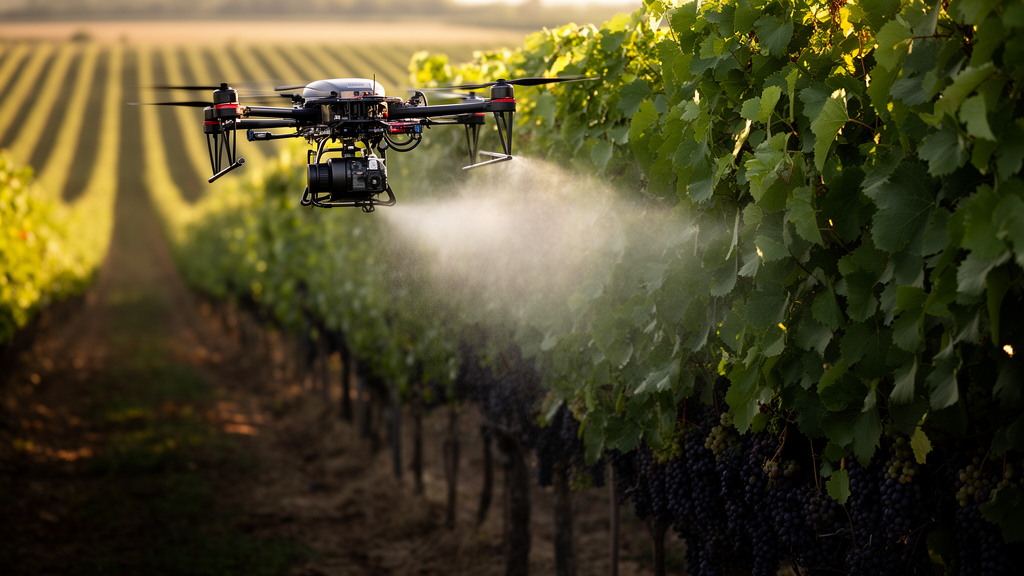
Drone sprayers are spreading fast across high-value agriculture, but a team working in a Sardinian vineyard argues that the way their performance is judged has not kept pace with their adoption. In a new study conducted in a Vermentino di Sardegna vineyard in Badesi, Italy, researchers developed and tested a three-phase spatial methodology for evaluating unmanned aerial spraying systems (UASS), combining pre-flight spray-width characterisation, drone-based canopy mapping, and water-sensitive paper sampling arranged across the field. Their central observation: sampling positions with larger canopy volume consistently tended to receive less spray in the lower canopy layer, meaning that field-average deposition figures can hide under-treated zones inside denser vegetation.
The motivation is practical as much as scientific. UASS platforms are increasingly marketed to vine growers because they reduce operator exposure to agrochemicals, reach sloped or awkward terrain, and offer timely applications, yet operating parameters are often chosen from manufacturer defaults or general experience rather than verified evidence for a specific crop, canopy architecture, or phenological stage. Flight height, speed, nozzle type, flow rate, track spacing, and overlap between adjacent passes all shape how much spray lands where. In vineyards, heterogeneous canopy density and the vertical structure of the vine complicate this further, and the authors argue that average deposition values alone are simply insufficient to capture local under- or over-treatment and limits on penetration into the canopy.
The trial took place in a traditionally managed three-hectare vineyard planted in 2000 with Guyot-trained Vermentino di Sardegna vines at 1 by 2.40 metre spacing. The experimental plot covered 11 consecutive rows over 2,304 square metres, with a gentle gradient of roughly 6.3 percent running along the 80-metre row length. The spraying platform was a customised 25-kilogram quadcopter carrying an 11-litre tank and four ASJ LD 110,015 no-drift flat-fan nozzles positioned under each propeller, powered by two 16,000 mAh lithium-polymer batteries. Flights were flown automatically at 3 metres above ground level, monitored by an onboard terrain radar that adjusted altitude continuously to hold a constant height over the sloping ground, at a forward speed of 3 metres per second, flying perpendicular to the rows with a nominal 2-metre track spacing and a spray dose of 80 litres per hectare.
Before the vineyard flight, the team characterised the drone’s spray distribution on an 8-metre wooden structure simulating the vine trellis production wire at 0.70 metres above ground. Forty-one water-sensitive papers at 20-centimetre intervals recorded covered surface area, droplet density, and two droplet-size statistics, the Number Median Diameter (NMD) and Volume Median Diameter (VMD). Coverage and droplet counts followed a bell-shaped transverse profile, and NMD values ranged from 40 to 110 micrometres with little variation between passes, indicating stable atomisation. Applying a 15-percent threshold of maximum coverage yielded an effective spray width of approximately 4.2 metres, which the team used to set the 2-metre track spacing and achieve roughly 50 percent overlap. Notably, average canopy width in the vineyard was only 0.63 metres, far narrower than the effective swath, underlining why generous overlap matters when the target is a thin, spatially variable canopy wall.
Canopy architecture was mapped a week before spraying using a DJI Matrice 350 RTK drone with a 45-megapixel full-frame RGB sensor flying a smart-oblique acquisition mode at 60 metres altitude, capturing 334 images in eight and a half minutes with ground sampling distances of 0.75 centimetres per pixel for orthomosaics. Five RTK-measured ground control points anchored the photogrammetric models built in Agisoft Metashape, and canopy volume per square metre was computed from the Canopy Height Model within 5 by 5 metre polygons. Ordinary kriging then produced a continuous canopy-volume map, and k-means clustering delineated three distinct canopy-volume zones across the study area, with leave-one-out cross-validation showing reasonable prediction quality for the high-density canopy data.
For the deposition measurements, 33 sampling positions were distributed in a checkerboard pattern across the 11 rows, with two water-sensitive papers per position: one at 0.70 metres on the production strip in the lower canopy and one at 1.60 metres in the upper layer, giving 66 papers in total. The papers were handled with gloves, clipped to trellis wires, collected in sealed numbered bags, and analysed with an automated image-processing tool developed by the team, applying spread-factor corrections to convert stain diameters into true droplet diameters.
The spatial analysis delivered a clear pattern. Spearman rank correlations showed moderate inverse associations between canopy volume and lower-layer deposition metrics: covered surface area at the lower position correlated at rho of minus 0.55 with canopy volume, and droplet density at minus 0.59, with weaker but consistent negative associations at the upper layer (minus 0.44 and minus 0.54). Because the variables departed from normality and the sampling points are spatially nested, the authors treated the correlation matrix as exploratory rather than confirmatory, and Moran’s I tests showed that canopy volume itself was positively spatially autocorrelated at short range, adding a further source of non-independence. Droplet size metrics showed little relationship with canopy volume, apart from a modest negative correlation with lower-position VMD, which the authors offer only as an untested hypothesis that denser canopies may preferentially filter out larger droplets.
K-means clustering of the lower-layer measurements reinforced the picture: clusters with lower coverage and droplet density tended to fall in the high canopy-volume zone, while sparse canopy areas produced higher but more variable wetting. Under sparse canopies, the measurements proved highly sensitive to exactly where a paper was placed, since displacing it a few centimetres near discontinuous leaves could substantially alter the reading. A practical implication follows directly: deposition measurements under low-volume canopies need more careful paper placement, more representative plant selection, and more sampling points, ideally distributed according to canopy-volume zones rather than on a rigid grid.
The upper-layer results were noisier. Some upper papers, kept at fixed grid positions to preserve the checkerboard design, sat above little or no vegetation and were either blasted by the unobstructed spray jet or missed entirely, producing anomalous values that the authors describe as indicative rather than quantitatively reliable. The flight trajectory had deliberately been optimised to keep the drone close to the production-wire level to maximise lower-canopy penetration, at an inherent cost to upper-layer deposition. Raising the flight height by about 0.9 metres or tightening track spacing could improve upper-canopy overlap, but the authors note the trade-off: greater height risks more drift and weakens the propeller downwash that drives penetration into the canopy.
The study is candid about its limits. Reliable geostatistical interpolation of the deposition data proved impossible with 33 sampling points across 2,304 square metres, roughly one point per 70 square metres, because each paper is a punctual manual measurement that cannot represent its surroundings well enough to build a valid variogram. The drone’s non-RTK GPS may have allowed local deviations from the planned 2-metre track spacing, and the weather-station log could not be recovered, so wind speed, wind direction, temperature, and humidity compliance with ISO-derived thresholds cannot be verified retrospectively; transient gusts or crosswinds cannot be excluded as competing explanations. Crucially, all results come from a single, non-replicated flight on one day, at one site, one cultivar, and one phenological stage (BBCH 81), so the reported correlations of rho minus 0.55 to minus 0.59 should be regarded as preliminary and site-specific, and the observational design means the canopy-deposition association should not be read as a demonstrated causal mechanism.
Even so, the methodology itself is the study’s principal contribution. The innovation lies not in new sensing technology but in structurally integrating established tools, pre-flight swath characterisation, drone-based canopy volume mapping, and spatially designed water-sensitive paper sampling, into a single repeatable workflow that converts canopy structure into operational decisions: where to place samplers, how to set track spacing, and which parts of a vineyard are being under-treated. The authors report that the inverse canopy-deposition pattern matches earlier findings that canopy structure descriptors predicted lower-layer coverage better than terrain slope, and that upper layers receive more deposition than lower ones, and they note that previous spatial analyses used canopy data as a prescription input for ground machinery rather than as a diagnostic of drone spray performance. Their stated next step is freely accessible software that performs water-sensitive paper analysis, spatial deposition mapping, swath characterisation, and canopy-penetration assessment, so that researchers, technicians, and farmers can evaluate drone spraying not by a single field average but by the spatial reality of where the spray actually landed.
Subject of Research: Spatial methodology for evaluating unmanned aerial spraying system spray deposition against vineyard canopy volume
Article Title: Spatial methodology for unmanned aerial spraying systems performance evaluation in vineyards
Article References: Sassu, A., Poddighe, C., Deidda, A., Ghiani, L., & Gambella, F. (2026). Spatial methodology for unmanned aerial spraying systems performance evaluation in vineyards. Smart Agricultural Technology, 15, Article 102643. https://doi.org/10.1016/j.atech.2026.102643
Image Credits: AI Generated
DOI: 10.1016/j.atech.2026.102643
Keywords: unmanned aerial spraying systems, vineyard, spray deposition, water-sensitive paper, canopy volume, precision agriculture, drone mapping, geostatistics, k-means clustering, Sardinia, plant protection, spatial analysis
News Source: Alan Morgan. (October 23, 2026). Dense Vine Canopies Leave Lower Grapevine Layers Under-Sprayed, Drone Trial Finds. Scienmag.