Lithium-rich cathode materials have long been viewed as one of the most promising routes toward next-generation batteries, capable of storing considerably more charge than the materials used today in electric vehicles and consumer electronics. Because the cathode’s capacity is a major factor in how much energy a battery can hold, these materials could eventually enable phones, laptops, and electric vehicles to run longer on a single charge. Yet a stubborn structural problem has held the entire family of lithium-rich cathodes back from commercial use. Now, a team at Hanbat National University in South Korea reports that the solution may lie not in preserving order within the crystal, but in deliberately destroying it.
In a study published in the journal Energy Storage Materials, a research team led by Professor Kyojin Ku of the Department of Materials Science and Engineering at Hanbat National University set out to test a counterintuitive idea. The work was made available online on July 18, 2026, and appeared in Volume 90 of the journal on August 1, 2026. Rather than trying to keep the cathode’s atoms neatly arranged, the researchers intentionally disrupted the atomic structure of a lithium-rich cathode and found that the resulting disorder improved both performance and stability.
To understand why this approach is surprising, it helps to look at the problem it addresses. During charging and discharging, transition-metal ions such as nickel and manganese in lithium-rich cathodes can drift away from their original positions in the crystal structure. These migrating ions can obstruct the pathways that lithium ions need to travel through the material, slowing the movement of lithium and contributing to irreversible performance loss over repeated cycles. Scientists have mostly tried to tackle this issue by preserving an orderly crystal structure in the cathode, assuming that an orderly arrangement would give lithium a clearer path to move through.
The Korean team focused on a specific composition, Li1.2Ni0.4Mn0.4O2, a nickel-manganese compound that avoids expensive metals like cobalt. This composition normally forms a neatly layered structure, in which lithium ions and transition-metal ions sit in separate planes of the crystal. To produce the disordered form, the researchers used high-energy ball milling with two structurally compatible layered starting materials. This mechanochemical process disrupted the arrangement of the cations, producing a crystal structure in which lithium and transition-metal ions are distributed more randomly. According to Professor Ku, this is, to the team’s knowledge, the first time this type of composition has been made in the disordered form.
When the researchers compared the disordered material with its ordered counterpart, the differences were clear. The disordered version showed more symmetric charge-discharge behavior, delivered higher capacity, and performed better under high currents. The material also exhibited stable operation, retaining about 90 percent of its initial capacity after 50 cycles, and it did so without a reduction in voltage, a detail that matters because any loss of voltage over cycling would erode the energy a battery can actually deliver.
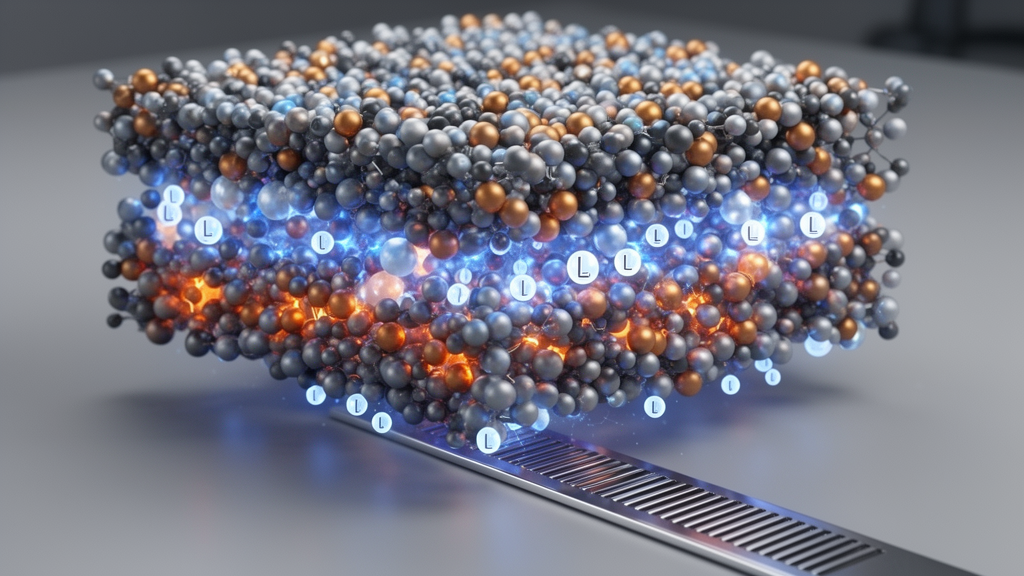
Detailed theoretical and computational analysis helped the team explain why the scrambled structure performed better. By deliberately scrambling the atoms into a disordered rock-salt arrangement, the researchers decoupled the movement of lithium from the harmful movement of the transition metals. In this configuration, lithium still flows efficiently through a connected network of open pathways, while the transition metals become effectively locked in place and can no longer block those pathways. In other words, the very disorder that was once seen as a defect becomes a mechanism for suppressing the ion migration that degrades the cathode.
The implications of this finding extend beyond a single material composition. Lithium-rich cathodes are attractive precisely because they can store more charge than conventional cathodes, which would translate directly into higher energy density for batteries. A higher energy density means that the same size and weight of battery could hold more energy, which is one of the most sought-after improvements in the industry, from smartphones and laptops that run longer between charges to electric vehicles with greater driving range and grid-scale energy storage systems that pack more capacity into less space.
Professor Ku framed the work as a shift in how researchers might approach cathode design. The team has shown, he said, that cation disorder can be used as a deliberate engineering tool to solve a problem that has held back an entire family of high-energy battery materials for years. If the principle is developed further, it could help move lithium-rich cathodes closer to real commercial use, paving the way for longer-lasting batteries for electric vehicles and energy storage. That framing positions the study as a proof of concept rather than a finished commercial technology, and the reported cycling data covers 50 cycles, so longer-term durability remains to be demonstrated.
The study, titled “Suppressing transition metal migration via cation disorder engineering for enhanced kinetics in lithium-rich cathodes,” was an experimental study, and the authors declared no known competing financial interests or personal relationships that could have appeared to influence the work reported in the paper. The research team included H. Choi, K. S. Kim, G. Park, S.-P. Cho, S. Lee, H. Kim, C. Kim, and B. Kim alongside Professor Ku, and the work was published with support from the Hanbat National University Industry–University Cooperation Foundation.
For the battery research community, the study offers a new direction in a field that has largely pursued the opposite strategy. Instead of fighting to maintain crystalline order in lithium-rich cathodes, engineers may now be able to embrace controlled disorder as a design feature, using mechanochemical methods such as ball milling to lock transition metals in place while leaving lithium free to move. As the demand for higher-energy-density batteries continues to grow across transportation and grid storage, approaches like this one, which reframe a long-standing weakness as a strength, could shape the next generation of cathode materials moving from the laboratory toward real-world applications.
Subject of Research: Cation disorder engineering to suppress transition-metal migration in lithium-rich battery cathodes
Article Title: Hanbat National University study shows cation disorder could improve lithium-rich cathodes
Article References: Hanbat National University study shows cation disorder could improve lithium-rich cathodes. Original publication (Bibliographic details unavailable.)
Image Credits: AI Generated
DOI: Not provided
Keywords: lithium-rich cathodes, cation disorder, battery materials, transition-metal migration, energy storage, cobalt-free cathode, ball milling, rock-salt structure, energy density, Hanbat National University, Energy Storage Materials, lithium-ion batteries
News Source: Denise Maddox. (October 23, 2026). Scrambled Atoms Could Unlock Longer-Lasting High-Energy Batteries, Study Finds. Scienmag.