Electron beam powder bed fusion produced sheet-based Ti-6Al-4V gyroid lattices whose static mechanical response strengthened substantially as their walls became thicker, while fatigue tests found no direct correlation between porosity and fatigue life. Across five nominal wall thicknesses ranging from 0.2 to 1.0 mm, the effective modulus increased from 1.5 to 4.3 GPa, yield strength rose from 65 to 166 MPa, and tensile strength climbed from 88 to 260 MPa as porosity decreased from 78% to 58%. The study examined laboratory specimens with a fixed unit-cell size and showed that wall thickness influenced both load capacity and the way the structures deformed and fractured.
The researchers fabricated the lattices by electron beam powder bed fusion, then assessed them under compression, tension, and cyclic loading. High-resolution computed tomography was used to examine their as-manufactured geometry and quantify internal micro-porosity, while finite-element simulations helped characterize local stress states. Actual wall thickness generally differed from the nominal designs, with the 0.4 mm specimens providing the exception. The measurements also captured a broad 78–58% porosity range among the five designs. These findings connect the amount of material in each wall with the structures’ effective stiffness and static strength, but the manufactured geometry and internal defects remained important features of the specimens rather than quantities that perfectly matched the digital designs.
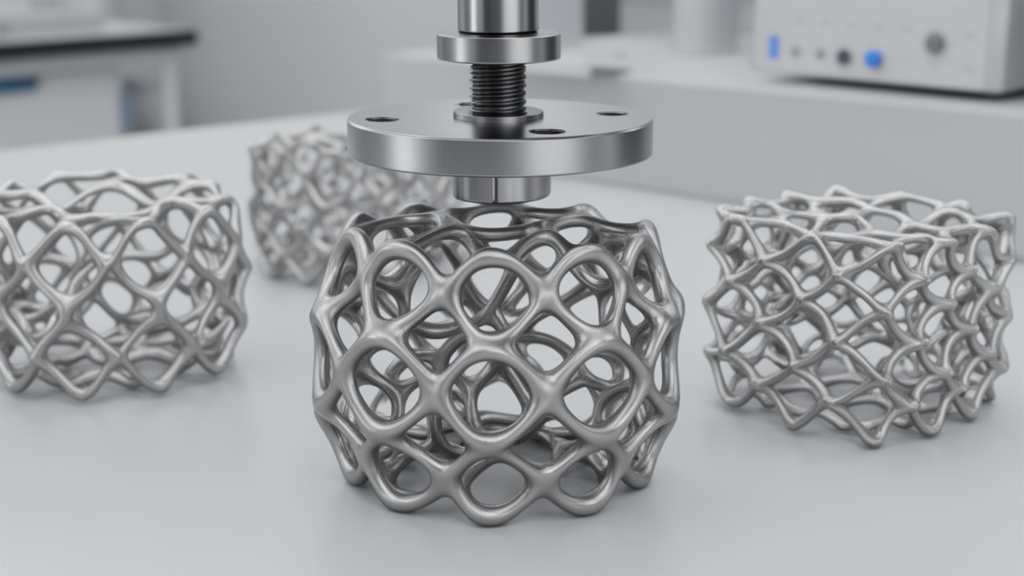
Ashby–Gibson analysis indicated that the gyroid walls carried their loads through bending-dominated behavior, a structural regime in which the thin walls flex as the lattice deforms. Lattices with nominal walls of 0.2–0.6 mm collapsed progressively, layer by layer, during loading. The thicker structures, with nominal walls of 0.8–1.0 mm, instead approached a stiffer, beam-like response governed by the ratio between wall thickness and unit-cell size. In these thicker gyroids, cracks began on horizontal surfaces, where high bending moments and differences between tensile and compressive stresses contributed to localized damage. Increasing wall thickness therefore did more than scale up the mechanical performance: it was associated with a transition in deformation mode and a change in crack-initiation location.
Fatigue behavior did not follow the same clear progression as static strength. Every tested wall thickness survived more than 1 million cycles under a cyclic load of 0.4σy, or 40% of the corresponding yield strength, despite substantial differences in porosity, stiffness, strength, and collapse behavior. The experiments found no direct porosity–fatigue correlation. In practical terms, the lattice with the most porous structure was not shown to have a shorter fatigue life than the less porous designs under the reported loading condition, and fatigue endurance could not be inferred directly from static strength or pore volume alone. The study instead identifies wall thickness, manufacturing deviations, internal defects, and local stress conditions as features that should be considered together when assessing a gyroid lattice’s mechanical response. Its scope remained focused on one Ti-6Al-4V alloy, one additive-manufacturing process, a fixed unit-cell size, and five nominal wall thicknesses, so the results provide a controlled structure–property comparison rather than validation across other materials, geometries, or large-scale load-bearing applications.
Subject of Research: Mechanical and fatigue properties of electron-beam-manufactured Ti-6Al-4V gyroid lattices with varying wall thickness
Article Title: Mechanical and fatigue behavior of Ti-6Al-4V sheet-based gyroid structures with different wall thickness manufactured by electron beam powder bed fusion
Article References: Khrapov, D., Mishurova, T., Surmenev, R., Koptyug, A., Panin, A., & Surmeneva, M. (2026). Mechanical and fatigue behavior of Ti-6Al-4V sheet-based gyroid structures with different wall thickness manufactured by electron beam powder bed fusion. Journal of Materials Science, 61(40), 31183-31208. https://doi.org/10.1007/s10853-026-13533-x
Image Credits: AI Generated
DOI: 10.1007/s10853-026-13533-x
Keywords: Ti-6Al-4V, gyroid lattices, electron beam powder bed fusion, additive manufacturing, wall thickness, porosity, fatigue life, compressive strength, tensile strength, computed tomography, Mechanical, fatigue
News Source: Denise Maddox. (October 22, 2026). Thicker titanium gyroids show stronger static response without direct porosity–fatigue link. Scienmag.