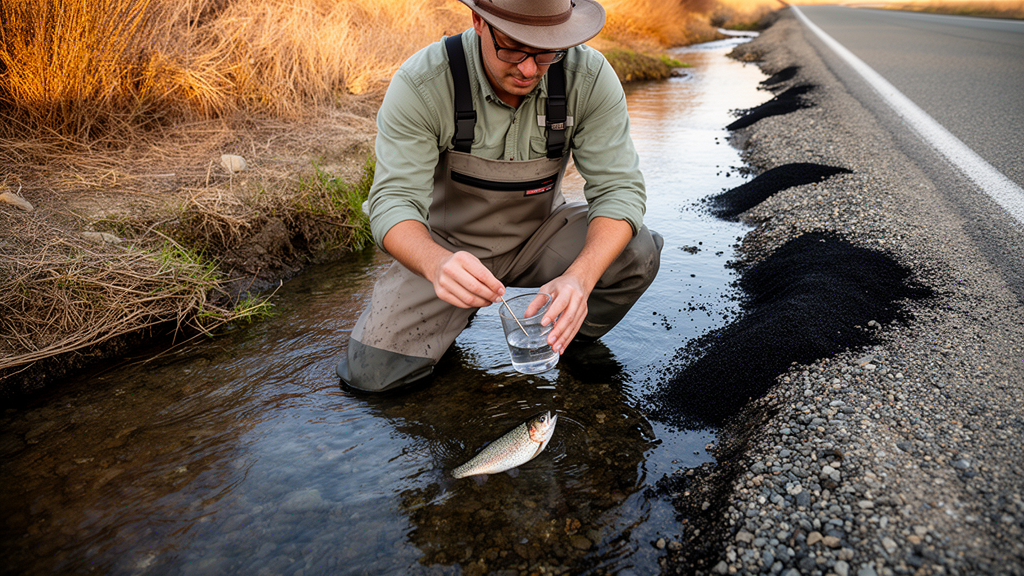
A peer-reviewed stormtime survey found potentially lethal concentrations of the tire-derived chemical 6PPD-quinone in Central California waterways containing habitat for endangered coho salmon and steelhead trout. Researchers collected water samples from six road outfalls, 14 creeks and rivers, and two estuaries around San Francisco Bay and the nearby coast. In 78% of the samples, 6PPD-quinone concentrations exceeded the U.S. Environmental Protection Agency’s value for the potential to cause acute harm to aquatic organisms. In 69% of samples, concentrations exceeded the level considered lethal to half of juvenile coho salmon exposed for 24 hours. The findings characterize potential exposure during one storm rather than chronic or year-round exposure.
The study examined watersheds supporting federally designated Endangered Species Act critical habitat for coho salmon and steelhead trout, both protected fish species that inhabit and spawn in areas affected by human activity. Although the two species are highly susceptible to 6PPD-quinone, little information was available about exposure near the southern end of their range along the U.S. West Coast. Tires contain a protectant called 6PPD, which reacts with ozone in the air to form 6PPD-quinone. Wind and rain transport tire debris and the resulting chemical into waterways. It is highly toxic to several fish species, including brook and rainbow trout.
Sampling during a rainstorm was intended to provide a snapshot of potential exposure when roadway runoff reaches receiving waters. Concentrations tended to be higher in creeks near heavy traffic and substantially lower at the estuary sites, indicating that proximity to busy roads can be an important influence on local contamination. The result was an association within the sampled landscape, not a quantified assessment of every pollutant source or a time series showing how concentrations change. Because the investigators sampled one storm, the measurements represent acute storm conditions and do not establish exposure across seasons or in all critical habitats.
One of the sampled creeks had received extensive habitat-restoration work but also contained some of the highest 6PPD-quinone concentrations measured in the study. Corresponding author Ed Kolodziej said that good physical habitat paired with toxic water quality can create an ecological trap for fish: habitat may appear suitable while exposing its occupants to harmful contaminants. The authors therefore suggest addressing physical habitat restoration and water quality together in watersheds that support endangered and threatened species. The research did not test whether combined interventions improve fish survival.
The authors also identify potential response strategies, including treating stormwater in heavily traveled areas and developing tires made from less-toxic or non-toxic materials. These were proposed possibilities rather than solutions evaluated in the study. Kolodziej emphasized that 6PPD-quinone is not the only harmful component of roadway runoff and that scalable, cost-effective solutions are needed. The study was published in Environmental Science & Technology Letters and was supported by Earthjustice, the Allan and Inger Osberg Endowed Professorship, and a National Oceanic and Atmospheric Administration grant that paid for analytical instruments.
Subject of Research: Stormtime 6PPD-quinone contamination in Central California coho salmon and steelhead trout critical habitats
Article Title: Tire-derived pollutant found at elevated levels in critical fish habitats
Article References: Tire-derived pollutant found at elevated levels in critical fish habitats. Original publication (Bibliographic details unavailable.)
Image Credits: AI Generated
DOI: Not provided
Keywords: 6PPD-quinone, tire pollution, roadway runoff, stormwater, coho salmon, steelhead trout, critical habitat, California waterways, environmental chemistry, endangered species, Tire-derived, pollutant
News Source: Russell Cooper. (October 22, 2026). Potentially lethal tire-pollutant concentrations found in California fish habitats. Scienmag.