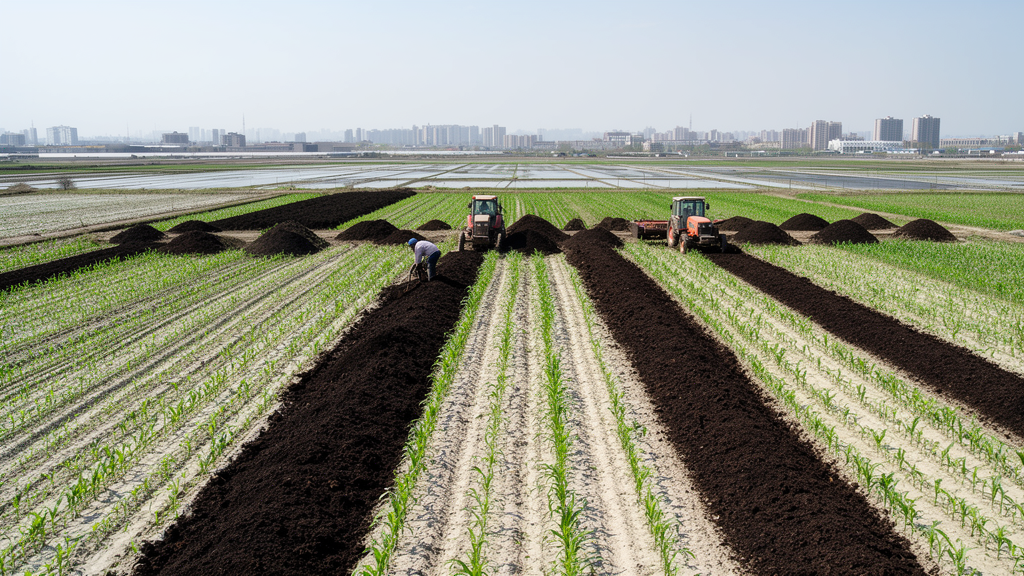
Long-term organic amendments shifted a Beijing maize field from a positive to a negative seasonal net global warming potential, according to a two-year field study that linked the change to greater soil carbon storage, lower nitrous oxide emissions and altered microbial functional genes. After more than a decade of contrasting fertilizer and tillage treatments, plots receiving composted poultry manure had the most favorable balance among carbon sequestration, greenhouse gas emissions and maize yield. The experimental site had received the same treatments since 2007, allowing researchers to examine the accumulated effects of manure, slurry and straw return within a winter wheat–summer maize rotation.
The measurements were made during the 2021 and 2022 maize growing seasons at a clay-loam site in Fangshan District on China’s North China Plain. Seven nitrogen treatments were tested in a randomized complete block design with three replicate plots per treatment: no nitrogen fertilizer, conventional urea, two mixtures combining urea with either composted poultry manure or composted slurry, manure alone, and two straw-return treatments conducted with either deep tillage or no tillage. All fertilized plots received the same seasonal total of 180 kilograms of nitrogen per hectare and matching phosphorus and potassium inputs.
The treatments differed in organic-matter inputs and tillage as well as nitrogen source, so the experiment did not independently isolate those components. Conventional urea fertilization produced positive net global warming potential in both maize seasons, with a two-year average of 2.91 tonnes of carbon-dioxide equivalent per hectare. Every organically amended treatment produced a negative value, indicating that estimated carbon gains from soil organic carbon exceeded the combined warming effects of carbon dioxide and nitrous oxide emissions associated with the crop season.
Manure alone generated the lowest net warming potential, averaging negative 11.75 tonnes of carbon-dioxide equivalent per hectare, followed by slurry plus urea at negative 7.27 tonnes. The mixed manure-and-urea and no-tillage straw treatments averaged negative 5.10 and negative 3.68 tonnes, respectively, while straw with deep tillage produced a smaller net sink of negative 2.39 tonnes. The shift did not result from lower carbon dioxide emissions.
Averaged across the two years, manure alone, straw with deep tillage and no-tillage straw increased cumulative carbon dioxide emissions by 22.6–44.5% relative to conventional urea. Soil carbon dioxide primarily originates from microbial respiration, and the organic amendments supplied additional substrate for microbial metabolism. Straw produced the largest seasonal carbon inputs, reaching 2,728 kilograms of carbon per hectare, compared with 1,355 kilograms under manure.
Carbon dioxide also remained the dominant contributor to gross global warming potential across the treatments. Even so, the carbon accumulated in soil more than offset the greater respiration associated with the amendments during the measured maize seasons. That compensation came primarily from soil organic carbon.
Organic amendments raised stocks in the upper 20 centimeters of soil by 16.7–46.2% compared with conventional nitrogen fertilization, with the largest increase under manure. Averaged over the two observation years, the estimated carbon sequestration rate reached 0.71 tonnes per hectare per year under manure, compared with 0.13 tonnes under conventional urea. Sequestration efficiency, which relates soil carbon gains to carbon inputs, reached 17.4% under manure.
These gains explain why treatments with higher carbon dioxide emissions could still have a negative net climate balance. Nitrous oxide moved in the opposite direction from carbon dioxide. In 2021, the organic treatments that included manure, slurry or no-tillage straw emitted 22.9–30.2% less nitrous oxide than conventional urea.
The pattern was more uniform in 2022, when every organically amended treatment reduced emissions by 25.1–29.4% relative to the conventional treatment. Nitrous oxide fluxes typically peaked after nitrogen application or rainfall, while carbon dioxide fluxes rose during the warmer parts of the season. The study converted cumulative nitrous oxide emissions to carbon-dioxide equivalents using a 100-year warming factor of 273.
Microbial measurements offered a possible explanation for the contrasting gas emissions. Organic amendments generally increased the abundance of genes involved in carbon and nitrogen cycling, including genes associated with carbon fixation, carbon degradation, denitrification and other nitrogen transformations. Relative to conventional urea, the combined abundance of carbon-fixation genes was 53.0% higher under manure and 25.3% higher under deep-tilled straw, although differences among the organic treatments were not statistically significant.
The abundance of carbon-degradation genes was 82.5% higher under manure than under conventional urea, consistent with its greater carbon dioxide emissions. Manure also produced significantly higher levels of several individual genes, including acsA, napA, narG and ureC. A path model associated the carbon-fixation gene profile with greater soil organic carbon and the carbon-degradation profile with higher carbon dioxide emissions.
For nitrous oxide, two gene-level trends matched the lower measured emissions. Bacterial amoA2, associated in the study with nitrification potential, tended to be less abundant under organic amendments, while nosZ, associated with reduction of nitrous oxide to nitrogen, tended to be more abundant. These were tendencies rather than significant differences in the combined amoA and nosZ abundances.
The path model associated the nitrogen-cycling gene profile with lower nitrous oxide emissions, while lower soil nitrate availability was also associated with reduced emissions. Because the analysis was based on 21 plot-level observations and established associations rather than directly manipulating individual microbial genes, the results support a microbial explanation without proving that either gene group directly caused the observed gas balance. The wider microbial community also responded to treatment.
Non-metric multidimensional scaling separated the functional gene communities under organic amendments from those under conventional urea, with the strongest separation occurring for manure alone. Redundancy analysis and Mantel tests indicated that soil organic matter, total nitrogen and nitrate nitrogen accounted for substantial variation in communities responsible for carbon degradation, carbon fixation and denitrification. Total nitrogen and nitrate were particularly associated with the nitrification community, while soil temperature was associated with other nitrogen-cycling groups.
Organic amendments also generally produced higher soil moisture than conventional urea, while soil temperatures were broadly similar among treatments. Together, these observations linked the microbial communities to the carbon and nitrogen conditions that changed under the different management regimes. Maize yields were maintained under the organic amendments, allowing manure to replace conventional urea nitrogen without an observed yield penalty.
The manure treatment had the strongest overall performance when yield, soil carbon sequestration and net global warming potential were considered together. The results do not establish how the practice would perform across other soils, climates, farms or fertilizer-management systems. The study also covered only the maize phases of two growing seasons within a long-term trial, used three replicate plots per treatment and calculated carbon effects from the upper 20 centimeters of soil.
Within those limits, the experiment showed that manure-driven increases in soil carbon storage, combined with reduced nitrous oxide emissions, can outweigh higher soil carbon dioxide emissions. The results link greater carbon-fixation potential and lower nitrous oxide production potential with enhanced nitrous oxide reduction potential to a shift toward negative seasonal net warming potential.
Subject of Research: Microbial and carbon mechanisms linking manure application to net warming potential in a long-term maize field experiment
Article Title: Microbial mechanisms underlying the shift of net global warming potential in a maize field under organic amendments
Article References: Fan, D., Xue, W., Zhang, L., He, L., Zou, G., Zhang, X., Zhao, X., Han, C., & He, W. (2026). Microbial mechanisms underlying the shift of net global warming potential in a maize field under organic amendments. Frontiers in Microbiology, 17, Article 1966738. https://doi.org/10.3389/fmicb.2026.1966738
Image Credits: AI Generated
DOI: 10.3389/fmicb.2026.1966738
Keywords: maize cultivation, organic amendments, manure application, nitrous oxide, soil carbon sequestration, global warming potential, soil functional genes, North China Plain, wheat-maize rotation, field experiment, Microbial, mechanisms
News Source: Alan Morgan. (October 22, 2026). Long-term manure shifted Beijing maize plots toward negative warming potential. Scienmag.