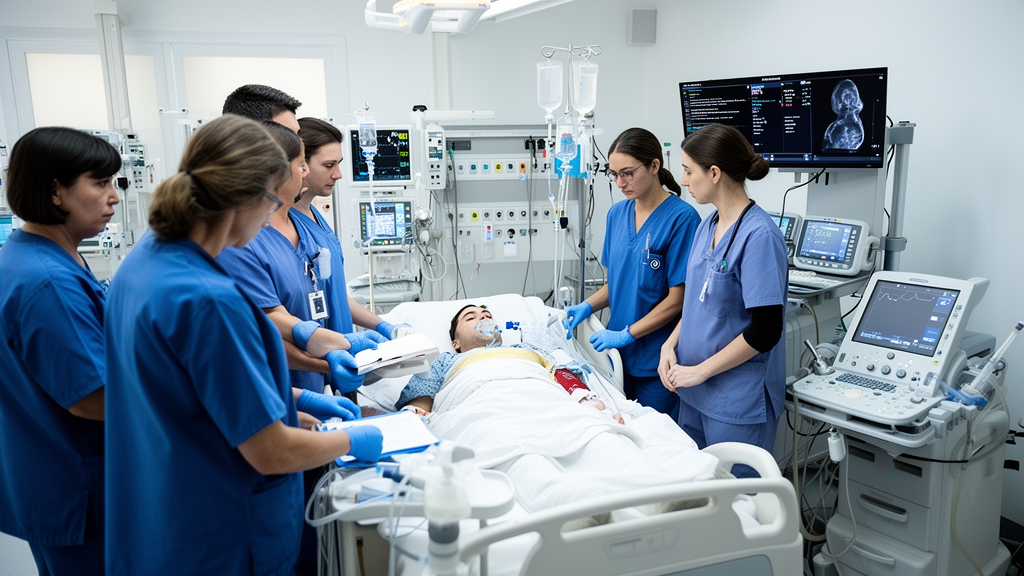
A review of current trauma critical care argues that severe injury should be understood as a multisystem biological disturbance rather than a collection of isolated anatomical problems. Tobias Gauss, Martin W. Dünser and colleagues on behalf of the ESICM Trauma and Emergency Medicine Section describe a shift from labels such as “major trauma” and “polytrauma,” which can encourage sequential, organ-specific management, toward an approach centred on the patient’s physiological response to injury. The emerging model integrates damage-control resuscitation, surgery, prevention of complications and rehabilitation rather than treating them as disconnected phases. Injury location and severity remain important, but anatomy alone cannot explain why patients with similarly described injuries can develop different combinations of organ dysfunction and different recovery trajectories.
The biological response to severe trauma involves several overlapping processes rather than one fixed pathway. These include the release of damage-associated molecular patterns, a catecholamine surge, endotheliopathy, abnormal coagulation and inflammatory and neuroendocrine responses. Their relative intensity and combination vary among individuals. Under this framework, secondary organ dysfunction, immunomodulation and catabolism are downstream manifestations of the systemic response to injury rather than independent, injury-specific events. The review connects this perspective with critical care principles used for other systemic conditions such as sepsis, while emphasizing that the biological response still requires individualized assessment rather than a fixed protocol for every injured patient.
Understanding these processes may help clinicians recognize distinct clinical phenotypes: reproducible patterns of secondary organ dysfunction that differ in their onset and combination of affected organs. The article links these patterns to organ cross-talk involving the gut–lung, gut–brain and brain–immune axes, as well as interactions between coagulation and the endothelium. Acute kidney injury after trauma illustrates the limits of a single-mechanism model. It seldom results from renal hypoperfusion alone, but commonly reflects a combination of inflammation-related tubular injury, rhabdomyolysis, nephrotoxin exposure and venous congestion. Surveillance and intervention therefore need to extend beyond the initial resuscitation period. Recognizing how phenotypes evolve can also help determine the safe sequencing of surgical and non-surgical interventions in multisystem trauma.
Shock remains a central diagnostic and resuscitation challenge, and the review warns that haemorrhage should not be allowed to monopolize the diagnostic frame. It remains the most frequent reversible cause of trauma death and therefore must be addressed first, but several other potentially fatal causes can resemble haemorrhagic shock. Pneumothorax and cardiac tamponade are reversible obstructive causes that are frequently underdiagnosed. Distributive shock may follow spinal cord injury or systemic inflammation, while a massive catecholamine surge can cause acute heart failure that mimics haemorrhagic shock, particularly in severe traumatic brain injury. Inflammation-mediated cardiac dysfunction may produce cardiogenic shock after prolonged shock, in patients with massive injuries or in those with pre-existing cardiac disease. Resuscitation therefore requires clinicians to consider concurrent diagnostic hypotheses while continuing to prioritize haemorrhage until it has been ruled out.
Machine learning may help identify trauma patients who need urgent haemorrhage control earlier, but the evidence reviewed supports its use as decision support rather than as a replacement for clinical assessment. Artificial-intelligence tools can assist with rapid assessment of haemorrhage risk and help identify patients who may require haemorrhage-control resuscitation, consolidating information that must otherwise be interpreted under time pressure. Their deployment remains constrained by an intrinsic limitation: performance can deteriorate when a model is applied to populations that differ from those represented in its training dataset. The review does not provide evidence that any particular machine-learning system improves survival, and implementation would need to account for how well a tool performs outside the population used to develop it.
Blood products have replaced crystalloids as the primary resuscitation fluids for bleeding trauma patients and are a core component of damage-control resuscitation. Their optimal administration, however, remains unsettled. A Cochrane review cited in the article concluded that no blood-product strategy—ratio-based administration, goal-directed use of viscoelastic tests or a combination of the two—was superior. Two prehospital trials investigated whole blood and component blood, and neither demonstrated a mortality benefit. These results leave important questions unresolved, including when blood products should be given, which types and quantities should be used, and which patients are most likely to benefit. The move toward early blood-product-based resuscitation therefore reflects a change in resuscitation practice, but it has not settled the central questions of timing, selection and amount.
Trauma-induced coagulopathy is likewise being reconsidered as a manifestation of systemic dysregulation rather than merely a laboratory abnormality to be corrected in isolation. The article describes links among shock severity, endothelial injury and neurohormonal activation, with mechanisms including protein C–mediated fibrinolysis, glycocalyx degradation and platelet dysfunction. This broader understanding affects both the timing and selection of haemostatic therapies. Pragmatic operational strategies can incorporate a fixed 2-g bolus, which has logistical advantages in resource-restricted military and prehospital settings because it avoids a prolonged maintenance infusion. The review does not establish that this strategy is superior in all environments; rather, it illustrates how the practical constraints of a treatment setting may shape implementation alongside the underlying pathophysiology.
Early prevention has also gained prominence within trauma critical care. Antibiotic prophylaxis in selected circumstances, including open fractures, penetrating injuries and traumatic brain injury, can reduce infectious complications, yet implementation remains inconsistent. Appropriate risk stratification should account for injury characteristics, the degree of contamination, the duration of hypoperfusion and patient-specific factors. Early pharmacological thromboprophylaxis is another area in which practice can lag behind the available evidence. It is often delayed because of concerns about bleeding, although evidence supports its effectiveness and safety in stabilized patients, including those with traumatic brain injury. Mechanical prophylaxis alone is insufficient. Institutional protocols can help align clinical decisions with the evidence by reducing inconsistent practice in these areas.
The review also presents multisystem trauma as a long-term condition rather than an event whose medical consequences end at hospital discharge. Survivors frequently experience physical, cognitive and psychological sequelae, while conventional severity scores often predict functional recovery poorly. Socioeconomic factors can act both as predisposing factors for adverse outcomes and as determinants of recovery. Evidence cited in the article indicates that admission to a trauma centre and coordinated care pathways, including the prehospital phase, can improve survival and functional outcomes. Multidisciplinary planning involving rehabilitation physicians, physiotherapists, occupational therapists, specialized nurses, case managers and social workers therefore forms part of trauma care itself. Honest communication, psychological support, structured follow-up and involvement of patients and their families connect acute decisions with the longer-term goal of restoring meaningful function, not simply surviving the initial injury.
Taken together, the review presents contemporary trauma critical care as an integration of multisystem pathophysiology, evidence-based resuscitation, decision-support technology, preventive interventions and longitudinal rehabilitation. Its central conclusion is not that anatomical assessment has become obsolete, but that the anatomy of injury must be interpreted alongside the dynamic biological response it provokes. The article synthesizes recent evidence and operational experience rather than reporting results from a new clinical trial, and important uncertainties remain in blood-product administration, haemostatic treatment and the implementation of machine-learning tools. It nevertheless identifies a clear change in emphasis: critical care should address the linked physiological, functional and social systems that shape outcomes after life-threatening injury, with success measured not only by reduced early mortality but also by long-term functional recovery and quality of life.
Subject of Research: Review of physiology-led approaches to multisystem trauma critical care
Article Title: What’s new in trauma critical care?
Article References: Gauss, T., Dünser, M. W., Carenzo, L., Roedl, K., Skrifvars, M., & on behalf of the ESICM Trauma and Emergency Medicine Section (2026). What’s new in trauma critical care?. Intensive Care Medicine. https://doi.org/10.1007/s00134-026-08618-9
Image Credits: AI Generated
DOI: 10.1007/s00134-026-08618-9
Keywords: trauma critical care, multisystem trauma, haemorrhagic shock, damage-control resuscitation, trauma coagulopathy, machine learning, acute kidney injury, organ cross-talk, trauma rehabilitation, trauma, critical, care
News Source: Ophelia Keating. (October 22, 2026). Trauma critical care shifts toward a multisystem, physiology-led approach. Scienmag.