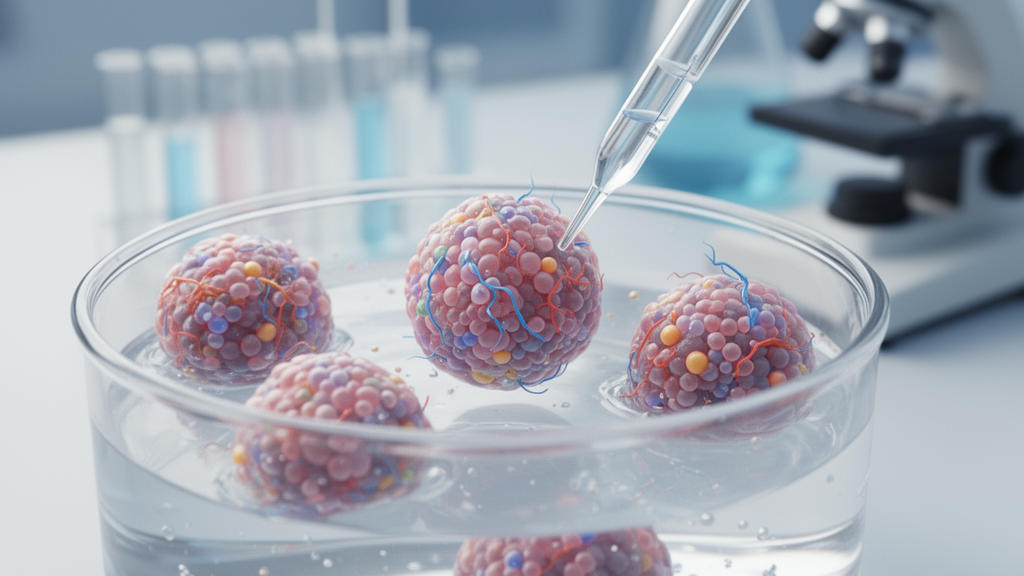
Mouse hepatocytes expanded in a two-stage culture system formed three-dimensional organoids that showed partial recovery of hepatic identity and metabolic function, according to an original laboratory study. The system first supports serial cell propagation on an adherent surface and then transfers the cells to low-attachment culture in a hepatocyte maturation medium. Organoids expressed albumin, E-cadherin, CYP2E1 and CK19, while bulk transcriptomic analysis indicated renewed activity in programs associated with cholesterol biosynthesis, the urea cycle, steroid biosynthesis and bile-acid production.
The recovery was incomplete: the organoids did not fully reproduce the mature state of freshly isolated primary hepatocytes or physiological liver zonation. The researchers began with primary mouse hepatocytes, which rapidly lose differentiated functions during prolonged in vitro culture. In the first stage, a transition and expansion medium supported serial propagation, maintained albumin expression, increased the proportion of Ki67-positive cells and reduced senescence.
The investigators then transferred the cells to low-attachment plates for three-dimensional culture. A seeding density of 3 × 10⁴ cells per well produced compact and uniform organoids. The study assessed cell growth, senescence, organoid formation, hepatic marker expression, bulk transcriptomic changes, albumin secretion, urea production, lipid and cholesterol metabolism, zonation-related responses and recovery after cryopreservation.
Statistical comparisons used ordinary one-way or two-way analysis of variance, as appropriate. Functional measurements showed that the organoids retained selected hepatic characteristics, but the outputs did not all recover equally. Urea production increased during three-dimensional culture and, by day 16, was not significantly different from the primary hepatocyte control.
Passage-2 cells displayed strong cell-cycle activity during expansion, whereas three-dimensional culture was associated with partial recovery of hepatic metabolic programs. Thus, the reported findings distinguish proliferative expansion from function-specific maturation, and they do not establish that renewed cell growth by itself represents a mature hepatocyte state. Culture conditions also produced measurable metabolic and zonation-related responses.
Exposure to 5% oxygen increased lipid-droplet accumulation. Adding glucose and insulin increased free and total cholesterol, showing that the model responded to these nutrient and hormonal inputs. Wnt and R-spondin increased the pericentral-associated marker glutamine synthetase, while ascorbic acid and bilirubin increased the periportal-associated marker CPS1.
These results demonstrate directionally distinct zonation-related responses in the culture system, but the organoids did not reproduce physiological liver zonation in full. Early-passage cells retained organoid-forming capacity after cryopreservation and recovery, providing an additional measure of the system’s practical resilience. Overall, the study presents an experimentally accessible in vitro platform for investigating mouse hepatocyte expansion, partial hepatic maturation, metabolic regulation and microenvironment-dependent modulation of hepatocyte function.
Subject of Research: Experimental development and functional assessment of a two-stage mouse hepatocyte-derived organoid culture system
Article Title: Establishment and functional evaluation of a two-stage mouse hepatocyte-derived organoid culture system
Article References: Chen, Y., Shan, Y., & Tang, L. (2026). Establishment and functional evaluation of a two-stage mouse hepatocyte-derived organoid culture system. Frontiers in Cell and Developmental Biology, 14, 1974273. https://doi.org/10.3389/fcell.2026.1974273
Image Credits: AI Generated
DOI: 10.3389/fcell.2026.1974273
Keywords: mouse hepatocytes, organoids, liver culture, hepatic maturation, metabolic recovery, cellular expansion, metabolic zonation, cryopreservation, three-dimensional culture, Establishment, functional, evaluation
News Source: Gregory Coleman. (October 22, 2026). Mouse hepatocyte organoid system shows partial metabolic recovery in vitro. Scienmag.