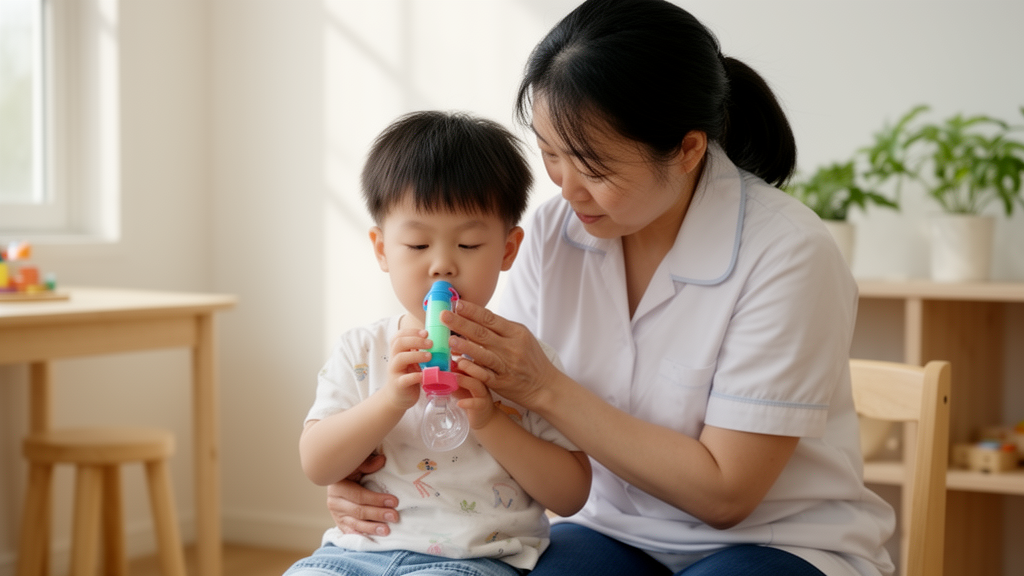
A 25-item Chinese scale showed satisfactory overall reliability and validity for assessing the confidence of caregivers of children aged 3 to 6 to manage asthma at home, according to a psychometric study in BMC Pediatrics. The measure covers six areas: medication and nebulization management, symptom monitoring and identification, daily care and environmental management, emergency management of acute attacks, psychological care and emotional management, and doctor-patient communication and follow-up. Researchers said the culturally adapted scale can serve as a standardized instrument for clinical evaluation and research, although one reliability measure fell below a conventional benchmark and one dimension had a weaker-than-ideal value for convergent validity.
Researchers built the preliminary instrument through literature reviews, semi-structured interviews and two rounds of Delphi consultation with 15 specialists. They then enrolled two independent convenience samples of caregivers. The first group comprised 275 caregivers who completed a preliminary questionnaire used for item screening and exploratory factor analysis. A separate group of 360 caregivers responded to the formal scale and provided the data for confirmatory factor analysis. This two-sample design allowed the researchers to examine the questionnaire’s internal structure in one population and test the proposed factor model in another.
The exploratory analysis identified six factors that accounted for 62.02% of the total cumulative variance, with standardized factor loadings ranging from 0.645 to 0.844. Confirmatory factor analysis then produced indicators of favorable model fit: the chi-square statistic was 826.34 with 260 degrees of freedom, the chi-square-to-degrees-of-freedom ratio was 1.265, the root mean square error of approximation was 0.027, and the comparative fit index was 0.976. Together, these findings supported the six-domain structure of the scale in the study sample. The use of convenience sampling means the results are based on the caregivers recruited for the research and do not establish that the scale will perform in the same way in every population or clinical system.
Internal consistency was strong for the complete scale, which had a Cronbach’s alpha of 0.861, while coefficients for the individual dimensions ranged from 0.781 to 0.830. Stability over time was also high, with total test-retest reliability reaching 0.876 among 60 participants who completed the assessment twice. Split-half reliability was less satisfactory at 0.641, below the conventional threshold of 0.7 cited by the researchers. In the assessment of convergent validity, one dimension had an average variance extracted of 0.467. This value met the lenient acceptability criterion of greater than 0.4, but the investigators characterized it as suboptimal. The pattern therefore shows that the scale performed well overall while retaining a weaker result on selected psychometric properties.
Specialist review supported the content validity of the instrument. The scale-level content validity index was 0.93, while item-level values ranged from 0.80 to 1.00. These results show that the questionnaire was designed and evaluated to represent the targeted construct of home-management self-efficacy in caregivers of preschoolers with asthma. However, this was a measurement and validation study, not a trial of asthma care, and it did not test whether use of the questionnaire changes treatment, caregiver behavior or children’s health outcomes. Its supported role is therefore narrower: providing a standardized tool for evaluating caregiver confidence in specified home-management tasks, with results most directly applicable to the study setting and its convenience-sampled participants.
Subject of Research: Validation of a Chinese scale measuring caregivers’ home-management confidence for preschool children with asthma
Article Title: Development, reliability, and validity of the scale for assessing home management confidence among caregivers of preschool children with asthma
Article References: Wang, Y., Liu, F., Gu, Y., Wu, Y., & Yu, H.-P. (2026). Development, reliability, and validity of the scale for assessing home management confidence among caregivers of preschool children with asthma. BMC Pediatrics. https://doi.org/10.1186/s12887-026-07584-x
Image Credits: AI Generated
DOI: 10.1186/s12887-026-07584-x
Keywords: childhood asthma, preschool children, caregiver confidence, home management, self-efficacy, questionnaire validation, psychometrics, scale reliability, scale validity, Development, reliability, validity
News Source: Ophelia Keating. (October 22, 2026). Chinese validation study supports caregiver asthma confidence scale for preschoolers. Scienmag.