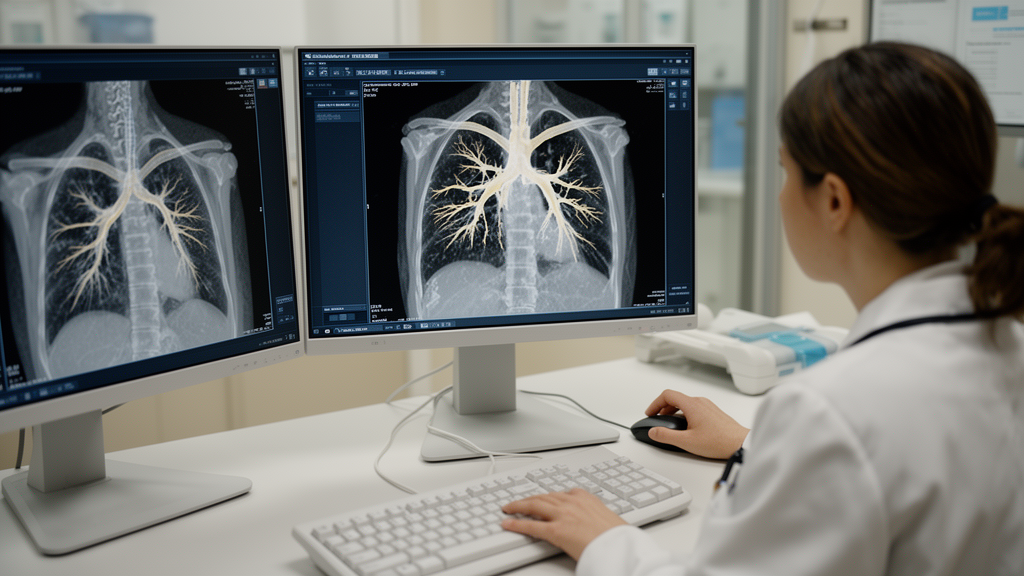
Modern artificial-intelligence systems can delineate airways in chest CT scans with striking accuracy, but a high overlap score does not guarantee that the reconstructed bronchial tree is anatomically complete or clinically useful. A narrative review of airway image analysis concludes that progress depends on preserving branching structure, testing models across institutions, and evaluating whether better reconstructions improve measurements or decisions. The review examined airway-specific datasets, segmentation metrics and model families ranging from convolutional neural networks to transformers, topology-aware networks and adapted foundation models. Its central message is that airway analysis has moved beyond a single segmentation task, but most evidence remains retrospective and technical rather than proof of patient benefit.
Airways are unusually difficult structures for automated image analysis. They form a connected hierarchy of thin, elongated tubes extending from the trachea to small peripheral bronchi across several spatial scales. The distal branches may occupy only a few voxels, making them vulnerable to noise, partial-volume effects and small segmentation errors. Airway pixels also represent a small fraction of a CT volume, creating severe class imbalance, while differences in anatomy, disease, scanners, reconstruction settings and respiratory phase alter how airways appear. These characteristics can produce a misleading result: a model may achieve strong global agreement with an expert annotation while disconnecting branches, omitting peripheral airways or extending into adjacent tissue.
Computed tomography remains the dominant modality because its spatial resolution and volumetric representation make air-filled airways distinguishable from surrounding structures. Most reviewed airway-specific deep-learning systems were developed on CT. Magnetic resonance imaging offers soft-tissue contrast without ionizing radiation, and newer zero-echo-time and ultrashort-echo-time sequences can improve pulmonary visualization. However, lower pulmonary signal, lower spatial resolution and greater susceptibility to acquisition artifacts make MRI-based airway analysis less represented in the evidence base. Results derived from specialized MRI sequences also cannot automatically be assumed to apply to routine clinical MRI, so models developed for each modality require validation in their own imaging context.
Dataset limitations remain one of the field’s largest obstacles. EXACT’09 provides a long-standing benchmark of 40 CT examinations, divided equally between training and testing, while the ATM’22 challenge expands the field with 500 examinations from multiple sites and domains, including 300 training, 50 validation and 150 test cases. AeroPath adds 27 CT angiography examinations focused on challenging anatomy and pathology. Other thoracic resources serve narrower purposes: SegTHOR contains 60 CT cases with central tracheal and several other organ annotations, while StructSeg includes 50 training cases and six thoracic organs at risk, including the trachea. Large resources such as LIDC-IDRI, COPDGene and KOLD are clinically valuable but do not supply comprehensive airway-tree labels and are not equivalent to airway-segmentation benchmarks.
Annotation itself is difficult and variable. Distal branches require labor-intensive expert labeling, and different protocols or observers can define boundaries inconsistently, particularly where an airway occupies only a few voxels. Reference masks are therefore expert-derived estimates rather than error-free representations of anatomy. Shared benchmarks improve comparability only when annotation extent, case splits, pathology and metric definitions are reported clearly. No current resource covers the full range of scanner manufacturers, acquisition protocols, diseases and patient populations encountered in practice. The shortage of dense labels has consequently encouraged interest in weak supervision, semi-supervised learning, active learning and other annotation-efficient methods, although sparse or generated labels do not by themselves eliminate uncertainty in the ground truth.
Evaluation has also evolved. Dice Similarity Coefficient and Intersection-over-Union remain common because they summarize voxel overlap, but the large proximal airways dominate those values and can conceal peripheral failures. Precision and recall offer additional information, while voxel accuracy and specificity can be especially deceptive when background pixels dominate. Surface measures such as Average Symmetric Surface Distance and the 95th-percentile Hausdorff Distance quantify boundary discrepancies in millimeters, which matters when algorithms support measurements of airway diameter, stenosis or wall characteristics. These measures do not, however, establish that a branching tree has remained connected. A comprehensive assessment needs volumetric accuracy, geometric precision, structural completeness, leakage and anatomical plausibility rather than a single score.
Topology-aware metrics address the distinct risk of losing whole branches. Tree Length Detected measures the proportion of reference airway centerline recovered, while Branch Detected measures the proportion of reference branches recovered. Benchmarks also report branch counts, leakage counts and volume, false-positive rates, and centerline or connectivity measures. Completeness must be interpreted together with correctness: a system can recover additional distal branches while introducing leakage into neighboring structures or anatomically implausible extensions. The distinction is essential for downstream uses such as airway–artery analysis, bronchiectasis quantification, airway tapering, stenosis assessment and intervention planning. Statistical comparisons, confidence intervals and Bland–Altman analyses can strengthen assessment of derived morphometric measurements, but retrospective expert review still does not establish clinical impact.
The computational methods reflect competing strengths rather than a simple hierarchy. U-Net and related convolutional neural networks efficiently learn local patterns, remain stable to train and can perform well on relatively small datasets, although limited receptive fields may impede long-range continuity. Hybrid systems and transformers, including TransUNet, UNETR and Swin-Unet, model wider anatomical context but often require more memory and data, and global attention alone does not guarantee a connected airway. Airway-specific work has therefore added graph refinement, skeleton guidance, centerline supervision, anatomical decomposition and iterative topology correction. Tubular-aware designs attempt to encode the geometry and direction of airway branches directly. In a separate category, semi-supervised, weakly supervised and human-in-the-loop methods target the scarcity of expert annotations rather than the segmentation architecture itself.
Foundation models have attracted particular interest because adaptations of Segment Anything, including MedSAM, Medical SAM Adapter and MedSAM2, may transfer knowledge from large-scale pretraining to specialized medical images. Their potential roles include transfer learning, interactive correction, annotation acceleration and human-in-the-loop dataset construction. Yet general success on other organs or modalities does not establish that a model preserves fine peripheral branches or connected topology. The review notes that direct comparisons on airway benchmarks, with branch detection, tree length, leakage and overlap measures reported together, are still needed. Likewise, newer architectures should not be assumed to outperform convolutional approaches merely because they are newer: a useful comparison must consider distal completeness, topology, computational demands, annotation burden and performance on independent data.
Translation to practice remains the largest gap. Retrospective testing on a curated or internal dataset establishes technical performance; independent external testing assesses robustness to new institutions; prospective workflow studies examine feasibility in routine care; and clinical-impact studies ask whether a system improves a measurement, decision, efficiency or outcome. Most airway-computing studies stop well before that final stage. Multi-institutional datasets, standardized annotation and adjudication procedures, uncertainty reporting and transparent failure analysis are needed, as are downstream tests of whether reconstructed airways produce reliable airway dimensions, wall measurements or usable navigation plans. The review’s forward-looking conclusion is that topology-preserving learning, foundation-model adaptation, data-efficient training and quantitative assessment offer credible paths forward, but no clinical recommendation is warranted from segmentation performance alone. The decisive test will be whether airway AI becomes robust, anatomically faithful and demonstrably useful across the diverse conditions of real clinical imaging.
Subject of Research: Datasets, evaluation methods and deep-learning approaches for airway image analysis
Article Title: Airway image analysis systems: a review of datasets, evaluation methodologies, and deep learning approaches
Article References: Toulkeridou, E., Kosmidou, P., Antoniou, Z., Pattichis, M. S., & Panayides, A. S. (2026). Airway image analysis systems: a review of datasets, evaluation methodologies, and deep learning approaches. Frontiers in Digital Health, 8, 1962988. https://doi.org/10.3389/fdgth.2026.1962988
Image Credits: AI Generated
DOI: 10.3389/fdgth.2026.1962988
Keywords: airway segmentation, medical imaging, deep learning, computed tomography, topology-aware learning, transformer networks, foundation models, benchmark datasets, clinical artificial intelligence, Airway, image, analysis
News Source: Ophelia Keating. (October 22, 2026). Airway AI needs more than high segmentation scores. Scienmag.