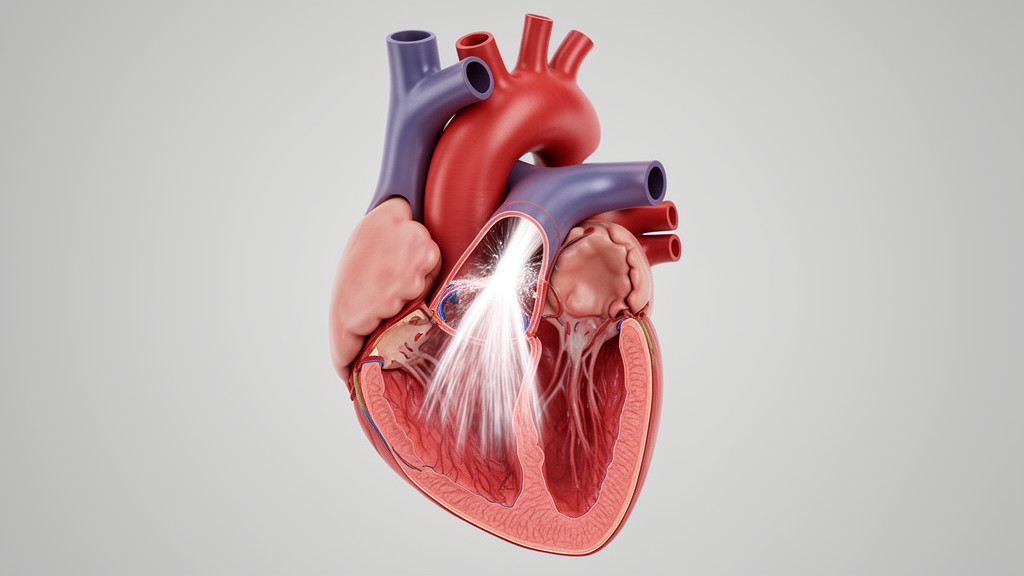
Severe aortic regurgitation does not necessarily produce the steady enlargement of the left ventricle that has shaped clinical guidance for deciding when to replace the aortic valve. In a retrospective study of 140 patients with the condition, traditional echocardiographic measurements changed only modestly during follow-up, even though several remained associated with a higher risk of adverse outcomes. The findings suggest that simple linear progression toward a ventricular-size cutoff may not describe the course of most patients.
The researchers reviewed patients who underwent serial echocardiographic follow-up for at least 18 months. The study’s composite outcome combined symptom-driven aortic valve replacement, hospitalization for acute heart failure, and death. The cohort was followed for a median of 93 months, with an interquartile range of 58 to 130 months. The investigators used joint modeling to account for within-subject correlation and censoring while analyzing longitudinal measurements alongside the time to an event. Their stated aim was to reassess the clinical relevance of guideline recommendations based on changes in left ventricular size and function in routine practice.
Three measurements were central to the analysis: left ventricular end-systolic diameter, or LVESD; left ventricular end-diastolic diameter, or LVEDD; and fractional shortening, or FS. LVESD and FS showed small but statistically significant longitudinal trends, while LVEDD did not show a significant longitudinal trend. In the threshold analysis, only 8 patients, or 5.7% of the cohort, were predicted to exceed the guideline-recommended LVEDD threshold of 65 mm over 10 years. The results therefore distinguish the risk associated with a measurement at a particular time from the likelihood that the same measurement will progress consistently over many years.
Despite the limited average changes, all three measurements retained prognostic associations in separate joint models adjusted for age at onset and sex. For each 1 mm increase in LVESD, the model associated a 6% increase in risk of the composite event; the same relative increase was estimated for each 1 mm increase in LVEDD. Each 1-percentage-point decrease in FS was associated with a 12% increase in risk. These are observational associations within the analyzed cohort and do not establish that changes in ventricular diameter or shortening caused the events. Age at onset was also a significant risk factor: across the three parallel joint models, each additional decade of age at onset was associated with a 65% increase in risk.
The study provides a qualified challenge to waiting for predictable linear enlargement before considering valve replacement in severe aortic regurgitation. Its evidence comes from retrospective observational data, so the results characterize this cohort and do not establish what will happen for every patient. The authors concluded that aortic valve replacement decisions should be based on a comprehensive clinical and volumetric assessment rather than reliance on anticipated progression to a simple guideline cutoff. The central finding is that left ventricular measurements can remain relatively stable over long periods while still carrying prognostic information: in the 140-patient cohort, modest longitudinal change in LVESD and FS, no significant longitudinal trend in LVEDD, and persistent associations between all three measurements and the composite outcome coexisted in the same patients.
Subject of Research: Longitudinal left ventricular changes and prognostic associations in severe aortic regurgitation
Article Title: Challenging the guidelines: longitudinal trends in left ventricular diameter and function in severe aortic regurgitation
Article References: Schwartzenberg, S., Berkowitz, A., Lerman, T. T., Bental, T., Vaturi, M., Goldberg, Y., & Shapira, Y. (2026). Challenging the guidelines: longitudinal trends in left ventricular diameter and function in severe aortic regurgitation. Frontiers in Cardiovascular Medicine, 13, Article 1975473. https://doi.org/10.3389/fcvm.2026.1975473
Image Credits: AI Generated
DOI: 10.3389/fcvm.2026.1975473
Keywords: severe aortic regurgitation, aortic valve replacement, left ventricular diameter, fractional shortening, echocardiography, retrospective cohort, joint modeling, cardiac imaging, heart failure, risk prediction, Challenging, guidelines
News Source: Ophelia Keating. (October 22, 2026). Severe aortic regurgitation: stable ventricular size, persistent risk. Scienmag.