• HOME
  • NEWS
  • EXPLORE
    • CAREER
      • Companies
      • Jobs
    • EVENTS
    • iGEM
      • News
      • Team
    • PHOTOS
    • VIDEO
    • WIKI
  • BLOG
  • COMMUNITY
    • FACEBOOK
    • INSTAGRAM
    • TWITTER
Saturday, February 7, 2026
BIOENGINEER.ORG
No Result
View All Result
  • Login
  • HOME
  • NEWS
  • EXPLORE
    • CAREER
      • Companies
      • Jobs
        • Lecturer
        • PhD Studentship
        • Postdoc
        • Research Assistant
    • EVENTS
    • iGEM
      • News
      • Team
    • PHOTOS
    • VIDEO
    • WIKI
  • BLOG
  • COMMUNITY
    • FACEBOOK
    • INSTAGRAM
    • TWITTER
  • HOME
  • NEWS
  • EXPLORE
    • CAREER
      • Companies
      • Jobs
        • Lecturer
        • PhD Studentship
        • Postdoc
        • Research Assistant
    • EVENTS
    • iGEM
      • News
      • Team
    • PHOTOS
    • VIDEO
    • WIKI
  • BLOG
  • COMMUNITY
    • FACEBOOK
    • INSTAGRAM
    • TWITTER
No Result
View All Result
Bioengineer.org
No Result
View All Result
Home NEWS Science News Biology

Scientists reveal distinct substrate-binding mode in o-succinylbenzoyl-CoA synthetase

Bioengineer by Bioengineer
September 13, 2017
in Biology
Reading Time: 2 mins read
0
Share on FacebookShare on TwitterShare on LinkedinShare on RedditShare on Telegram
IMAGE

Credit: Department of Chemistry, HKUST

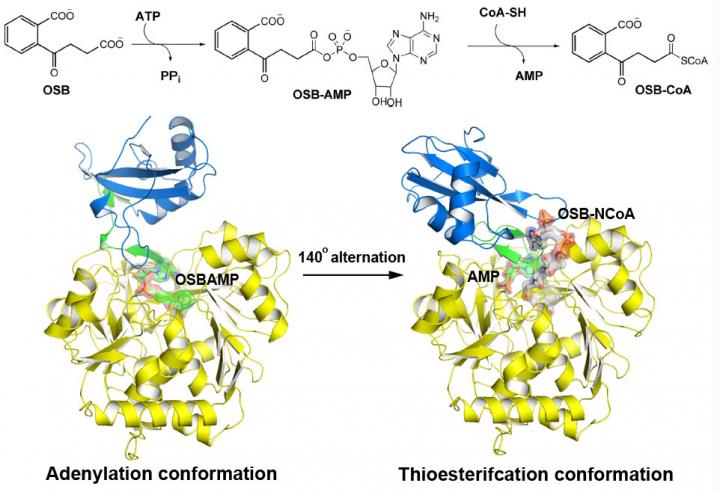
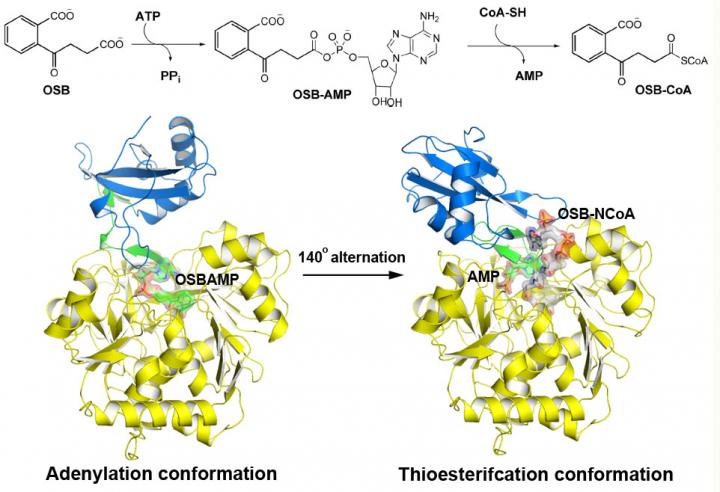
o-Succinylbenzoyl-CoA (OSB-CoA) synthetase (MenE) is an essential enzyme in bacterial vitamin K biosynthesis and an important target in the development of new antibiotics. It is a member of the adenylating enzymes (ANL) family, which reconfigure their active site in two different active conformations, one for the adenylation half-reaction and the other for a thioesterification half-reaction, in a domain-alternation catalytic mechanism. Although several aspects of the adenylating mechanism in MenE have recently been uncovered, its thioesterification conformation remains elusive.

Using a catalytically competent Bacillus subtilis mutant protein complexed with an OSB-CoA analogue, researchers from the Hong Kong University of Science and Technology revealed a thioesterification active site specifically conserved among MenE orthologues and a substrate-binding mode distinct from those of many other acyl/aryl-CoA synthetases. Several residues that specifically contribute to the thioesterification half-reaction without affecting the adenylation half-reaction were identified, and they also observed a substantial movement of the activated succinyl group in the thioesterification half-reaction.

Their findings were published in the Journal of Biological Chemistry on July 21, 2017 (doi: 10.1074/jbc.M117.790410).

"Our findings provide new insights into the domain-alternation catalysis of a bacterial enzyme essential for vitamin K biosynthesis, and of its adenylating homologues in the ANL enzyme family," said Zhihong Guo, an associate professor at the Department of Chemistry of HKUST. "Our work validated the hypothesis that a distinct substrate binding mode is unique to this enzyme."

As a member of the ANL enzyme family, OSB-CoA synthetase (MenE) is a valuable drug target in the vitamin K biosynthetic pathway, but little is known about the structure of the enzyme yet.

"We have constructed high-resolution crystal structures of a catalytically competent double mutant (IRAK) of bsMenE in complex with a stable product analogue, OSB-NCoA, and a combination of OSB-NCoA and AMP," said Guo. "In addition, these crystal structures revealed the amino acid residues contributing to recognition and binding of the substrates and products in the thioesterification reaction. These results have not only provided unambiguous support for the domain-alternation catalytic mechanism of ANL enzymes in general; they have also revealed the unique thioesterification active site of OSB-CoA synthetases and provided the structural basis for their catalysis of the thioesterification reaction to facilitate their utility as a drug target."

"Our findings provide fresh insights into the domain-alternation mechanism of the essential vitamin K biosynthetic enzyme and its homologues in the ANL enzyme family, and will help us build a protein catalytic cycle in a continuous manner, which no one has done before."

###

Media Contact

Anita Lam
[email protected]
852-235-86313

http://www.ust.hk

Related Journal Article

http://dx.doi.org/10.1074/jbc.M117.790410

Share12Tweet8Share2ShareShareShare2

Related Posts

Florida Cane Toad: Complex Spread and Selective Evolution

Florida Cane Toad: Complex Spread and Selective Evolution

February 7, 2026
New Study Uncovers Mechanism Behind Burn Pit Particulate Matter–Induced Lung Inflammation

New Study Uncovers Mechanism Behind Burn Pit Particulate Matter–Induced Lung Inflammation

February 6, 2026

DeepBlastoid: Advancing Automated and Efficient Evaluation of Human Blastoids with Deep Learning

February 6, 2026

Navigating the Gut: The Role of Formic Acid in the Microbiome

February 6, 2026
Please login to join discussion

POPULAR NEWS

  • Robotic Ureteral Reconstruction: A Novel Approach

    Robotic Ureteral Reconstruction: A Novel Approach

    82 shares
    Share 33 Tweet 21
  • Digital Privacy: Health Data Control in Incarceration

    63 shares
    Share 25 Tweet 16
  • Study Reveals Lipid Accumulation in ME/CFS Cells

    57 shares
    Share 23 Tweet 14
  • Breakthrough in RNA Research Accelerates Medical Innovations Timeline

    53 shares
    Share 21 Tweet 13

About

We bring you the latest biotechnology news from best research centers and universities around the world. Check our website.

Follow us

Recent News

Evaluating Pediatric Emergency Care Quality in Ethiopia

TPMT Expression Predictions Linked to Azathioprine Side Effects

Improving Dementia Care with Enhanced Activity Kits

Subscribe to Blog via Email

Success! An email was just sent to confirm your subscription. Please find the email now and click 'Confirm' to start subscribing.

Join 73 other subscribers
  • Contact Us

Bioengineer.org © Copyright 2023 All Rights Reserved.

Welcome Back!

Login to your account below

Forgotten Password?

Retrieve your password

Please enter your username or email address to reset your password.

Log In
No Result
View All Result
  • Homepages
    • Home Page 1
    • Home Page 2
  • News
  • National
  • Business
  • Health
  • Lifestyle
  • Science

Bioengineer.org © Copyright 2023 All Rights Reserved.