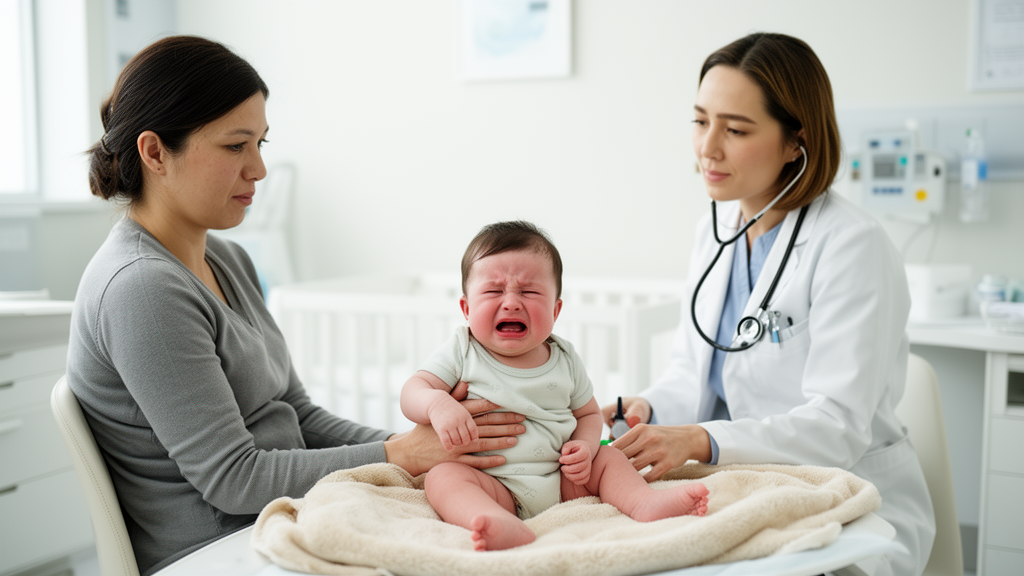
A 44-day-old term female infant with acute SARS-CoV-2 infection experienced two crying-triggered episodes of marked pallor, limpness and reduced responsiveness after crying had ceased, according to a case report in Frontiers in Pediatrics . Both episodes ended with spontaneous recovery, but the cause could not be definitively established because neither event was recorded with physiological monitoring. The infant experienced no further episodes during hospitalization or throughout eight weeks of follow-up, the report said.
This absence of recurrence was an observed outcome rather than proof of the underlying mechanism. Because the case involved one patient, it cannot establish how frequently such events occur during acute SARS-CoV-2 infection or whether the infection contributed to the episodes. The reported sequence suggested breath-holding spells as one possible explanation.
That possibility was based on the timing of the episodes: crying was followed by pallor, reduced muscle tone and diminished responsiveness, and the infant recovered spontaneously. The report also considered infection-associated apnea and other causes of paroxysmal events in early infancy, leaving several explanations in the differential diagnosis. The source report does not provide such contemporaneous recordings for either event.
As a result, the investigators could not confirm a specific physiological disturbance or determine which mechanism produced the pallor, hypotonia and reduced responsiveness. That uncertainty is central to the case. The report therefore describes the infant’s episodes as a diagnostic dilemma rather than assigning a confirmed diagnosis.
The authors emphasize careful differential diagnosis for crying-triggered pallid and hypotonic episodes occurring during acute SARS-CoV-2 infection. The case instead documents a temporal association between an acute infection and two unexplained episodes in one infant. The report was published in the General Pediatrics and Pediatric Emergency Care section of Frontiers in Pediatrics .
It is a case report, not a controlled study or population-level analysis, and the authors identify diagnostic uncertainty as the main feature of the case. No physiological data were captured during the two events, limiting the ability to distinguish among the potential explanations. For science reporting, the most defensible conclusion is narrow: an infant with acute SARS-CoV-2 infection had two episodes of pallor, hypotonia and reduced responsiveness after crying stopped, recovered spontaneously from each event, and had no reported recurrence during hospitalization or eight weeks of follow-up.
The clinical sequence was compatible with breath-holding spells, but infection-associated apnea and other paroxysmal causes remained possible. The case illustrates the importance of preserving diagnostic uncertainty when the events themselves are not physiologically documented.
Subject of Research: Diagnostic uncertainty in crying-triggered pallid and hypotonic episodes during infant SARS-CoV-2 infection
Article Title: Case Report: Crying-triggered pallid and hypotonic episodes in a 6-week-old infant with SARS-CoV-2 infection—a diagnostic dilemma
Article References: Wang, S., Chen, S., & Wang, Y. (2026). Case Report: Crying-triggered pallid and hypotonic episodes in a 6-week-old infant with SARS-CoV-2 infection—a diagnostic dilemma. Frontiers in Pediatrics, 14, 1989655. https://doi.org/10.3389/fped.2026.1989655
Image Credits: AI Generated
DOI: 10.3389/fped.2026.1989655
Keywords: SARS-CoV-2, infant, case report, pallor, hypotonia, breath-holding spells, apnea, differential diagnosis, pediatrics, viral infection, Case, Report
News Source: Ophelia Keating. (October 22, 2026). Case report: uncertain crying episodes during infant SARS-CoV-2 infection. Scienmag.