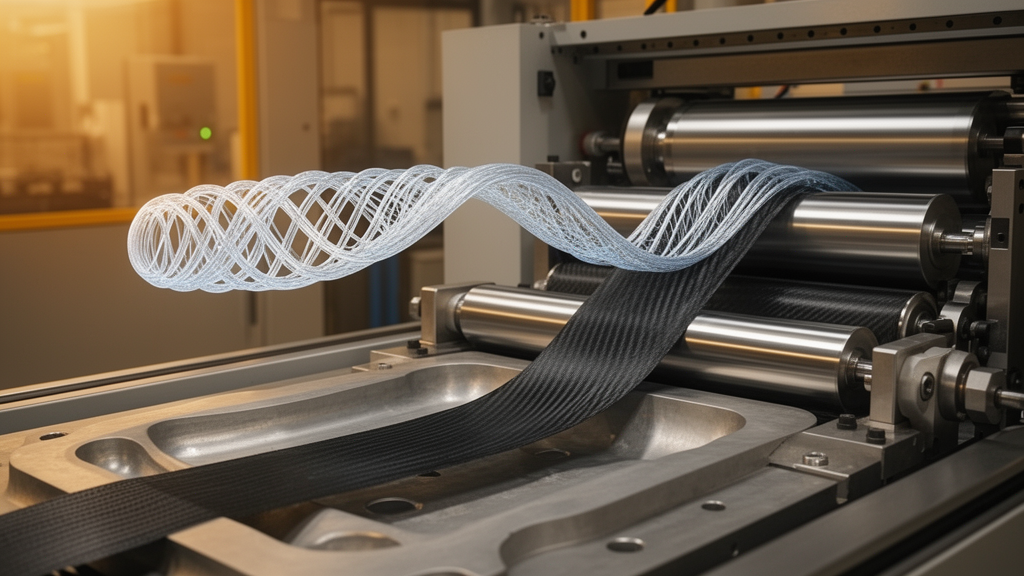
A mechanics-constrained digital twin for continuous-tow composite deposition was able to reproduce the principal deformation and contact responses of high-fidelity finite-element references in a computational study. The reduced-order model, built around Cosserat-rod mechanics, was compared with independently assembled Q4 and 43,065-degree-of-freedom Hex8 models under identical geometry, elasticity, loading, restraints and unilateral roller contact. Maximum discrepancies were 0.58% for centerline deformation, 9.71% for integrated reaction and 6.57% for peak pressure.
The work concerns tow-steered automated fiber placement, a process in which composite tows are deposited along programmed paths. The study notes that curvature and compaction can generate bending, shear, contact concentration and deposition mismatch before inspection. The digital twin maps programmed paths to residual-balanced deposited states and exports objective indicators of kinematics, energy, dissipation, contact response and defect tendency. Those outputs are mechanical risk indicators rather than direct, calibrated predictions of physical defects.
Beyond the initial benchmark, the researchers evaluated convergence using a corrected 320-case Latin-hypercube set and a separate 32-case severe set. All cases in both sets satisfied the study’s dual convergence criterion. The results indicate that the reduced Cosserat representation could maintain relevant mechanical responses across the sampled conditions, but the comparison remains a modeling assessment rather than a physical validation of composite manufacturing performance.
Surrogate models were then used to assess how quickly candidate process conditions could be ranked. With 48 training cases, a surrogate based only on process and geometry variables reversed the severe-case ordering, with a rank correlation of −0.904 relative to the Cosserat-mechanics result. A surrogate that included mechanics features retained a correlation of 0.990 and identified all 11 cases classified as high risk within that test set.
In a separate fixed-geometry process counterfactual, mechanics features recovered the top-risk ordering with a correlation of 0.918. However, the surrogate underpredicted all four high-risk thresholds. This separation between ranking and absolute values is central to the authors’ caution: a fast surrogate may identify which candidates deserve attention while still requiring nonlinear mechanics reevaluation before its absolute risk estimates are trusted.
For an unseen process candidate, the surrogate estimate and Cosserat-mechanics reevaluation differed by an absolute amount of 2.27 × 10⁻⁴. The reported computational advantage applied specifically to prewarmed surrogate screening, which was 4.72 × 10⁴ times faster than the Cosserat-rod reevaluation in this case. The finding does not establish a general speed advantage over all high-fidelity finite-element calculations.
Together, the results support a possible workflow in which mechanics-based screening narrows a large set of manufacturing conditions before selected cases are subjected to more detailed nonlinear analysis. The approach is computational: the study does not demonstrate that the digital twin can identify actual manufacturing flaws, and its authors explicitly distinguish the method from defect prediction and automated fiber placement qualification.
Calibration remains a limitation. Absolute risk thresholds would require machine-specific experiments or calibrated high-fidelity process finite-element analysis, according to the study. As a result, the most defensible interpretation is that the Cosserat-rod digital twin acts as a triage tool, using objective mechanics features to prioritize candidates for deeper evaluation. Its demonstrated performance supports mechanics-constrained screening, not production qualification or a universal numerical threshold for defects.
Subject of Research: Mechanics-constrained computational screening of continuous-tow composite deposition conditions
Article Title: Mechanics-constrained Cosserat-rod digital twin for defect-aware continuous-tow composite deposition
Article References: Mao, Y., & Wang, H. (2026). Mechanics-constrained Cosserat-rod digital twin for defect-aware continuous-tow composite deposition. Frontiers in Materials, 13, 1935061. https://doi.org/10.3389/fmats.2026.1935061
Image Credits: AI Generated
DOI: 10.3389/fmats.2026.1935061
Keywords: automated fiber placement, composite manufacturing, continuous-tow deposition, Cosserat rods, digital twins, finite-element modeling, mechanics-based screening, surrogate modeling, process mechanics, manufacturing risk, Mechanics-constrained, Cosserat-rod
News Source: Denise Maddox. (October 22, 2026). Cosserat-rod digital twin screens continuous-tow composite deposition risks. Scienmag.