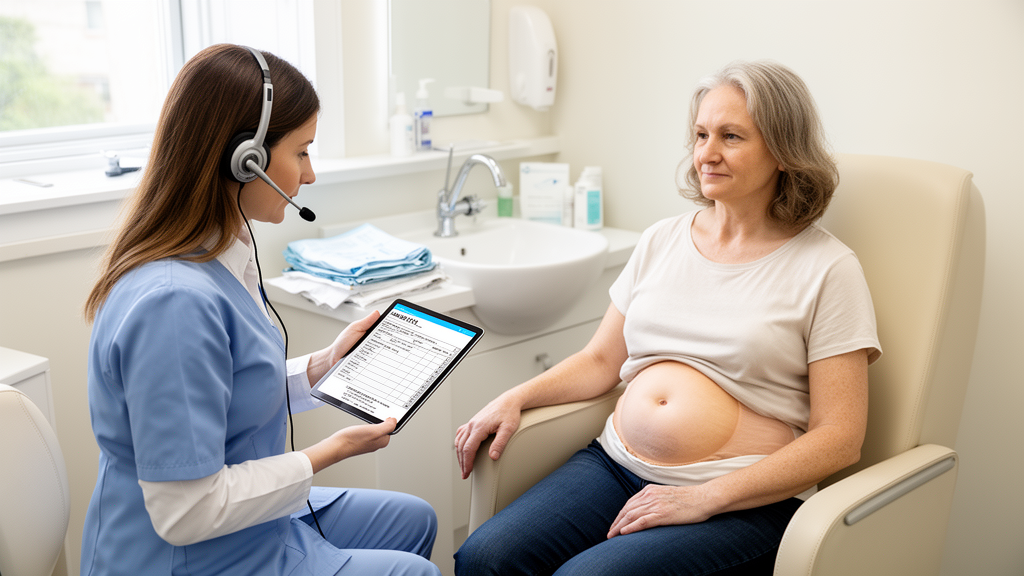
A randomised controlled trial found that people with a colostomy who received telephone-based education and counselling had better stoma adjustment and lower complication severity after three months than participants receiving routine stoma care. The intervention group recorded significantly higher acceptance and total stoma-adjustment scores, together with significantly lower complication-severity scores, according to the study abstract. Participants were randomly assigned either to the telephone-based education and counselling group or to the control group.
Their baseline characteristics were comparable, and the investigators collected data throughout a three-month follow-up using validated measures of stoma adjustment and complication severity. The results were specific rather than uniform across every measured outcome. At the end of follow-up, the education group had significantly better acceptance and total stoma-adjustment scores than the control group.
It also had significantly lower complication-severity scores. However, the researchers found no significant between-group differences in anxious preoccupation, social engagement or anger scores. Thus, the trial’s main finding concerned overall stoma adjustment, one measured dimension of acceptance, and complication severity, rather than every psychological or social component assessed by the study.
It also does not give enough information to determine how large the between-group differences were or how precisely they were estimated. In addition, the summary does not establish whether the telephone programme differed from another form of additional patient contact, and it does not indicate whether the observed outcomes persisted beyond the three-month assessment period. The authors stated that integrating this approach into routine practice may strengthen continuity of care.
The randomised design strengthens the comparison between the telephone intervention and routine stoma care, while the three-month follow-up and incomplete reporting in the abstract limit how broadly the results can be interpreted. The study tested a care-delivery strategy against routine care and measured its association with stoma adjustment and complication severity over that period.
Subject of Research: Effects of telephone-based education and counselling on stoma adjustment and complication severity in people with a colostomy
Article Title: The effect of telephone-based education and counselling on stoma adjustment and complication severity in individuals with a colostomy: a randomised controlled trial
Article References: Yurtseven, Ş., Deniz Doğan, S., & Akıl, Y. (2026). The effect of telephone-based education and counselling on stoma adjustment and complication severity in individuals with a colostomy: a randomised controlled trial. Supportive Care in Cancer, 34(11), Article 1138. https://doi.org/10.1007/s00520-026-11347-w
Image Credits: AI Generated
DOI: 10.1007/s00520-026-11347-w
Keywords: colostomy, stoma adjustment, telephone counselling, nurse-led care, complication severity, patient education, randomised controlled trial, post-discharge care, effect, telephone-based, education, counselling
News Source: Nathaniel Bowman. (October 22, 2026). Telephone counselling improves measured colostomy outcomes in three-month trial. Scienmag.