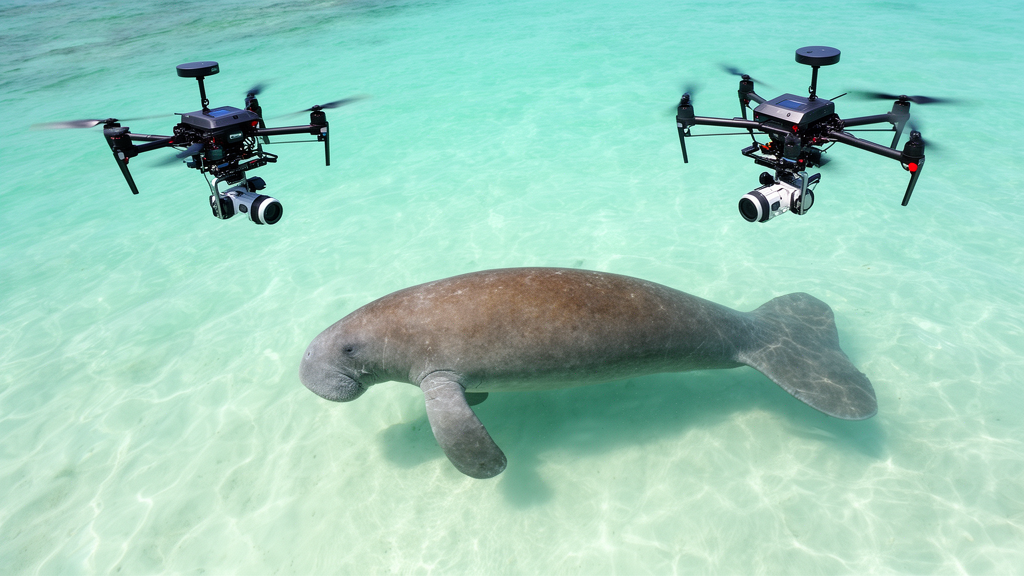
Two synchronized drones can reconstruct the three-dimensional posture of free-swimming dugongs and measure their body length with less error than a conventional overhead image when the animals curve during surfacing, according to a field study in Moreton Bay, Australia. In ground-truthed dugongs temporarily captured for health assessments, the dual-drone method produced an overall body-length error of 3.6 ± 3.0 cm, or 1.4% ± 1.2% of body length. The advantage became clearest in frames selected one or two seconds before or after the clearest image of each breath: the conventional overhead method had an average absolute error of 11.4 ± 8.4 cm, compared with 3.9 ± 3.3 cm for the three-dimensional reconstruction. The study tested 25 dugongs with directly measured body dimensions and used footage from another 188 free-swimming animals to characterize natural posture.
The researchers developed the method around a specific problem in aerial photogrammetry: a body seen from directly above may look shorter when it bends or dips beneath the surface. Conventional drone measurements generally screen out visibly curved animals because their reliability cannot be established with a single vertical view. Such exclusions can be especially costly for low-density, difficult-to-approach populations, and some marine-mammal studies have retained only 38% to 94% of their images after visual quality control. The new approach combines one drone filming vertically from above with a second filming from an oblique angle of about 45 degrees. By tracing the animals’ dorsal body lines in both views and calculating the intersection of their viewing rays in three-dimensional space, the researchers reconstructed the path of the back rather than simply measuring its projection onto the overhead image.
Technical accuracy depended on the geometry and calibration of the two-camera system. The DJI Mavic 3E drones flew at an altitude of 40 m, using 7× optical zoom with a 35-mm-equivalent focal length of 162 mm and producing an empirical ground sampling distance of 2.4 mm per pixel. Their real-time positions were corrected through a fixed GNSS reference station, while a vessel duckboard or buoy of known length was filmed at the water surface before and after each observation to establish scale. Videos and flight logs were synchronized by tapping chopsticks in front of both cameras before takeoff and after landing. Lens distortion was corrected for every frame, and researchers annotated the dorsal line, the boundary between exposed and submerged tissue, and, where visible, the nostrils and peduncle. For body sections underwater, the apparent location was projected onto the water surface and its ray was refracted using Snell’s law; body roll was not modeled because no apparent roll was observed.
Accuracy was assessed by comparing drone estimates with tape-measure measurements taken on 25 apparently healthy dugongs after they were temporarily removed from the water for medical examinations. The animals were marked at 10 evenly spaced points along the dorsal line, and multi-angle video was used to construct three-dimensional reference models, scaled from accurately measured fluke width. A separate validation of the modeling procedure using a stationary crate produced a mean absolute error of 0.59 ± 0.43 cm over six tests, although some peduncle-to-fluke measurements differed by several centimeters between deck measurements and the dugong models. For each animal, three surfacing events were sampled, with a “best” frame chosen when the body was most parallel to the surface and both endpoints were most visible. Frames one and two seconds on either side of that moment were examined to test performance under less favorable posture and visibility.
For the clearest frames, the two methods were close: the dual-drone estimate had an absolute error of 3.3 ± 2.8 cm, or 1.3% ± 1.1%, while the overhead-only estimate had an error of 5.0 ± 4.2 cm, or 1.5% ± 1.2%. The gap widened markedly in the less favorable frames, when average errors reached 4.8% ± 3.8% for the overhead method and 2.0% ± 1.6% for the reconstructed method. Neither the position of the oblique camera relative to the animal’s body axis nor the degree of curvature produced a systematic rise in the magnitude of error in the three-dimensional estimates. Repeated measurements across three breaths and best and non-best frames yielded a mean interquartile range of 4.4 ± 1.7 cm, or 1.7% ± 0.7% of body length. The method therefore produced measurements with accuracy and precision comparable to some earlier measurements of stationary animals and objects, despite free-swimming dugongs showing varied postures and disturbing the water surface.
The investigators also tested whether redefining the body-length endpoints could reduce the effects of curvature. Candidate measures ran from the snout or nostrils to either the fluke notch or peduncle. The overhead method showed a significant overall effect of endpoint choice, while the dual-drone method did not. In curved images, overhead measurements taken from the nostrils were consistently too short, with mean errors of −17.9 ± 6.6 cm for nostril-to-fluke-notch length and −13.2 ± 6.8 cm for nostril-to-peduncle length. By contrast, the dual-drone estimates showed no systematic directional change when endpoints were altered. The researchers did not recommend the peduncle as an endpoint because ripples often obscured its position, but the results did not support replacing either the snout or fluke notch with it.
Water movement remained a separate source of uncertainty. When fluke tips were clearly visible in extremely calm conditions, apparent fluke width still varied by approximately 1 ± 1 cm, equivalent to 0.4% ± 0.4% of body length, as currents and the animal’s own swimming disturbed the surface. The variation tracked apparent pixel length rather than drone-altitude readings, indicating that water distortion rather than vertical instability was the likely cause. Across all ground-truthed animals, the absolute error in fluke width averaged 2.3 ± 1.5 cm, or 0.86% ± 0.60% of body length. Errors decreased significantly as visibility improved: root-mean-square errors were 3.3 cm for poor frames, 3.0 cm for fair frames, 2.56 cm for good frames and 1.9 cm for excellent frames. Altitude fluctuations were small relative to the 40-m flight height, and a mixed-effects analysis found that camera yaw had no significant effect on body-length error.
The field survey showed why retaining curved images could change the size of usable ecological datasets. Among 188 free-swimming dugongs, the mean body curve ratio—a comparison between the overhead dorsal-line length and the reconstructed three-dimensional length—was 0.926 ± 0.049, with a range of 0.751 to 0.992. The researchers defined a threshold of 0.919 at which the predicted magnitude of overhead error exceeded the lower limit of the dual-drone method’s 95% confidence interval, which extended from −3.7% to 3.2% of body length. Only 31.9% of the sampled animals fell below that threshold, indicating that about 68% were more strongly curved than the point at which the conventional method was expected to perform less reliably. The finding does not mean the single-drone estimate was unusable for every such animal, but it provides an objective basis for identifying frames likely to benefit from three-dimensional reconstruction rather than relying only on visual screening.
The method also comes with clear constraints. Both body endpoints must remain visible in the oblique and vertical views, and turbidity, glare, sea state, water depth, surfacing behavior and surface disturbance can make this difficult. Turning animals sometimes prevented the snout from appearing in the oblique footage. Operating the second drone required an experienced pilot to maintain horizontal movement and yaw beside the animal, and the two complete drone systems, together with the GNSS receiver, cost approximately US$8,800 at 2025 prices. The flights were conducted at 40 m under protocols considered to have minimal impact, but 15 of the 188 randomly sampled dugongs surfaced without breathing in some events, and one animal made a sudden dive; the study did not establish whether these behaviors were responses to the drones. The reconstructed method may nevertheless be useful for other air-breathing marine megafauna, particularly species without dorsal fins or other prominent midline landmarks, provided suitable visibility, calibration and flight coordination can be maintained.
Subject of Research: Three-dimensional drone photogrammetry for measuring body length and posture in free-swimming dugongs
Article Title: Estimating Three‐Dimensional Posture to Correct Drone‐Based Measurements of Free‐Swimming Marine Mammals: An Application to Dugongs in Shallow Waters
Article References: Yamato, C., Sneath, H. L., & Lanyon, J. M. (2026). Estimating Three‐Dimensional Posture to Correct Drone‐Based Measurements of Free‐Swimming Marine Mammals: An Application to Dugongs in Shallow Waters. Ecology and Evolution, 16(10), Article e74446. https://doi.org/10.1002/ece3.74446
Image Credits: AI Generated
DOI: 10.1002/ece3.74446
Keywords: dugongs, drone photogrammetry, three-dimensional reconstruction, marine mammals, body curvature, wildlife monitoring, Moreton Bay, morphometrics, animal posture, biomass, Estimating, Three
News Source: Drew Townsend. (October 22, 2026). Dual drones improve curved-body measurements of swimming dugongs. Scienmag.