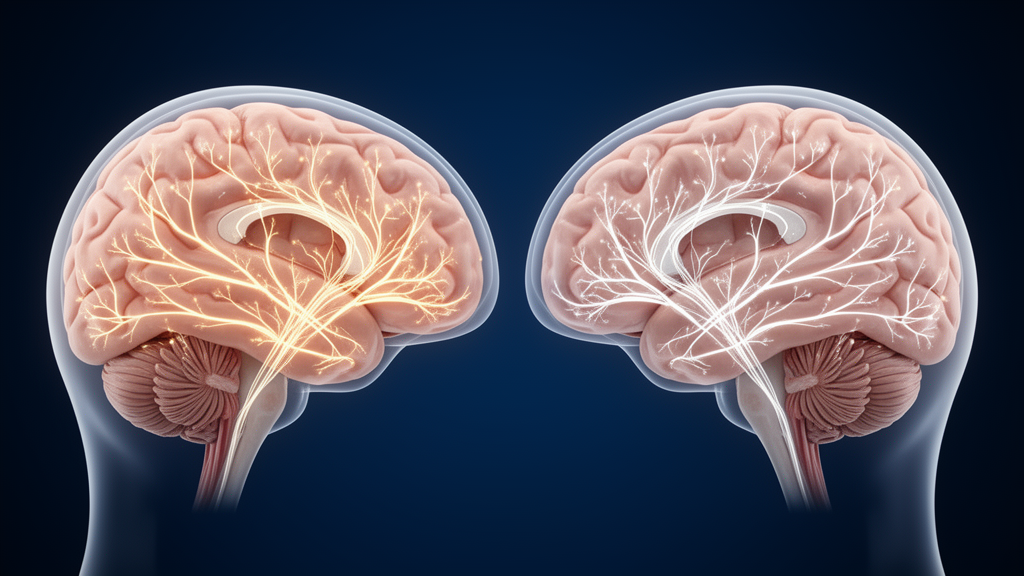
A study of 138 people aged 7 to 21 found that the volume of specific frontal, striatal, cingulate and limbic gray matter was statistically associated with brain electrical responses recorded while children and young adults learned rules through trial and error. The associations were generally modest, and most apparent differences between female and male participants did not survive correction for multiple comparisons. Two relationships were notably stronger in females: the timing of an N400 response during later rule use was linked to subgenual anterior cingulate volume, while the amplitude of a P300 response to feedback was linked to right medial orbitofrontal cortex volume. These are correlations, not evidence that larger or smaller regions caused better learning.
The research combined structural magnetic resonance imaging with 64-channel electroencephalography, allowing the investigators to relate anatomical variation to the timing and magnitude of cognitive processing. Participants learned an implicit visual-motor rule that could change every five to seven trials. A picture appeared on either side of a screen, and participants had to infer whether to press the left or right arrow. The hidden rule might require always choosing one side, matching the stimulus side or choosing the opposite side. Feedback in the first language of each participant indicated whether the response was correct.
Each task block contained six runs of five to seven trials, for 192 trials overall. The first three trials of a run were treated as an early rule-acquisition stage, while trials from the fourth onward were considered a late rehearsal stage, provided no mistakes were made after learning began. The researchers analyzed only correct runs, meaning that late-stage feedback was positive and signaled continued successful use of the inferred rule. This design allowed separate estimates of brain activity during initial learning and later application of an established stimulus-response mapping.
MRI data were acquired with a 3 Tesla scanner, and voxel-based morphometry was used to estimate regional gray-matter volume. The researchers predefined five spherical regions of interest centered on areas previously associated with reinforcement learning: right orbitofrontal cortex, left caudate nucleus, left putamen, left olfactory cortex and right nucleus accumbens. EEG signals were cleaned with independent-component analysis, divided into anterior and posterior electrode groups and analyzed for two long-latency components. N400 peak amplitudes and latencies were extracted from 300 to 500 milliseconds, while P300 amplitudes and latencies were extracted from 300 to 450 milliseconds. Statistical maps used small-volume correction for family-wise error.
Among female participants, longer anterior N400 latency at early stimulus onset was associated with more gray matter in the left putamen and lentiform nucleus, with a correlation of r = 0.437. The same association was not significant in males, although the direct difference between the sex-specific correlations did not quite meet the corrected threshold. A clearer sex difference appeared during the late stage: anterior N400 latency was positively related to subgenual anterior cingulate volume in females (r = 0.486) but not in males, and the difference between those correlations remained significant after correction. The result links regional anatomy with the timing of associative processing, but does not establish a uniquely female neural pathway.
The clearest female structure-function relationship involving reward-related circuitry concerned feedback. During late-stage feedback presentation, anterior P300 amplitude rose with gray-matter volume in the right nucleus accumbens, putamen and lentiform nucleus (r = 0.461) and in the right medial orbitofrontal cortex (r = 0.465). Neither association was significant in males. The orbitofrontal difference was statistically significant between sexes, whereas the basal-ganglia difference was not. A negative relationship between late-stage feedback-locked P300 latency and subgenual anterior cingulate volume was also detected in females, but its between-sex contrast did not survive correction. Because the analyzed late trials contained only correct feedback, these findings concern processing of successful outcomes rather than responses to errors.
Male participants showed a different descriptive distribution of associations. In late-stage stimulus-locked responses, more negative anterior N400 amplitude was associated with greater left caudate volume (r = -0.425). Early-stage feedback elicited an anterior P300 amplitude that was positively associated with a cluster spanning the left hippocampus and amygdala (r = 0.481). A posterior P300 response to early stimulus onset was also associated with gray matter extending into an extra-nuclear region (r = 0.484). None of these male correlations differed significantly from the corresponding female associations after correction. The researchers cautioned that signals classified as extra-nuclear white matter may reflect morphological variation in neighboring gray-matter structures rather than a distinct effect of white matter.
Behavioral performance did not differ significantly between females and males. Mean accuracy was 0.695 in females and 0.723 in males, while response times were longer during early rule acquisition than during later use, regardless of sex. This stage effect was large, with a partial eta-squared of 0.64, suggesting that learning the rule became substantially easier once it had been inferred. The groups did differ in absolute brain size: males had greater total intracranial volume and larger gray-matter, white-matter and cerebrospinal-fluid volumes. The main imaging models therefore included age, intracranial volume and primary language as covariates, and the ERP-volume correlations were analyzed separately by sex.
An exploratory age analysis found positive associations between chronological age and local gray-matter volume in both groups after accounting for total intracranial volume. The overlapping patterns involved medial orbitofrontal and medial frontal regions, anterior cingulate cortex, caudate, putamen, pallidum, nucleus accumbens, amygdala, olfactory cortex and other subcortical or limbic areas. The investigators interpreted these as evidence of differential regional maturation, but stressed that the analysis was exploratory and that voxel-based morphometry provides only an indirect estimate of tissue volume. The results do not demonstrate that greater regional volume reflects more advanced or less advanced learning; age was a statistical control, and the analysis was not designed to test a causal developmental mechanism.
The study’s central message is that the timing and magnitude of learning-related electrical activity co-vary with variation in several brain structures, especially frontostriatal, cingulate and medial temporal regions. The N400 is generally associated with integrating incoming information into semantic, contextual or associative frameworks, while the P300 is linked to attention, context updating and evaluation of task-relevant information. In this experiment, their relationships with anatomy varied by learning stage and, descriptively, by sex. Nevertheless, the limited size of the female and male groups, the observational design, the indirect nature of morphometric measurements and the inability to separate biological from experiential influences all constrain interpretation. Larger independent studies with direct tests of sex-by-brain-by-ERP interactions will be needed before the apparent sex-specific patterns can be regarded as robust.
Subject of Research: Sex-specific links between regional gray-matter volume and EEG responses during associative learning in people aged 7 to 21
Article Title: Striatal and orbitofrontal grey matter volumes are associated with cognitive event related potentials during associative learning task performance in male and female children and adolescents
Article References: Kassen, K., Shakhzadayev, R., Zholdassova, M., Kabenova, O., Kamzanova, A., Datkhabayeva, G., Abdilmanov, D., Allendorfer, J. B., Eliassen, J., Mel’nikov, M. Y., & Kustubayeva, A. (2026). Striatal and orbitofrontal grey matter volumes are associated with cognitive event related potentials during associative learning task performance in male and female children and adolescents. Frontiers in Neuroscience, 20, Article 1902749. https://doi.org/10.3389/fnins.2026.1902749
Image Credits: AI Generated
DOI: 10.3389/fnins.2026.1902749
Keywords: associative learning, brain development, event-related potentials, N400, P300, gray-matter volume, sex differences, orbitofrontal cortex, striatum, electroencephalography, Striatal, orbitofrontal
News Source: Cassandra Pierce. (October 22, 2026). Brain structure tracks learning signals, with some sex-specific links. Scienmag.