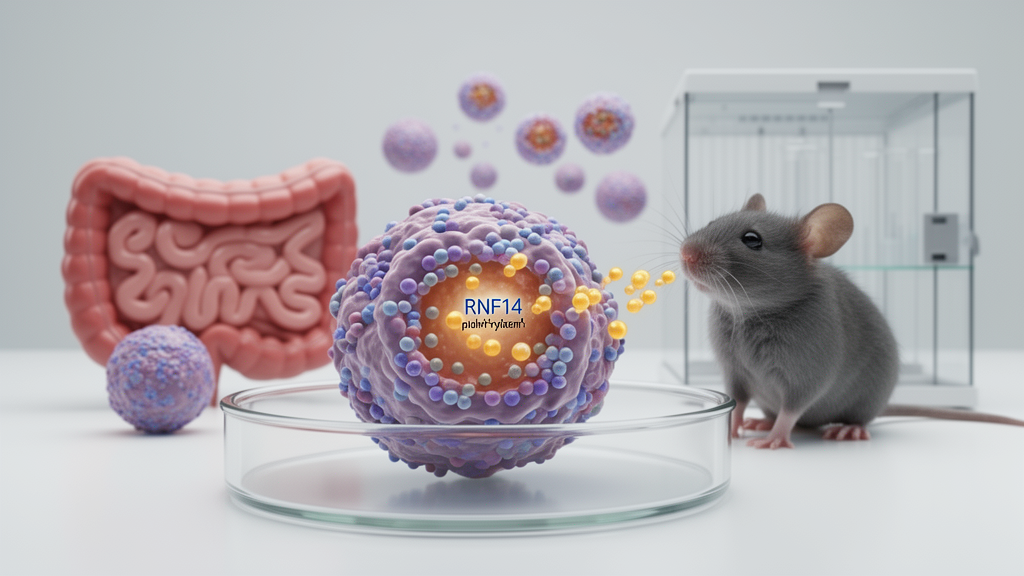
A preclinical study reports that palmitoylation of the RING finger protein RNF14 stabilizes it by preventing ubiquitin-mediated degradation, enhancing lipid metabolism and promoting tumor growth in colorectal cancer models. The researchers also identified an upstream regulatory pathway in which the acetyltransferase GCN5 modifies the transcription factor YY1, increases expression of ZDHHC9 and thereby enables RNF14 palmitoylation. The work used colorectal cancer cell lines and a mouse xenograft model, so its findings concern experimental models rather than clinical outcomes in people with colorectal cancer.
The investigators focused on modification of RNF14 at cysteine 407. Adenoviral transduction was used to introduce either wild-type or palmitoylation-deficient RNF14 constructs, allowing the researchers to test the functional importance of this site. The study reports that palmitoylation stabilized RNF14 and supported the protein’s role in lipid metabolism and tumor growth.
Silencing ZDHHC9 disrupted RNF14 palmitoylation, impaired lipid metabolism and strongly suppressed tumor progression in the tested models. Together, these observations support a causal regulatory relationship between the modification, RNF14 stability and the measured growth-related phenotypes within the experimental system. Protein-interaction and modification assays identified ZDHHC9, a zinc finger DHHC-type palmitoyltransferase, as the enzyme that catalyzed RNF14 palmitoylation.
The study then traced increased ZDHHC9 expression to GCN5-mediated acetylation of YY1. According to the results, acetylation of YY1 activated ZDHHC9 expression, forming a four-part regulatory axis: GCN5 acetylates YY1, activated YY1 raises ZDHHC9 expression, ZDHHC9 promotes RNF14 palmitoylation at cysteine 407, and stabilized RNF14 supports lipid metabolic reprogramming and colorectal cancer progression. Researchers used western blotting to assess protein expression, immunoprecipitation to examine protein–protein interactions and immunofluorescence to visualize relevant cellular features.
Post-translational modifications were also analyzed. RNF14 palmitoylation levels were measured using an acyl resin-assisted capture assay, and cell viability was examined with a Cell Counting Kit-8 assay. These complementary approaches were used to connect the molecular modification with changes in RNF14 stability, lipid metabolism, cell viability and tumor behavior.
The authors characterized the findings as evidence for a palmitoylation-dependent mechanism regulating lipid metabolism in colorectal cancer and proposed the GCN5–YY1–ZDHHC9–RNF14 axis as a potential therapeutic target. That proposal remains preclinical. The supplied study evidence does not include a human clinical trial, patient outcomes, treatment safety data or evidence that inhibiting any component of the pathway would benefit people with colorectal cancer.
The article was published in Cellular and Molecular Life Sciences on 22 October 2026 as an open-access, peer-reviewed article shared ahead of the final version of record, with further edits still possible.
Subject of Research: Preclinical analysis of a GCN5–YY1–ZDHHC9–RNF14 pathway regulating lipid metabolism and tumor growth in colorectal cancer models.
Article Title: GCN5-mediated acetylation of YY1 enhances ZDHHC9-dependent palmitoylation of RNF14 and promotes colorectal cancer progression
Article References: Li, B.-F., Li, G.-Q., Lv, F.-Y., Li, Q.-H., & Lv, L. (2026). GCN5-mediated acetylation of YY1 enhances ZDHHC9-dependent palmitoylation of RNF14 and promotes colorectal cancer progression. Cellular and Molecular Life Sciences. https://doi.org/10.1007/s00018-026-06493-7
Image Credits: AI Generated
DOI: 10.1007/s00018-026-06493-7
Keywords: colorectal cancer, RNF14 palmitoylation, GCN5, YY1 acetylation, ZDHHC9, lipid metabolism, cancer cell lines, mouse xenografts, GCN5-mediated, acetylation, enhances, ZDHHC9-dependent
News Source: Nathaniel Bowman. (October 22, 2026). Cell and mouse study links RNF14 palmitoylation to colorectal cancer progression. Scienmag.