In a small observational, cross-sectional repeated-measures study of 17 adults with chronic stroke, carotid-femoral pulse-wave velocity produced the strongest test–retest results among vascular measurements taken from paretic and non-paretic limbs. Across two laboratory visits within one week, the intraclass correlation coefficient was 0.85 for the paretic side and 0.94 for the non-paretic side, indicating good and excellent relative reliability, respectively. Peripheral pulse-wave velocity was substantially less stable, while flow-mediated dilation showed poor reliability when expressed in millimeters and only moderate reliability when expressed as a scaled percentage.
The study provides preliminary stroke-specific error estimates for determining when a repeated measurement differs by more than ordinary measurement variation. Participants were eligible if they were 50 to 80 years old, had experienced their stroke at least 12 months earlier and could walk at least 10 meters independently, with or without an assistive device. The analyzed group had a mean age of 63.9 years, a mean body mass index of 31.2 kilograms per square meter and a mean time since stroke of 4.5 years.
Four participants were female. Median scores indicated mild stroke severity, mild cognitive impairment and reduced arm spasticity. Participants had mild neurological impairment and were generally able to follow the standardized procedures, so the results describe a relatively narrow chronic-stroke population rather than people in acute recovery or with severe disability.
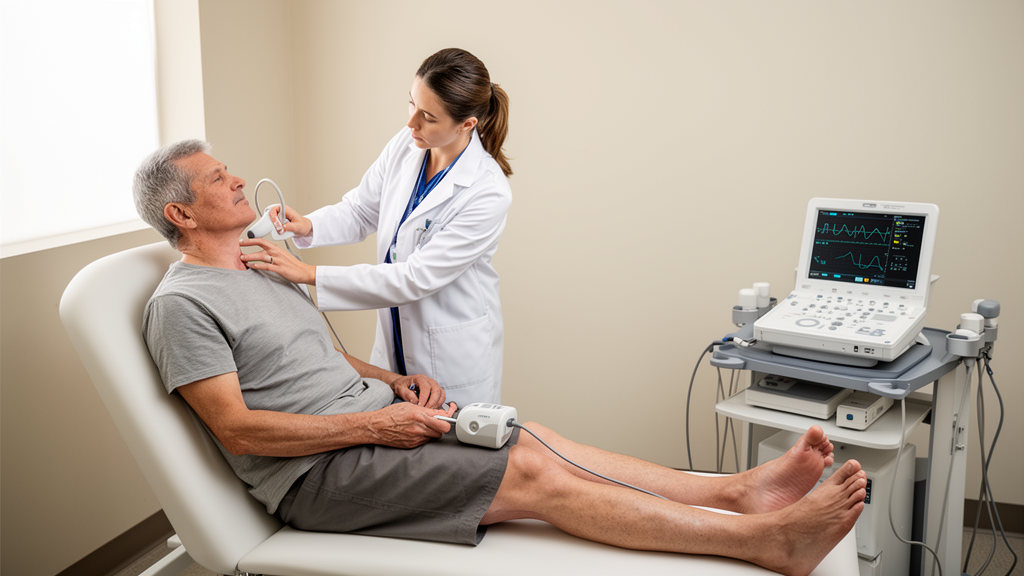
Investigators measured pulse-wave velocity in the carotid-femoral, carotid-radial and femoral-dorsalis pedis arterial segments. The carotid-femoral segment was treated as the measure of central arterial stiffness, while the other two represented peripheral arterial sites. Noninvasive applanation tonometers recorded pressure waveforms at the proximal and distal sites, and pulse-wave velocity was calculated as the distance between those sites divided by the time delay between waveform arrival.
Each measurement was collected twice on both the paretic and non-paretic sides and averaged over 30 consecutive cardiac cycles. The surface-distance estimates used in the calculations were consistent across repeated measurements and between limbs, although the study did not establish that these distances caused or contributed to the observed reliability estimates. Carotid-femoral pulse-wave velocity had a standard error of measurement of 0.80 meters per second in paretic limbs and 0.61 meters per second in non-paretic limbs.
Its minimal detectable change at 95% confidence was 2.23 meters per second and 1.68 meters per second, respectively. By comparison, carotid-radial pulse-wave velocity had poor relative reliability, with intraclass correlation coefficients of 0.33 in paretic limbs and 0.24 in non-paretic limbs. Its 95% minimal detectable changes were 2.82 and 3.23 meters per second.
Femoral-dorsalis pedis pulse-wave velocity also performed poorly, with coefficients of 0.12 and 0.28 and minimal detectable changes of 4.71 and 4.09 meters per second. Confidence intervals for these estimates were wide, reflecting the small numbers of participants with usable site-specific data. Brachial artery flow-mediated dilation was evaluated with duplex ultrasound through a 30-second baseline recording, a five-minute ischemic-occlusion phase and three minutes of reactive hyperemia after rapid cuff deflation.
The cuff was inflated to 200 mmHg distal to the cubital fossa. Absolute dilation, expressed as the difference between peak and baseline artery diameter in millimeters, showed poor reliability: the intraclass correlation coefficient was 0.11 in paretic limbs and 0.44 in non-paretic limbs. Its 95% minimal detectable changes were 0.29 and 0.34 millimeters.
Relative dilation, calculated with allometric scaling, had moderate reliability, with coefficients of 0.50 in paretic limbs and 0.59 in non-paretic limbs. The corresponding 95% minimal detectable changes were 6.88% and 7.65%. The central finding was not a pronounced difference between paretic and non-paretic limbs.
Instead, the arterial site appeared more consequential: carotid-femoral pulse-wave velocity was much more reproducible than either peripheral pulse-wave measurement, while relative and absolute flow-mediated dilation showed similar broad patterns on the two sides. The investigators noted that peripheral arteries are smaller, more muscular and more responsive to vasodilatory stimuli than larger central arteries. They also considered post-stroke changes in sympathetic activity, muscle tone and spasticity, along with cardiovascular risk factors, as possible contributors to peripheral measurement variability.
Flow-mediated dilation displayed a different reliability pattern from central stiffness. Baseline and peak artery diameters were broadly similar between the two visits, yet the derived change score was not stable, especially when expressed in millimeters. The investigators suggested that variability in baseline measurements may have affected absolute dilation more than the scaled percentage measure, although this mechanism was not directly examined.
They also emphasized the use of experienced sonographers, stable probe positioning and automated edge-detection software when seeking greater precision. The sample’s relative dilation values of roughly 4% to 7% were consistent with the pooled estimate from a meta-analysis of post-stroke studies, but that broader literature showed extremely high heterogeneity and included values ranging from negative 4% to 13%. Minimal detectable change estimates provide a statistical way to distinguish measured physiological change from the error expected when an assessment is repeated.
They are not equivalent to minimally clinically important differences. A change can exceed measurement error without necessarily mattering to a patient, and this study did not establish stroke-specific clinical thresholds. The authors noted that epidemiological associations in non-stroke cohorts have linked each 1-meter-per-second increase in central pulse-wave velocity with an approximately 15% increase in cardiovascular-event risk, while a 1-percentage-point increase in brachial flow-mediated dilation has been associated with about 13% lower cardiovascular-event risk.
Those associations come from non-stroke populations and do not turn the study’s error estimates into clinical cutoffs for people after stroke. The principal limitations were the sample size and the narrowly defined cohort. Participants were mostly men, generally had mild strokes and were more than a year beyond onset, limiting generalization to acute stroke, more severe neurological impairment and more gender-balanced populations.
Site-specific analyses included only 10 to 14 participants, producing wide confidence intervals and imprecise reliability estimates, particularly for flow-mediated dilation. Measurement error was unavoidable, and operator skill may have contributed to variability between assessment protocols. Inter-rater reliability was not examined, so the results do not establish whether the same performance would hold when more than one assessor collects the measurements.
Overall, the preliminary findings identify carotid-femoral pulse-wave velocity as the most reproducible stiffness measurement examined in this group of adults with chronic stroke and provide error bounds for interpreting repeated central stiffness and flow-mediated dilation measurements, while the poorer performance of peripheral pulse-wave velocity and absolute flow-mediated dilation argues for caution in their use as precise outcome measures.
Subject of Research: Test–retest reliability and minimal detectable change of vascular measurements in paretic and non-paretic limbs of adults with chronic stroke
Article Title: Test–retest reliability and minimal detectable change of pulse wave velocity and flow‐mediated dilation in paretic and non‐paretic limbs of older adults post‐stroke
Article References: Abreu, J. A., D'Isabella, N., Stouth, D. W., MacDonald, M. J., Tang, A., & Moncion, K. (2026). Test–retest reliability and minimal detectable change of pulse wave velocity and flow‐mediated dilation in paretic and non‐paretic limbs of older adults post‐stroke. Physiological Reports, 14(20), Article e71138. https://doi.org/10.14814/phy2.71138
Image Credits: AI Generated
DOI: 10.14814/phy2.71138
Keywords: stroke, pulse-wave velocity, flow-mediated dilation, arterial stiffness, endothelial function, test–retest reliability, minimal detectable change, chronic stroke, older adults, vascular measurement, Test, retest
News Source: Cassandra Pierce. (October 22, 2026). Repeated-measures study in 17 chronic-stroke adults finds carotid-femoral pulse-wave velocity most reliable. Scienmag.