A 2025 review concludes that engineered fish gut microbiomes may help aquaculture improve feed efficiency, immunity and disease resistance while reducing dependence on antimicrobials, but it finds that many approaches remain at experimental or early implementation stages. Published in Blue Biotechnology, the review examines the composition and functions of fish microbiomes and evaluates probiotics, prebiotics, synbiotics, bacteriophages, microbial transplantation, genetic engineering and synthetic biology. Its evidence is drawn largely from individual species, life stages and controlled systems rather than long-term trials across commercial farms, so it presents microbiome engineering as a possible component of sustainable aquaculture rather than a proven universal solution.
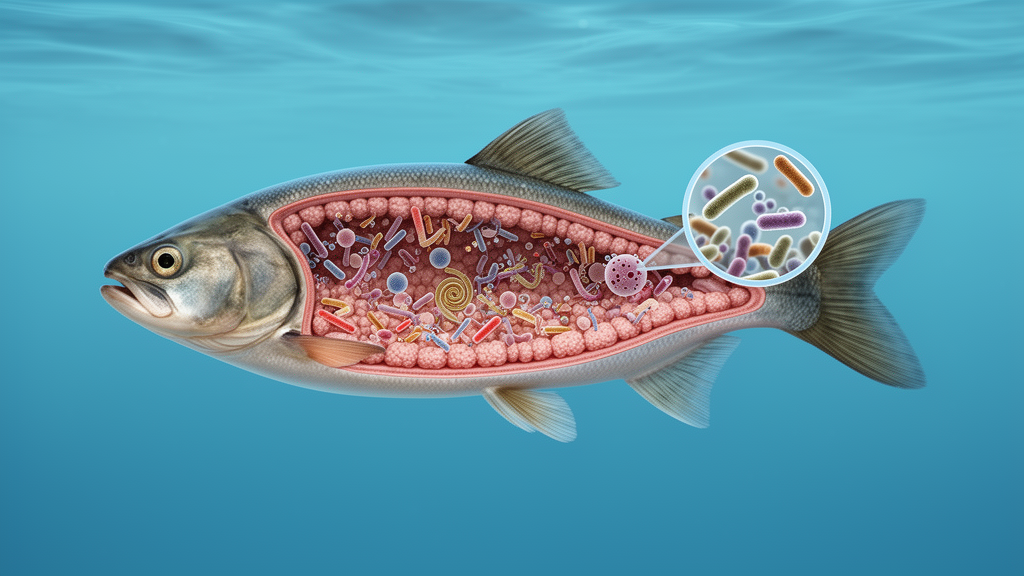
The fish gut microbiome comprises bacteria, fungi, viruses and other microorganisms living in the gastrointestinal tract. Bacteria generally form the majority, and they may be aerobic, facultatively anaerobic or obligately anaerobic depending on their local environment. The review identifies Proteobacteria and Fusobacteria as commonly abundant groups in fish, with Firmicutes and Bacteroidetes also represented in many species.
Microbial communities can include persistent inhabitants associated with the intestinal epithelium and temporary organisms acquired through food, water or sediment. These communities participate in digestion, nutrient absorption, epithelial development, immune regulation, energy balance, appetite and stress responses, making their composition relevant to fish health and husbandry. Microbial enzymes help fish process dietary carbohydrates, proteins and lipids that may be difficult to digest without microbial assistance.
Fermentation products can also serve as substrates for other organisms and contribute to the intestinal environment. By competing for nutrients and attachment surfaces, resident microbes can provide colonization resistance against pathogens. Evidence discussed in the review includes observations in zebrafish that microbiota were associated with more lipid droplets in intestinal epithelial cells and with epithelial-cell proliferation through Wnt-related signalling.
Feeding common carp with Lactobacillus delbrueckii was associated with increased intestinal enzyme activities and growth performance. These experimental findings identify plausible mechanisms, but they do not show that the same effects occur across all farmed species or production environments. Probiotics, prebiotics and synbiotics are the most extensively explored microbiome interventions in aquaculture.
Probiotics are living microorganisms that provide a host benefit when administered in adequate amounts, commonly through feed or water. Candidate strains are selected for properties such as safety, antimicrobial activity, environmental compatibility and the ability to survive administration and proliferate in the gut. Prebiotics are indigestible feed ingredients that support beneficial bacteria or modify their activity, including fructo-oligosaccharides, galacto-oligosaccharides, mannan-oligosaccharides, xylo-oligosaccharides, inulin, chitosan and beta-glucans.
Synbiotics combine a probiotic with a suitable substrate intended to support microbial proliferation, survival or activity. Experiments across fish and shrimp species have reported improvements in growth, feed conversion, digestive-enzyme activity, intestinal morphology, innate immunity, stress tolerance or disease resistance following supplementation with particular preparations. The review describes a combination of Bifidobacterium, Lactobacillus acidophilus, Enterococcus faecium, mannan-oligosaccharides and chitosan that improved immunity and resistance to Aeromonas hydrophila in Nile tilapia.
Other studies associate inulin or mixtures of oligosaccharides with better growth and immune measures in catfish, tilapia, hybrid grouper and shrimp. These outcomes depend on the organisms, compounds, ratios, doses, diets, species, sizes and husbandry conditions tested. The review also notes that supplementation beyond an optimum can have negative effects, underscoring the need for long-term and species-specific formulation studies.
Bacteriophages provide a targeted way to remove selected pathogenic bacteria. These viruses infect bacteria and can reproduce within them, causing lysis; their natural host range may extend from a particular strain to a genus or species. Aquaculture applications described in the review include oral delivery through feed, immersion in water and incorporation into edible coatings intended to protect phages during storage and release them in the intestine.
Phage PZL-Ah152 reduced Aeromonas hydrophila colonies in crucian carp while increasing gut microbial diversity, and other reviewed studies report improved survival or reduced pathogen burdens in salmon, shrimp, rainbow trout and turbot. A single phage may nevertheless be inadequate when a pathogen changes rapidly or proliferates faster than the phage, while temperate phages carrying undesirable genes require careful screening. Microbial transplantation includes faecal microbiota transplantation and the transfer of defined bacterial consortia.
In fish models, transplantation after antibiotic treatment has been reported to restore microbial diversity more effectively than natural recovery, repair intestinal injury and improve digestive-enzyme activity. Early-life transplantation in rainbow trout has also been associated with faster growth and greater muscle yield through changes in microbial metabolism. Transfers between fish species and between zebrafish, mice and human sources show that introduced communities can colonize recipients and reshape their microbiomes.
However, donor selection, recipient compatibility and the ecological effects of non-native organisms remain important uncertainties. Adverse effects reported in human transplantation, including diarrhoea and abdominal pain, add further weight to the need for controlled protocols and evaluation of safety in aquatic species. Genetic engineering and synthetic biology offer ways to modify microbial functions.
CRISPR-Cas systems can introduce targeted changes in microbial genes, and approaches such as inducible plasmid self-destruction, in situ conjugation and genome editing have been applied experimentally to lactic-acid bacteria and other candidate probiotics. Phage-mediated delivery can transport genetic material into bacteria. The review also discusses base editors, prime editors, CRISPR-associated transposases, metabolic engineering and artificial-intelligence-assisted design as potential tools for developing defined microbial consortia.
Important obstacles include incomplete aquatic genomic information, difficulty editing organisms within mixed communities, uncertainty about changes in microbial function, and the need to restrict engineered organisms to the intended host and site. Safety, containment and eventual removal remain central requirements for any wider use. Safety and sustainability constrain the move from laboratory research to farm-scale deployment.
Genetically modified microorganisms could persist, exchange genes, disrupt native communities or multiply beyond intended control, while phages may transfer undesirable genes and selected probiotic strains can occasionally behave opportunistically. The review calls for strain-level screening, containment measures, stability testing and species-specific evaluation, supported by regulatory frameworks addressing animal welfare, biodiversity and food safety. Environmental conditions also influence performance: temperature affects probiotic viability, while salinity, feed composition, water quality and the resident community can determine whether introduced organisms establish.
One reviewed study combined a probiotic with a broad-host-range vibriophage and observed reduced mortality among fish infected by pathogenic Vibrio, illustrating the potential of combined approaches without establishing their effectiveness across commercial farms. The review recommends environmentally adaptive microbiome management rather than treating every fish microbiome as an identical target. Better baseline databases built through metagenomics, metatranscriptomics, metabolomics and single-cell analysis could clarify which organisms and functions are associated with health or disease.
Gnotobiotic zebrafish and other controlled models can help separate host effects from microbial effects, while long-term farm studies are needed to test persistence, cost, safety and practical adoption. Artificial intelligence, synthetic biology, next-generation probiotics and metabolic engineering may help design stable consortia, but these remain developing applications. The authors conclude that fish gut microbiome engineering could become part of sustainable aquaculture by improving animal health and potentially reducing antimicrobial use.
Whether it can deliver those benefits at scale will depend on reproducible field evidence, manageable costs, safe containment, limited environmental effects and evidence that producers can use the resulting products effectively.
Subject of Research: Review of fish gut microbiome engineering for improving health and sustainability in aquaculture
Article Title: Engineering the fish gut microbiome: could it serve as future-proof strategy for sustainable aquaculture?
Article References: MA, A., Sarasan, M., Kachiprath, B., Sukumaran, V., Singh, I. S. B., & Puthumana, J. (2025). Engineering the fish gut microbiome: could it serve as future-proof strategy for sustainable aquaculture?. Blue Biotechnology, 2(1), Article 6. https://doi.org/10.1186/s44315-025-00026-w
Image Credits: AI Generated
DOI: 10.1186/s44315-025-00026-w
Keywords: fish gut microbiome, aquaculture, microbiome engineering, probiotics, prebiotics, synbiotics, bacteriophages, microbial transplantation, CRISPR-Cas, sustainable aquaculture, Engineering, fish
News Source: Morgan Morrow. (October 21, 2026). Research report: Engineering the fish gut microbiome: could it serve as future-proof strategy for sustainable aquaculture? Scienmag.