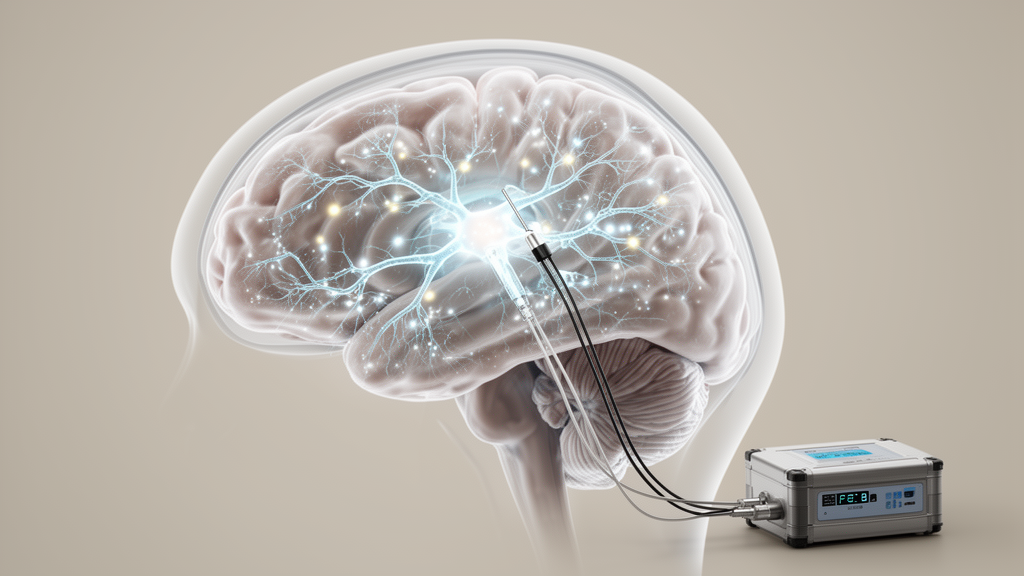
Motor cortex stimulation can relieve certain chronic pain conditions by altering local electrical activity and microcircuitry in the primary motor cortex, according to a review in BMC Medicine. The review synthesizes clinical electrophysiological findings with evidence about motor neuroanatomy and neuroplasticity to propose a local-circuit framework for analgesia. Its central message is that pain relief does not depend on a single uniform mechanism: the response varies with the stimulation method, the cortical layers engaged and the balance between excitatory pyramidal neurons and inhibitory interneurons.
The proposed framework starts with motor cortical output. Pyramidal neurons in the primary motor cortex, or M1, can inhibit spinal pain processing through direct and indirect activation of descending control systems. Through thalamic relays and corticocortical connections, they also modulate broad cortical and subcortical regions involved in pain.
At the cellular level, motor cortex stimulation changes the electrical states of local neurons and affects their microcircuit activity, enhancing motor output while altering wider pain-related network activity. The review therefore treats analgesia as a circuit-level process rather than the simple consequence of activating a motor area. Targeting appears especially important within this model.
By comparison, protocols that directly recruit deeper M1 layers may produce enhanced motor output without recruiting the same local network. The review presents this as an important distinction for understanding efficacy and identifies the engagement of superficial layers as a feature shared by effective therapeutic stimulation approaches. Long-term pain relief after non-invasive M1 stimulation is also associated with N-methyl-D-aspartate receptor-dependent, or NMDA receptor-dependent, long-term potentiation-like synaptic plasticity in local excitatory microcircuits.
The association provides a possible explanation for durable analgesic effects, although the clinical contribution and causal extent of that mechanism require direct evaluation. The review distinguishes this longer-lasting synaptic change from the acute modulation produced by changing neuronal electrical states during a stimulation session. Chronic pain can also change the local response to stimulation by shifting excitation and inhibition within M1.
The review reports that enhanced excitability of GABAergic interneurons suppresses the analgesic effect associated with activation of M1 pyramidal neurons. M1-targeted rTMS is proposed to rebalance these dynamics and restore M1 analgesic output, indicating that the response may depend on the excitability state of local cells as well as the location of stimulation. Based on this framework, the authors propose spatially precise, temporally targeted and personalized neuromodulation strategies.
These are research directions derived from a translational review, not established clinical recommendations, and the synthesis does not establish that every chronic pain condition responds through the same local circuitry.
Subject of Research: Local motor cortex microcircuitry associated with chronic pain relief from motor cortex stimulation
Article Title: Local circuitry mechanisms underlying motor cortex stimulation for chronic pain treatment
Article References: Bai, Y., Fregni, F., Liang, G.-B., Li, Y.-Q., & Nitsche, M. A. (2026). Local circuitry mechanisms underlying motor cortex stimulation for chronic pain treatment. BMC Medicine. https://doi.org/10.1186/s12916-026-05313-w
Image Credits: AI Generated
DOI: 10.1186/s12916-026-05313-w
Keywords: motor cortex stimulation, chronic pain, primary motor cortex, rTMS, microcircuitry, synaptic plasticity, NMDA receptors, GABAergic interneurons, neuromodulation, descending pain control, Local, circuitry
News Source: Ophelia Keating. (October 21, 2026). Research report: Local circuitry mechanisms underlying motor cortex stimulation for chronic pain treatment. Scienmag.