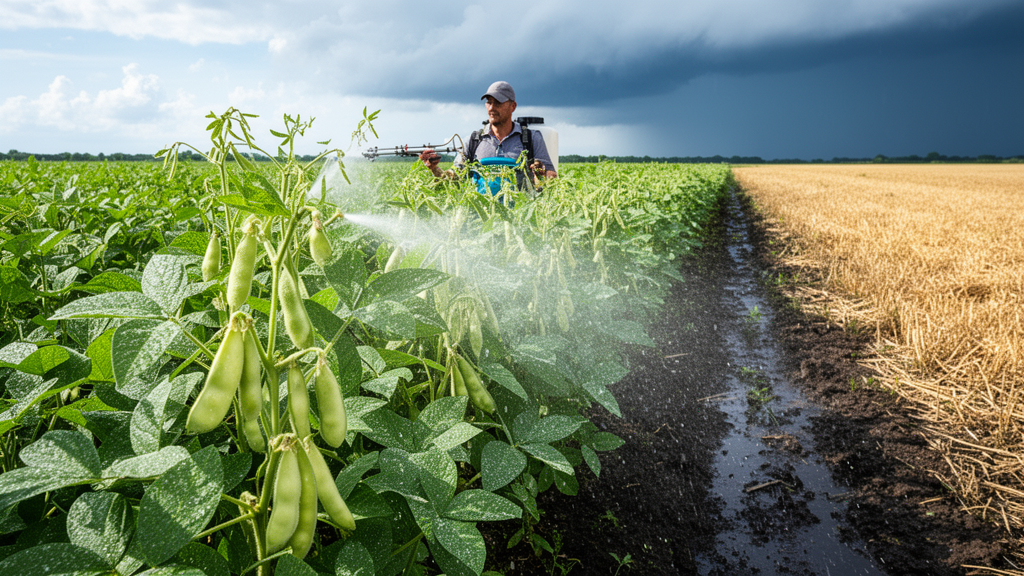
A two-year field experiment found that foliar thiourea was associated with greater soybean growth, canopy development, seed yield, profitability and input-use efficiency under contrasting seasonal rainfall, with supplemental irrigation provided in both years. The strongest responses were recorded at 500 and 750 mg L−1, while 750 mg L−1 produced the highest overall values. The experiment covered two soybean genotypes, PS 1347 and SL 958, grown at one site in New Delhi. Because researchers did not directly measure soil moisture or plant-water status, the results show a treatment-associated response under different rainfall conditions but do not establish that thiourea alleviated drought or improved water-stress tolerance.
The study was conducted during the 2021 and 2022 kharif seasons at the Research Farm of the ICAR–Indian Agricultural Research Institute in New Delhi. Rainfall totaled 1484.2 mm in 2021 and 478.4 mm in 2022, providing a marked seasonal contrast. Maximum air temperatures ranged from 25.0 to 42.2 °C in 2021 and 24.0 to 37.4 °C in 2022. The sandy-loam soil was slightly alkaline, with a pH of 7.6 and 0.54% organic carbon. Each plot received two supplemental irrigations of approximately 50 mm each, one at flowering and one during pod development, for a total irrigation input of about 100 mm. The treatments were laid out in a factorial randomized block design with three replications, and thiourea was applied twice, at 20–25 and 50–55 days after sowing, using a spray volume of 500 L ha−1. Concentrations of 250, 500 and 750 mg L−1 supplied 125, 250 and 375 g thiourea ha−1 per application.
Growth measurements showed a graded response across thiourea concentrations. Relative to the untreated control, 750 mg L−1 was associated with about 25–26% greater plant height, approximately 36% more branches per plant, 23–26% greater dry matter accumulation, about 16% higher leaf area index and 11.4–14.2% higher SPAD readings. The 500 mg L−1 treatment was often statistically comparable with 750 mg L−1, and both generally performed better than 250 mg L−1. A water-only spray showed little or no significant advantage over the untreated control in most growth attributes, suggesting that the observed treatment pattern was not explained simply by the act of spraying. The year-by-thiourea interaction was not significant for the reported growth attributes, indicating that the response pattern was broadly consistent across the two seasons, although the experiment was limited to one location and two growing seasons.
Canopy measurements followed the same general pattern as the growth data. In genotype SL 958, 750 mg L−1 thiourea produced normalized difference vegetation index values of 0.78 in 2021 and 0.81 in 2022, about 32% and 35.5% above the respective control values of 0.59 and 0.60. At 30–45 days after sowing, net photosynthetically active radiation under the highest concentration was approximately 1430 µmol m−2 s−1, around 21% above the control; at 45–60 days, it was approximately 1275 µmol m−2 s−1, about 19% above control. The 500 mg L−1 treatment increased radiation interception by roughly 13–15%. Foliar thiourea was also associated with approximately 21% higher crop growth rate at 30–45 days and 17% higher crop growth rate at 45–60 days. Relative growth rate, by contrast, was largely unaffected by thiourea treatment, and the year-by-thiourea interaction for relative growth rate during the earlier sampling interval was significant.
Yield formation was consistent with the larger canopy and biomass measurements. The 750 mg L−1 treatment produced 2300 kg ha−1 of seed in 2021 and 2200 kg ha−1 in 2022, improvements of 27.8% and 28.5% over control yields of 1800 and 1700 kg ha−1. The 500 mg L−1 concentration produced 2200 kg ha−1 in both years, representing increases of 25.7–26.7% over control. Pod numbers reached 71 and 68 per plant at 750 mg L−1, gains of 36.2% and 37.4%, while seed index increased by approximately 11–12%. Stover yield reached 5400 kg ha−1 in 2021 and 4900 kg ha−1 in 2022 at the highest concentration. Biological yield was 7600 and 7100 kg ha−1 in the two seasons, about 33% and 29% above control. Harvest index remained comparatively stable, meaning that the higher seed production was accompanied mainly by greater total biomass rather than a major measured shift in partitioning between grain and stover.
Genotype SL 958 generally outperformed PS 1347. Across the two seasons, SL 958 produced 9.6–9.7% more dry matter, 4.8–5.4% higher leaf area index, 8.4–15.4% higher SPAD readings and 11.2–11.8% greater seed yield. It also produced more pods per plant, although PS 1347 recorded the larger seed index. Under control conditions, SL 958 yielded 2100 kg ha−1 in 2021 and 2000 kg ha−1 in 2022, compared with 1900 and 1800 kg ha−1 for PS 1347. The thiourea-associated yield increases appeared in both genetic backgrounds, but absolute growth, yield and economic performance was higher for SL 958. The researchers therefore reported that genotype, thiourea concentration and seasonal conditions could modify the size of the response, while the year-by-thiourea interaction was not significant for the principal growth, yield and economic measures.
The added spray and labor costs were small relative to the reported gains in returns. At 750 mg L−1, gross returns were $1450 ha−1 in 2021 and $1500 ha−1 in 2022, approximately 29–30% above the untreated control. Net returns reached $980 and $1030 ha−1, around 45–47% higher than in untreated plots. The benefit–cost ratio was 2.14 in 2021 and 2.18 in 2022, compared with 1.48 and 1.53 for the control in the results table. The 500 mg L−1 treatment generated net returns of $940 and $1010 ha−1 and benefit–cost ratios of 2.05 and 2.14. Cultivation costs differed by only about $10 ha−1 between the control and the highest thiourea concentration in each year, making increased gross output the principal source of higher profitability in the reported accounting. These economic findings apply to the costs and returns used in the study and do not establish profitability under other market conditions or production systems.
Input-use efficiency measures also improved with foliar treatment. At 750 mg L−1, water productivity reached 3.2 kg m−3 in 2021 and 4.8 kg m−3 in 2022, gains of about 38% and 35% over control. This metric was calculated as grain yield divided by effective rainfall plus irrigation water, rather than from directly measured crop evapotranspiration or a soil-water balance. Production efficiency rose by approximately 27–29%, monetary efficiency by 30–31% and factor productivity by about 35–40%. Factor productivity expressed grain output per kilogram of applied NPK fertilizer. The year-by-thiourea interaction was not significant for the reported efficiency measures, suggesting that the direction of these changes was stable despite the substantial difference in seasonal rainfall. Because soil-water status was not measured, the water-productivity result should not be interpreted as a direct measurement of how thiourea changed drought physiology or crop water use.
Correlation analysis showed that canopy and growth variables tracked seed production closely. Plant height, dry matter accumulation, SPAD, NDVI and crop growth rate were strongly and positively associated with seed and biological yield, while pod number was strongly correlated with both yield measures. Dry matter had Pearson correlation coefficients of 0.96 and 0.97 with seed yield in the two seasons, and crop growth rate had coefficients of 0.91 and 0.92. NDVI was positively associated with seed yield, with coefficients of 0.65 and 0.93. These relationships support the narrower conclusion that treatment-associated improvements in canopy development and biomass accumulation coincided with higher yields. They do not prove that any single physiological measurement caused the yield gains. Relative growth rate showed negative correlations with dry matter, SPAD, crop growth rate, pod number and yield in the two seasons, despite little treatment-related change in that index.
The authors proposed that thiourea might support soybean through antioxidant regulation, reactive oxygen species control, chlorophyll retention, nitrogen and sulfur metabolism and improved cellular hydration, but none of these biochemical pathways was directly tested in the experiment. Antioxidant enzymes, reactive oxygen species, malondialdehyde, leaf water status and soil moisture were not measured, nor were thiourea residues assessed. Quantum yield, electron transport, gas exchange, cellular division and plant-water relations were also not directly evaluated, so these mechanisms remain plausible explanations from the cited literature rather than demonstrated causal pathways. The strongest practical signal was that 500 mg L−1 achieved much of the measured benefit seen at 750 mg L−1 with less chemical applied. That inference is restricted to the single-location, two-season trial. Multilocation and multiyear studies incorporating direct water measurements, physiological and biochemical assays, dose-response evaluation, environmental-safety assessment and economic sensitivity analysis would be needed before establishing a universal optimum rate or making broad agronomic recommendations.
Subject of Research: Effects of foliar thiourea on soybean growth, yield, profitability and input-use efficiency under contrasting rainfall with supplemental irrigation
Article Title: Effect of thiourea application on growth, physiological traits, yield, and water productivity of soybean under contrasting rainfall with supplemental irrigation
Article References: Dass, A., Singh, A., A R, D., Nithinkumar, K., Verma, R. K., Lal, S. K., Meena, V. S., Devi, A. D., Rathore, S. S., Dhar, S., Meena, S. L., Sharma, V. K., & Ritika (2026). Effect of thiourea application on growth, physiological traits, yield, and water productivity of soybean under contrasting rainfall with supplemental irrigation. Results in Engineering, 32, Article 113586. https://doi.org/10.1016/j.rineng.2026.113586
Image Credits: AI Generated
DOI: 10.1016/j.rineng.2026.113586
Keywords: soybean, thiourea, foliar treatment, field experiment, crop growth, canopy development, seed yield, water productivity, plant growth regulator, contrasting rainfall, Effect, application
News Source: Alan Morgan. (October 21, 2026). Foliar thiourea associated with higher soybean growth and yield across contrasting rainfall seasons. Scienmag.