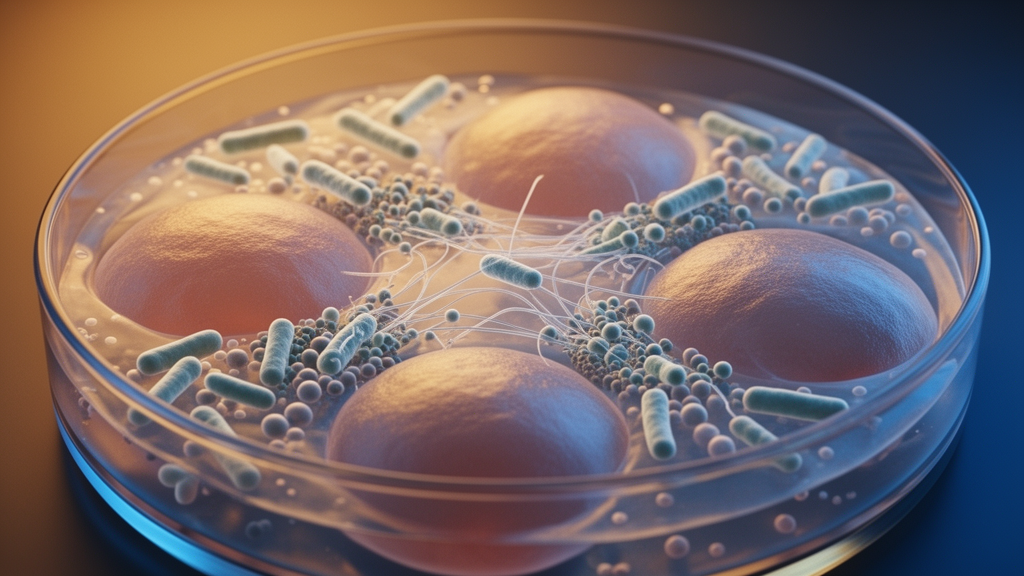
A 2026 Perspective in Frontiers in Bioengineering and Biotechnology examines how engineered spaces can improve the stability of live bacteria–mammalian cell co-cultures by controlling where the organisms are placed, whether they make physical contact, and which materials cross between them. The analysis compares tumor-spheroid colonization models, biomimetic hydrogel barriers, bacteria-containing microcapsules, layered hydrogel beads, and multiphasic droplets. These approaches address a central obstacle in vitro: bacteria generally multiply faster than mammalian cells, consume nutrients rapidly, change pH and oxygen levels, and can accumulate waste, toxins, or inflammatory products that kill the host cells. By constraining bacterial proliferation, engineered systems can create longer and more interpretable observation windows for studying infection, colonization, microbial signaling, tumor biology, and engineered bacterial therapies.
Such models are needed because bacteria and mammalian cells do not interact as isolated populations. In the intestine, respiratory tract, oral cavity, skin, chronic infection sites, and tumor microenvironments, microbial activity can alter host-cell proliferation, metabolism, immune responses, and drug sensitivity, while host-cell states influence which microbes survive and what functions they perform. The Perspective cites colorectal cancer cells carrying an oncogenic KRAS mutation as an example of this feedback: these cells selectively enriched Bacteroides acidifaciens, whose surface protein SusF further amplified KRAS–MAPK signaling and promoted tumor growth by stabilizing the host protein ARHGEF2. Separating bacteria from mammalian cells, using bacterial lysates, or collecting cell-free supernatants cannot reproduce continuous, two-way feedback during a live co-culture, but a well-defined shared environment can permit those interactions to be measured under controlled conditions.
Tumor spheroids offer one of the least artificially constrained options. Bacteria are introduced directly into three-dimensional tumor aggregates, after which organisms outside the spheroid can be removed by washing and gentamicin treatment. Bacteria in hypoxic or necrotic regions can remain present for more than two weeks, preserving processes such as adhesion, invasion, and biofilm formation that cannot be reproduced by complete physical separation. A microfluidic model described in the Perspective allowed Pseudomonas aeruginosa biofilms to form on lung tumor spheroids; bacterial siderophores then altered local iron metabolism and reduced tumor-cell sensitivity to ferroptosis. The approach provides a biologically relevant niche, but researchers do not directly prescribe the final bacterial location: it emerges from oxygen and nutrient gradients and may also depend on the strain, antibiotic sensitivity, and tumor-cell type.
Biomimetic barriers provide a different compromise by placing an engineered interface between bacteria and a mammalian-cell monolayer while retaining selected routes for molecular exchange. In one respiratory and intestinal model, bacteria were confined to defined regions by an aqueous two-phase system, while an alginate–mucin hydrogel covered 16-HBE or Caco-2 cells and recreated a mucus-like barrier. The 12-hour model protected the mammalian monolayers, but the barrier was not biologically inert: adding mucin changed the gel’s diffusion properties and increased bacterial tolerance to antibiotics. This finding illustrates why material composition must be considered an experimental variable rather than merely a physical container. At natural interfaces, host mucus or extracellular matrix, bacterial extracellular polymeric substances, and synthetic hydrogels can jointly affect adhesion, retention, molecular diffusion, antibiotic penetration, and host exposure to bacterial products.
Microcapsules and core–shell beads offer another route to physical separation. An Escherichia coli biosensor was enclosed in an alginate core and protected by a polyelectrolyte coating, allowing it to detect lactate from external CHO cells without rapid bacterial proliferation disrupting that culture. Other layered microspheres placed different bacteria in the core or peripheral hydrogel layers, where they could communicate through diffusible signals. In a therapeutic variation, Lactococcus lactis expressing β-glucuronidase was confined in an alginate shell; the bacterial enzyme entered an external precursor, converted it into an active compound, and reduced cancer-cell viability in both monolayers and three-dimensional spheroids. These systems are especially suitable for investigating metabolites, enzymes, and engineered signaling pathways, but they cannot readily reproduce direct bacterial adhesion to or invasion of mammalian cells.
Multiphasic droplets make contact mode an adjustable variable. Polymer phase separation creates liquid and hydrogel compartments within a single platform. In a direct configuration, bacteria grow in a liquid core while mammalian cells attach to the hydrogel–liquid interface and can contact them. In an indirect configuration, mammalian cells are embedded in the hydrogel and bacteria occupy the surrounding liquid phase, leaving diffusion as the main communication route. Comparing these arrangements on the same platform can help determine whether a cellular phenotype requires physical contact. The distinction is important because extending culture duration alone does not establish mechanism, whereas changing spatial relationships while holding material and culture conditions constant creates a more controlled comparison between contact-dependent and diffusible interactions.
Confining bacteria and transporting useful molecules are competing requirements. A barrier loose enough to permit rapid exchange may fail to prevent escape, whereas a dense network can starve cells or restrict signals. Alginate can be crosslinked under mild conditions and is suitable for encapsulating live bacteria, but a single gel layer may not prevent long-term escape. Chitosan and polylysine coatings improved microsphere stability, and the polylysine layer resisted swelling more strongly; however, additional coating delayed lactate transport by roughly two hours relative to a single-layer structure. Molecular retention cannot be predicted from molecular weight alone, because molecular shape, charge, gel swelling, and network structure also affect movement. In a PEG system, a gel estimated to have pores of about 4–10 nanometres slowly admitted 10-kilodalton dextran while strongly restricting 70-kilodalton dextran and bovine serum albumin.
Material properties can also alter whether mammalian cells function as intended. A 5% PEG gel supported A549 spheroid formation, whereas a 10% gel failed to support spheroid growth because its denser network imposed stronger physical constraints. For an indirect configuration requiring complete host-cell encapsulation, increased PEG branching and a shorter crosslinker produced a stiffer gel with less swelling after hydration. Yet rheological stability does not necessarily predict transport: adding mucin to alginate altered viscoelasticity and improved interface stability without significantly changing the effective diffusion coefficients measured for 150-kilodalton dextran and immunoglobulin G. Transport should therefore be quantified using the metabolites, proteins, or drugs involved in a particular interaction rather than inferred from a single tracer or from the apparent strength of a material.
Geometry and oxygen supply add further constraints. Larger droplets can slow nutrient depletion and metabolite accumulation, but they may be less compatible with flow-cytometric sorting. The Perspective reports higher mammalian-cell viability after 48 hours in 90-micrometre droplets than in approximately 50-micrometre droplets. In spheroids, a diameter near 500 micrometres can produce an oxygen-limited core because inward diffusion no longer meets cellular consumption, creating a niche that favors bacterial colonization. Device architecture can instead regulate oxygen through gas-permeable materials, controlled permeability and barrier thickness, separately perfused oxygenated and anoxic compartments, or integrated oxygen sensors. Such gradients must match the target tissue because mucosal, tumoral, and infection environments have different oxygen conditions and may accommodate organisms with incompatible requirements.
The Perspective presents spatial engineering as a framework for balancing confinement, exchange, biological activity, experimental duration, and throughput rather than as a single universal platform. Its representative systems range from 8-hour perfusion experiments to spheroid models maintained for more than two weeks, showing that stability depends on the organisms, materials, and question being investigated. Current evidence also comes from a limited set of bacterial strains and mammalian cell lines, so results may require re-optimization for other species, tissues, and media. Proposed advances include hydrogels that resist swelling and bacterial degradation without blocking target molecules, standardized measurements of leakage and transport, and modular systems that can compare direct contact with selective separation under matched conditions. Integration with high-throughput sorting, real-time imaging, and sequencing could eventually extend the approach from single-strain, cell-line systems toward multispecies communities and tissue models containing immune, stromal, and patient-derived cells.
Subject of Research: Spatial engineering of live bacteria–mammalian cell co-culture systems
Article Title: Bacteria-mammalian cell co-culture systems mediated by spatial engineering strategies
Article References: Luo, A., & Zhao, D. (2026). Bacteria-mammalian cell co-culture systems mediated by spatial engineering strategies. Frontiers in Bioengineering and Biotechnology, 14, Article 1999112. https://doi.org/10.3389/fbioe.2026.1999112
Image Credits: AI Generated
DOI: 10.3389/fbioe.2026.1999112
Keywords: bacterial co-culture, mammalian cells, spatial engineering, hydrogel barriers, microcapsules, multiphasic droplets, tumor spheroids, molecular transport, bacterial confinement, microbiome models, Bacteria-mammalian, cell
News Source: Denise Maddox. (October 21, 2026). Perspective Reviews Spatial Strategies for Bacterial–Mammalian Cell Co-Culture. Scienmag.