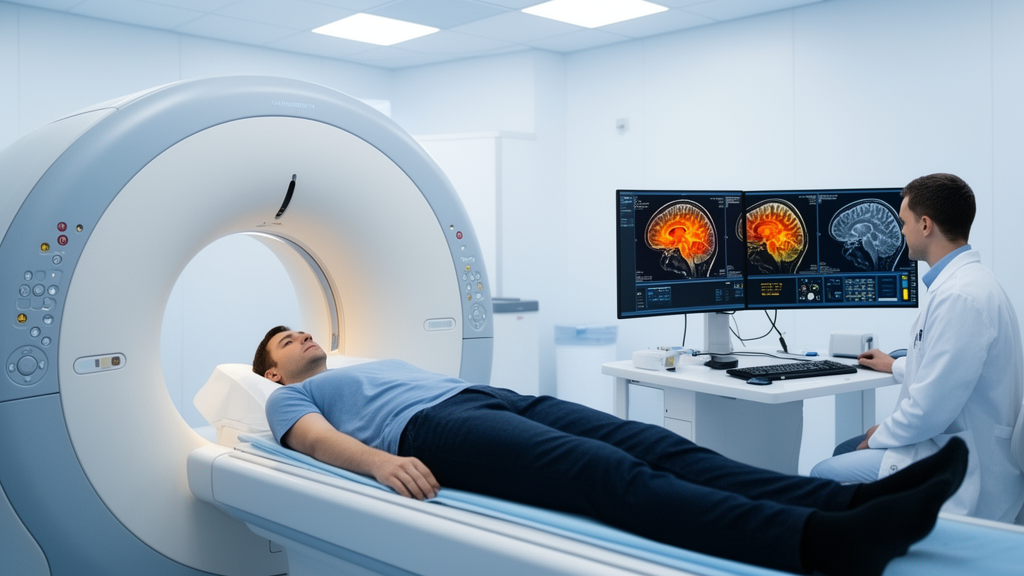
A multimodal MRI study of 100 people with Crohn’s disease and 50 healthy controls found coordinated differences in brain structure and resting-state functional signals, with the affected regions showing spatial correspondence to dopaminergic, serotonergic, noradrenergic and opioid systems. The researchers combined structural MRI data measuring gray matter volume with resting-state functional MRI data analyzed using fractional amplitude of low-frequency fluctuations, or fALFF, through multimodal canonical correlation analysis and joint independent component analysis.
The joint analysis identified one component that discriminated between patients and controls across both imaging modalities. Its structural measure, gray matter independent component 1, remained significantly different after false-discovery-rate correction at P = 0.028, while its functional counterpart, fALFF independent component 1, remained significant at P = 0.001. The spatial pattern involved the thalamus, default mode network, insula, sensorimotor cortex, occipital lobe, cerebellum and frontal regions. This shared component indicates that the structural and functional signals varied together across the two MRI measures rather than being interpreted separately.
The analysis also found a functional component, fALFF independent component 3, that differed between Crohn’s disease and control groups without being identified as part of the joint component. Its distribution included the cerebellum and extensive frontal areas, and the group difference was significant after correction at P = 0.009. The two functional components were strongly correlated across the sample, with r = 0.883 and FDR-corrected P < 0.001. This statistical relationship does not establish that Crohn’s disease caused either pattern, nor does it show that one component produces the other.
Clinical variables were linked to the imaging components in different ways. The joint gray matter component was negatively correlated with disease activity, with r = −0.430 and FDR-corrected P < 0.001, meaning that lower component values were associated with greater disease activity in this sample. The joint functional component was positively correlated with quality of life, at r = 0.261 and FDR-corrected P = 0.031. These are cross-sectional associations among the participants and should not be interpreted as evidence that a particular MRI pattern is a validated biomarker, treatment target or consequence of Crohn’s disease.
The researchers then used JuSpace to compare the imaging patterns with spatial reference maps of neurotransmitter-related systems. The shared components corresponded to distributions involving dopamine, serotonin, noradrenaline and opioid systems. Because this comparison relied on normative maps rather than direct measurements of neurotransmitter levels or receptor binding in participants, the results show spatial correspondence rather than proof of neurotransmitter involvement as a causal mechanism. The study therefore provides preliminary evidence for coordinated structural–functional brain patterns in Crohn’s disease and a framework for relating those patterns to clinical measures and established neurotransmitter-system maps, while remaining limited by the sample-based, observational nature of the analysis and the indirect nature of the neurotransmitter comparison.
Subject of Research: Multimodal MRI analysis of brain changes in Crohn’s disease
Article Title: Multimodal CCA + joint ICA reveals fused gray matter volume and resting-state functional alterations with neurotransmitter associations in Crohn’s disease
Article References: Yin, Y., Luo, M., Ou, D., Zhou, Z., Wang, X., & Liu, J. (2026). Multimodal CCA + joint ICA reveals fused gray matter volume and resting-state functional alterations with neurotransmitter associations in Crohn’s disease. Journal of Translational Medicine. https://doi.org/10.1186/s12967-026-09101-1
Image Credits: AI Generated
DOI: 10.1186/s12967-026-09101-1
Keywords: Crohn’s disease, brain MRI, gray matter volume, resting-state fMRI, fALFF, neurotransmitter mapping, gut–brain axis, multimodal analysis, disease activity, Multimodal, joint, reveals
News Source: Cassandra Pierce. (October 21, 2026). MRI links Crohn’s disease to coordinated brain changes. Scienmag.