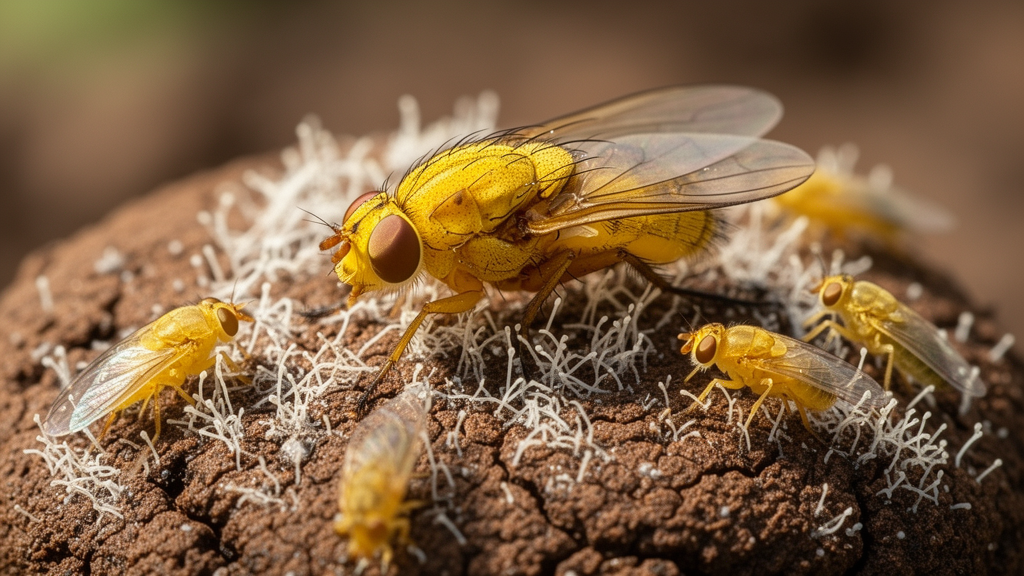
A fatal fungal parasite imposed negative viability selection on adult yellow dung flies at a Swiss field population in 2002, with larger flies more likely to die of infection than smaller ones. The finding emerged during an unusually intense epidemic of the fungus Entomophthora scatophagae, which infected as many as half of the flies in some seasonal samples. The parasite did not consistently select for or against fluctuating asymmetry, a measure of left-right developmental imbalance in paired legs and wings. It also erased the species’ customary mating advantage for large males among infected individuals, although infection itself did not provide an additional measurable penalty to female fecundity among flies that survived.
The study focused on Scathophaga stercoraria, a widespread fly that feeds as an adult on small flying insects and breeds in cattle dung. Larvae develop in fresh dung pats, where temperature, food quality, drying and competition vary substantially and can affect the body size reached by adults. Females also visit dung to lay clutches, while males wait at pats and compete intensely for access to arriving females. Because few unpaired females are present at dung, the proportion of males paired at a pat provides a practical measure of the operational sex ratio and the competitive environment in which male mating success is determined.
Researchers sampled the population near Fehraltorf, Switzerland, approximately once per month from April through November 2002, yielding eight seasonal samples and 541 flies. The collection included 171 females and 370 males, of which 126 females provided usable clutch-size data. Because visibly infected flies were too uncommon and irregularly distributed to sample systematically in the field, captured flies were maintained individually in laboratory bottles with sugar and water for up to two weeks. Flies already carrying the fungus developed visible infection within days and died, whereas flies that recovered, resisted infection or remained uninfected were treated as a single non-infected category. This design measured mortality associated with latent or developing infection, but it did not directly measure infection risk at the moment of capture.
After the flies died, investigators measured the left and right fore, mid and hind tibiae and wings under a binocular microscope. Mean appendage length represented body size, while absolute and size-corrected differences between the two sides represented fluctuating asymmetry. Measurements were repeated blind to estimate measurement error and repeatability. Trait repeatability ranged from 0.83 to 0.97 for the measurements and from 0.53 to 0.61 for asymmetry, indicating that left-right differences could be distinguished adequately from measurement error. Leg and wing lengths were strongly correlated, with bivariate correlations from 0.887 to 0.972, so the analyses also used the first principal component of the mean appendages as a compound body-size index. Fluctuating asymmetries among the individual appendages were largely uncorrelated, with correlations ranging from −0.024 to 0.215.
Selection was estimated with standardized linear and nonlinear regression models. Viability selection contrasted flies that died with those that survived, male sexual selection contrasted paired with unpaired males, and female fecundity selection related relative clutch size to body size. Logistic regression was used to test binary outcomes, while relative success was calculated by dividing each individual’s status by the relevant sample proportion. Linear coefficients measured combined direct and indirect selection, whereas quadratic coefficients tested whether selection changed across the trait range. The body-size index showed significantly negative viability selection in females and males, while mean fluctuating asymmetry had no significant effect on survival, female fecundity or male mating success. Most nonlinear coefficients were also small and nonsignificant; the exception was positive female fecundity selection on body size, consistent with accelerating selection favoring larger females.
Infection prevalence varied strongly across the season. It reached about 50% during cooler, more humid periods in spring and autumn but nearly disappeared during the hot midsummer, producing a strong seasonal effect. Females and males were affected similarly overall, although their susceptibility differed in particular seasons. The central result was that infection risk increased with body size, while the size effect varied among seasonal samples rather than differing significantly between the sexes. By contrast, mean fluctuating asymmetry did not predict whether a fly developed the fatal infection. The analysis therefore identified body size, but not the degree of bilateral developmental asymmetry, as the morphological trait consistently associated with vulnerability during the epidemic.
The parasite also altered the reproductive landscape of the flies. In the population as a whole, larger males had a clear mating advantage, and this advantage was stable through most of the season. Among 47 infected males observed mating in the field, however, the usual size advantage was absent: 28 were paired and 19 were unpaired, a pattern that differed significantly from the overall association between size and mating success. The study interpreted this reversal as evidence that the fungus nullified the reproductive advantage normally conferred on large males. Because infection was generally fatal and almost all infected females died before oviposition, estimates of female fecundity selection applied only to uninfected, recovered or resistant females. They cannot be interpreted as evidence that the fungus directly reduced egg production in surviving females.
The findings offer a possible counterweight to the strong positive sexual selection that favors large male yellow dung flies. Previous work at the same long-term Swiss population had documented average mating advantages for large males and fecundity advantages for large females, yet mean male body size had declined by almost 10% from 1993 to 2009, a change discussed in relation to climatic warming. The 2002 epidemic supplies evidence for an overlooked selective pressure: large adults may be less able to withstand infection. The study is phenomenological and cannot identify the mechanism responsible. Higher energy demands in larger flies, allocation to reproduction and immunity, or differences in exposure could all be involved, but the data do not demonstrate that any one of these explanations caused the pattern. Evidence linking phenoloxidase, a central mediator of insect immunity, to resistance in this species is also mixed, and phenoloxidase is not correlated with body size in yellow dung flies.
Several limitations constrain the conclusions. The parasite occurred in extraordinary abundance in 2002, and the observations came from one Swiss population during a single season, so the study does not establish how general the effect is across years, sites or environmental conditions. The laboratory protocol could not distinguish among flies that resisted infection, recovered from it or never developed detectable infection, and mortality after collection may not represent identical infection dynamics in the field. Larger flies might have been more exposed to fungal spores, or their energetic demands might have reduced their capacity to resist the infection, but neither mechanism was tested. The seasonal interaction associated with body size also indicates that the relationship between size and mortality was not constant. The absence of an asymmetry effect is more secure for the traits and fitness components measured than a general conclusion that asymmetry is unrelated to immunity in all contexts.
Despite these constraints, the observations provide direct evidence that a parasite can impose negative viability selection on body size in an invertebrate, a pattern the author notes is uncommon in animals and particularly scarce among invertebrates. They also support the interpretation that opposing selective pressures can contribute to the species’ unusual male-biased sexual size dimorphism: large males may gain mates more often but face a higher risk of dying from fungal infection. The study does not show that the parasite caused the long-term decline in fly size, and it does not establish the evolutionary effect of the 2002 epidemic on the population. Its clearest conclusion is narrower. During a severe Entomophthora outbreak, larger adult yellow dung flies were more susceptible to fatal infection, while fluctuating asymmetry of their legs and wings did not predict infection, survival, female clutch size or male mating success.
Subject of Research: Fungal viability selection on body size and fluctuating asymmetry in Swiss yellow dung flies
Article Title: A fungal parasite selects against body size but not fluctuating asymmetry in Swiss subalpine yellow dung flies
Article References: Blanckenhorn, W. U. (2021). A fungal parasite selects against body size but not fluctuating asymmetry in Swiss subalpine yellow dung flies. Alpine Entomology, 5, 27-35. https://doi.org/10.3897/alpento.5.65653
Image Credits: AI Generated
Keywords: yellow dung fly, Entomophthora scatophagae, fungal parasite, viability selection, body size, fluctuating asymmetry, sexual selection, fecundity selection, insect immunity, field study, fungal, parasite
News Source: Kristina Jarvis. (October 21, 2026). Fungal parasite selects against larger yellow dung flies. Scienmag.