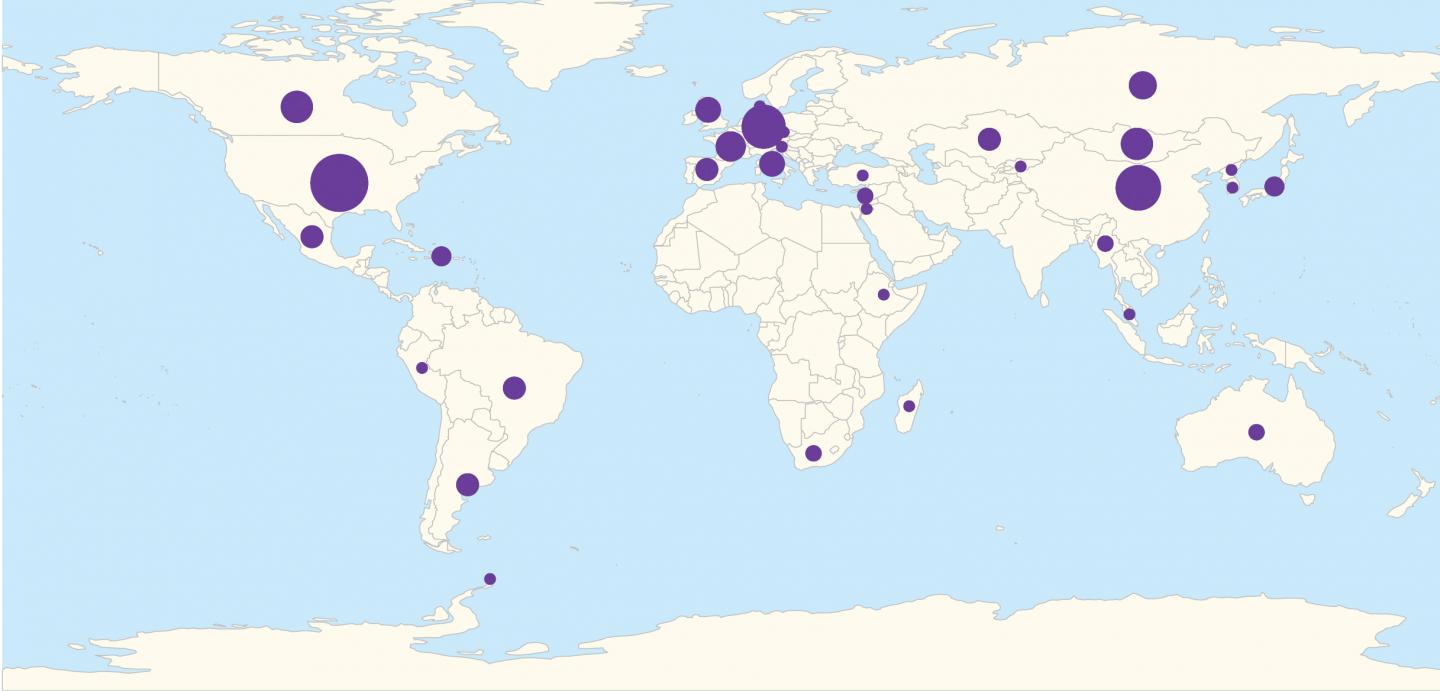
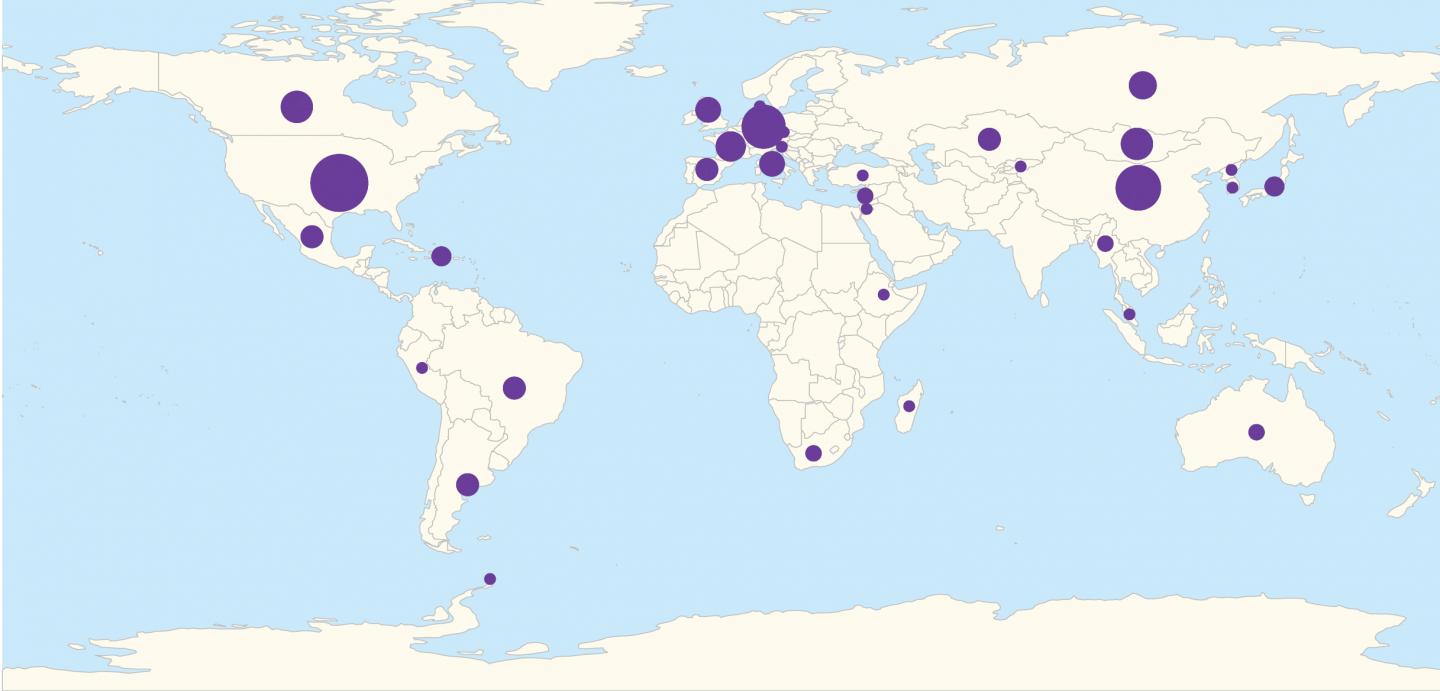
Credit: Image modified from Eliason et al. (2017) PRSB.
When most people hear the word fossil, they probably think of gigantic leg bones or sharp teeth. But, given the right conditions, after an animal dies even delicate body coverings like skin, hair and feathers can be preserved.
New research led by The University of Texas at Austin has found that when it comes to preserving these body parts, fossilized hair is rare–five times rarer than feathers–despite being an important tool for understanding ancient species. This finding has researchers trying to determine if the lack of hair in the fossil record has to do with physical traits that might make it more difficult for hair to fossilize, or an issue with scientists' collection techniques that could lead to them missing important finds.
"This pattern of where and when we do find fossilized feathers and hairs can be used to inform where we look for future fossil discoveries," said first author Chad Eliason, a researcher at the Field Museum of Natural History who conducted the research while a postdoctoral fellow at the UT Jackson School of Geosciences.
The study was published on Sept. 6 in the journal Proceedings of the Royal Society B. Co-authors include Julia Clarke, a professor in the Jackson School's Department of Geological Sciences who led the study, and three Jackson School undergraduate students, Leah Hudson, Taylor Watts and Hector Garza.
Fossils of body coverings contain unique data on the ecology and lifestyle of extinct animals, including what color they might have been. They also might affect our understanding of when kinds of body coverings, such as feathers and hair, evolved. In this study, the researchers used data on fossil type and age to determine that hair probably evolved much earlier than current fossil samples indicate.
Fossil beds that preserve soft tissues like hair and feathers are called lagerstatte ('fossil storehouses' in German) and are rare on their own. The researchers were interested in understanding how frequently different types of body coverings were found preserved in these exceptional sites, which include the Yixian Formation in China and the Green River Formation in the western United States.
Eliason and his collaborators assembled the largest known database of fossilized body coverings, or integument, from land-dwelling vertebrates, a group known as tetrapods, collected from lagerstatte. They found that unlike feathers, hairs are extremely rare finds.
"Mammal hair has been around for more than 160 million years yet over that time we have very few records," Eliason said.
The rarity might be explained by feathers and hair containing different types of the protein keratin, which may impact the likelihood of fossilization. However, the study notes that the lack of hair samples could have nothing to do with fossilization, and be explained by the collecting behavior of paleontologists, with a single feather usually being much easier to identify than a single hair.
The database also allowed the researchers to conduct a type of statistical method called gap analysis, which models the probability of finding a fossil in a given time. The team found that feathers appear to have evolved very close to the earliest known examples in the fossil record, about 165 million years ago. However, hair and hair-like filaments found on pterosaurs probably evolved far earlier in the fossil record than currently known.
"The hunt is on," said Clarke. "These data suggest we might expect to find records up to 100 million years earlier potentially."
The team also applied a statistical approach called a time series analyses to study if climatic factors might explain gaps in the fossil record. They found that soft tissue preservation was most common when ancient sea levels were high.
"There is still a lot we don't know about the chemistry of these deposits and why they are so uneven through time," Clarke said. "But we can say that their uneven distribution across the world–most [sites] are in North America or Eurasia–is an artifact of where paleontologists looked. We have a lot more work to do."
###
The National Science Foundation funded the research.
Media Contact
Monica Kortsha
[email protected]
512-471-2241
@UTAustin
http://www.utexas.edu
Original Source
http://www.jsg.utexas.edu/news/2017/09/ut-austin-study-raises-question-why-are-fossilized-hairs-so-rare/