A taxonomic and metabarcoding study conducted in the Republic of Korea identified 11 crust-like Sebacinaceae taxa from fungal fruiting bodies, described six as new species and detected additional lineages in roots associated with Korean pine and oak.
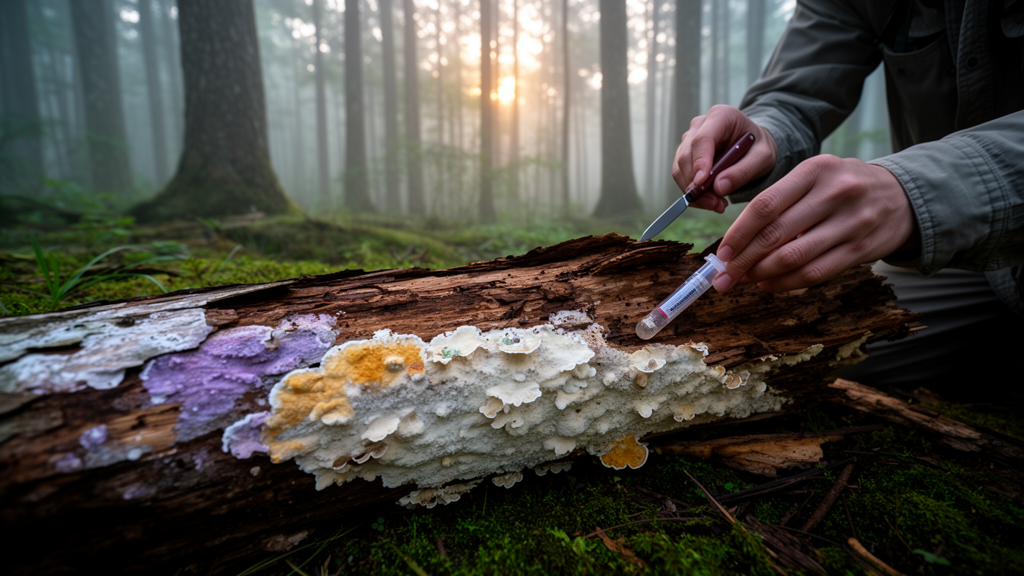
Researchers examined 38 basidiomata specimens obtained from three Korean fungaria. All were initially labeled Sebacina incrustans. DNA analysis used the internal transcribed spacer region, the nuclear large ribosomal subunit region and part of the RNA polymerase II subunit 2 gene, known as rpb2. The phylogenetic dataset included 141 ITS, 143 LSU and 46 rpb2 sequences.
Sequence comparisons and phylogenetic clustering divided the specimens into 11 taxa: nine Sebacina species and two Helvellosebacina species. Maximum-likelihood analysis separated crust-like Sebacinaceae from non-crust-like lineages in the family, but did not strongly resolve the boundary between Sebacina and Helvellosebacina.
The study proposed six new species: Helvellosebacina chrysallidodoma, H. koreana, Sebacina caducifoliicola, S. crystallina, S. incarnata and S. orientalis. Their descriptions combined growth habit and color with microscopic measurements of basidia, basidiospores and hyphae. The study also documented S. aciculicola and S. ocreata as new records for Korea.
Root sampling was conducted separately at 34 sites across the Korean Peninsula between 2019 and 2021. At each site, the researchers sampled five Pinus densiflora individuals and five oaks, identified as Quercus mongolica or Q. salicina, producing 340 pooled root samples. PacBio sequencing generated 2,243,343 high-fidelity reads, and processing yielded 3,439 amplicon sequence variants.
Forty variants were classified as crust-like Sebacinaceae and verified through phylogenetic analysis. Thirty-three variants, representing 19 phylotypes, were detected only by metabarcoding, while seven variants corresponded to three phylotypes also represented among the fruiting bodies. In the combined ecological analysis, 13 phylotypes occurred in Pinus roots and 16 in Quercus roots; six were detected in both hosts. These observations document associations with the sampled tree genera but do not establish exclusive host relationships.
Across the basidiomata and root datasets, the study identified 31 crust-like Sebacinaceae phylotypes, many of which did not match described species. The limited overlap between the two methods indicates that visible fruiting-body collection alone did not capture much of the diversity detected in roots. The multigene analysis also reclassified several public sequence records, including sequences previously labeled S. epigaea or S. incrustans.
The findings are limited to the Korean survey and root samples from two ectomycorrhizal tree genera. Many metabarcoding lineages could not be linked to observed fruiting bodies or formally named species, and inconspicuous morphology made species boundaries difficult to establish. Limited coverage of all three markers and weak support between Sebacina and Helvellosebacina also constrained genus-level resolution.
Subject of Research: Taxonomic and metabarcoding survey of crust-like Sebacinaceae diversity in the Republic of Korea
Article Title: Hidden diversity of crust-like Sebacinaceae ( Sebacinales , Agaricomycetes ) in Asia
Article References: Suh, H., Seo, C. W., Park, K. H., Yoo, S., Kim, D., Cho, Y., & Lim, Y. W. (2026). Hidden diversity of crust-like Sebacinaceae (Sebacinales, Agaricomycetes) in Asia. IMA Fungus, 17, Article e168486. https://doi.org/10.3897/imafungus.17.168486
Image Credits: AI Generated
DOI: 10.3897/imafungus.17.168486
Keywords: Sebacinaceae, Sebacina, Helvellosebacina, fungal taxonomy, phylogenetics, metabarcoding, ectomycorrhizal fungi, Korea, six new species, Hidden, diversity, crust-like
News Source: Roger Howard. (October 21, 2026). Korean survey identifies six new crust-like Sebacinaceae species. Scienmag.