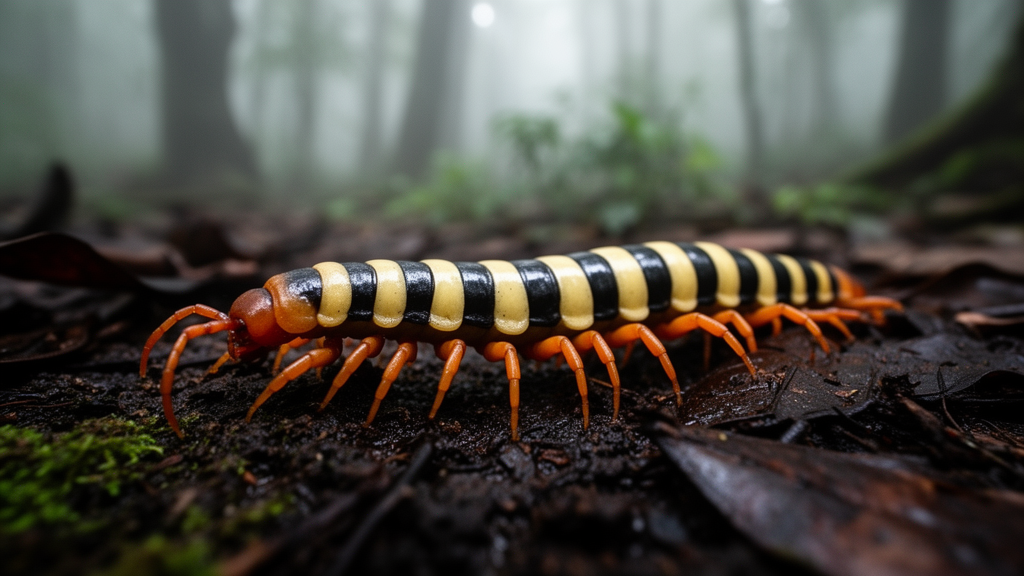
A morphological study of preserved centipede specimens collected from leaf litter and beneath stones identified and described Lithobius (Ezembius) zebrinus as a new species. The specimens came from Daweishan National Nature Reserve in Honghe Hani and Yi Autonomous Prefecture, Yunnan, in south-western China. The study assessed external anatomy and illustrated diagnostic features of the new taxon, contributing to the limited taxonomic record for lithobiomorph centipedes in the region.
The type series comprised 11 adults collected on 24 January 2019 at an elevation of 1,080 m: one male holotype, three male paratypes and seven female paratypes. The holotype measured 12.39 mm long, with a cephalic plate 1.56 mm long and 1.50 mm wide. Across the examined specimens, body length ranged from 12.39 to 15.06 mm, cephalic-plate length from 1.33 to 1.61 mm and cephalic-plate width from 1.10 to 1.56 mm.
Researchers examined the specimens with a ZEISS SteREO Discovery V20 microscope fitted with an Abbe drawing tube, an ocular micrometer and an Axiocam 512 colour camera. Colour descriptions were based on material preserved in 75% ethanol, while specimens from leaf litter and beneath stones had been preserved in 75% or 100% ethanol. The anatomical terminology followed Bonato and colleagues, and body length was measured from the anterior margin of the cephalic plate to the posterior end of the postpedal tergite. Voucher specimens were deposited at the Institute of Myriapodology, School of Life Sciences, Hengshui University, China.
Adult L. (E.) zebrinus had predominantly brown antennae that became paler toward their terminal segments and generally contained 18–22 articles, with a few specimens having 24. The holotype had 20 articles on each antenna. Usually eight ocelli were present on each side, although the observed range was seven to nine, and the posterior ocellus was the largest. Tömösváry’s organ, positioned near the ocelli, was described as small, nearly round and slightly larger than adjacent ocelli.
The coxosternite displayed prominent striae arranged in bilateral symmetry, a feature reflected in the species epithet, which refers to the distinct transverse striae on its ventral surface. Females had a subsemicircular coxosternite with a moderately shallow, V-shaped median diastema, whereas males had a subtrapezoidal form with a deeper, U-shaped diastema. Both sexes normally had 2+2 blunt triangular coxosternal teeth. The number of coxal pores varied from three to five, with female patterns predominantly 45,5,5 and a male pattern of 4,4,4,3.
Legs 14 and 15 were longer and thicker than the anterior legs, and each carried both anterior and posterior accessory spurs. Females had 2+2 small, blunt, coniform spurs on the first gonopod article and a simple apical claw on the third article. Their second gonopod article bore five to nine long ventral setae arranged in approximately three irregular rows. Male gonopods were short, small and papilliform, with four long apical setae. The tergites lacked posterior triangular projections and varied from smooth to slightly convex, with sparse short and long setae.
The authors compared the new species with three morphologically similar Chinese Ezembius taxa. L. (E.) datongensis from Qinghai differs in having 10 ocelli per side, only a posterior accessory spur on leg 15, a triangular basal protuberance on the female gonopod’s apical claw and anterior coxal spines on legs 13–15. L. (E.) hualongensis from Qinghai has two enlarged posterior ocelli, different accessory-spur arrangements on legs 14 and 15, 3+3 female gonopodal spurs and anterior coxal spines. L. (E.) hirsutipes from Xizang differs in bearing 10–11 ocelli per side, having substantially similar male and female coxosternites, and possessing five robust dorsal spines on the second female gonopod article.
Description of L. (E.) zebrinus was based on 11 preserved adults from one locality and collection date. The study presents a morphological diagnosis and illustrations, while also tabulating the distribution and principal adult characters of known Ezembius species recorded in China to assist identification. Because the evidence concerns external morphology and taxonomy of animal specimens, it does not establish ecological effects, geographic population trends or broader changes in biodiversity.
The description also addresses the restricted prior record for Lithobiomorpha in south-western China. The source states that 114 lithobiomorph species or subspecies had been recorded from China, including 33 Ezembius species, but only one lithobiomorph species had previously been documented from Yunnan Province. Within that context, the addition of L. (E.) zebrinus expands the documented diversity of the subgenus in the region and provides a new species for comparison with Chinese Ezembius.
Subject of Research: Morphological description of a new Lithobius (Ezembius) species from Yunnan, China
Article Title: Lithobius ( Ezembius ) zebrinus sp. nov. ( Lithobiomorpha , Lithobiidae ), a new species from south-western China
Article References: Pei, S., Ma, H., Li, B., Chen, Z., Zhang, K., Wang, J., & Zhang, Z. (2026). Lithobius (Ezembius) zebrinus sp. nov. (Lithobiomorpha, Lithobiidae), a new species from south-western China. Biodiversity Data Journal, 14, Article e194005. https://doi.org/10.3897/bdj.14.e194005
Image Credits: AI Generated
Keywords: new species, taxonomy, centipedes, Lithobiomorpha, Lithobiidae, Ezembius, Yunnan, morphology, Daweishan, China, Lithobius, zebrinus
News Source: Drew Townsend. (October 21, 2026). Morphological study describes new Ezembius centipede species from Yunnan, China. Scienmag.