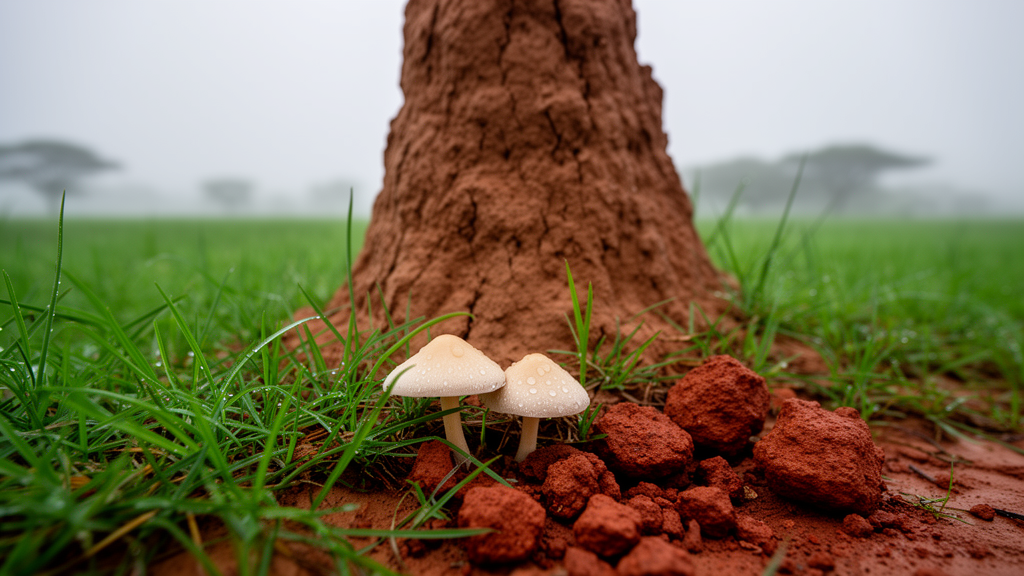
The two new species, named Micropsalliota latiumbonata and Micropsalliota striata, were identified through a combination of careful morphological study and multigene DNA phylogenetics. Both belong to what researchers call Clade megaspora, a well-supported evolutionary lineage within the genus. Before this study, only a single Micropsalliota species, M. ventricocystidiata, had ever been reported from Oman.
Micropsalliota latiumbonata is a very small mushroom, with caps measuring just 10 to 18 millimeters across. Its name refers to its broadly umbonate cap center, a raised disc that crowns a surface covered in reddish-brown to dark reddish-brown fibrils arranged in recurved squamules. The species fruits gregariously on the soil of termite mounds built by the termite Macrotermes subhyalinus, which constructs large earthen structures across the Dhofar landscape.
Its basidiospores measure 6.0 to 7.0 by 4.0 to 4.5 micrometers, broadly fusiform with a truncate apex, and the fungus lacks clamp connections in all tissues. Micropsalliota striata, by contrast, bears an acute papillate cap disc rather than a broad umbo, and its cap margins are finely striate and appendiculate, giving the species its name. Its fibrils are appressed and pinkish to light brown, sparser toward the margins than the dense, recurved fibrils of its new congener.
Its basidiospores are slightly larger, at 6.5 to 7.5 by 3.7 to 4.1 micrometers, oblong to broadly fusiform in face view. The fieldwork behind the discovery took place in August and September 2025 at three sites near Salalah: Ain Athum, Ashwur, and Qashrub. The researchers photographed the fruiting bodies in their natural habitat, recorded macromorphological features including size, shape, and color according to Munsell Soil Color Charts, and then dried the specimens at 45 degrees Celsius in a fruit dehydrator before sealing them in zipper bags and storing them at minus 80 degrees Celsius for two weeks to eliminate any insect eggs or larvae.
The preserved materials were deposited in the Fungal Collections at the Center for Environmental Studies and Research at Sultan Qaboos University in Oman, establishing permanent reference vouchers for the new taxa. Microscopic examination followed standard taxonomic protocols. Thin hand-cut sections from the pileus covering, the lamellae, and the stipe were mounted in 5 percent aqueous potassium hydroxide and stained with 1 percent Congo red to improve contrast.
Using a Nikon ECLIPSE Ni-U light microscope, the team measured spores, basidia, cheilocystidia, pleurocystidia, caulocystidia, and the structure of the pileipellis. Spore dimensions were reported with rigorous notation: for M. latiumbonata, 141 spores were measured across two basidiomata from two collections, with the range capturing at least 90 percent of observations and extreme values noted separately. The length-to-width ratio, expressed as the Q value, averaged 1.6 for M. latiumbonata and 1.7 for M. striata, quantifying the elongated proportions of the spores.
Sequencing produced new accessions for both species, including five collections of M. latiumbonata and one of M. striata. In BLAST similarity searches, the ITS sequence of M. latiumbonata showed its closest match, at 96.56 percent, to an undescribed Micropsalliota specimen from Oman, and 95.01 percent to M. appendiculata from Vietnam. The phylogenetic analysis assembled a combined dataset of ITS, 28S, rpb2, and tef1-alpha sequences spanning 112 specimens: 109 Micropsalliota samples representing 55 named species plus one unnamed species, and three outgroup taxa from the subfamily Agaricoideae, namely Agaricus arabiensis, Coniolepiota spongodes, and Hymenagaricus wadijarzeezicus.
These outgroups were chosen because they belong to a lineage phylogenetically distinct from Micropsalliota, making them suitable for rooting the tree. The final alignment was 3,310 characters long, comprising 1,875 constant sites, 980 informative sites, and 455 uninformative sites. The team aligned the sequences with MAFFT, refined them in BioEdit and ClustalX, and then ran two complementary tree-building approaches: maximum likelihood analysis in RAxML with 1,000 bootstrap replicates under a GTR+I+G model selected by the corrected Akaike information criterion, and Bayesian inference in MrBayes under a GTR+F+I+G4 model, running four Markov chains for one million generations each.
Both methods produced trees with similar topologies, recovering eleven major clades within Micropsalliota, each with strong to excellent statistical support, defined as bootstrap values of at least 70 percent and Bayesian posterior probabilities of at least 0.95. The two new species grouped together in Clade megaspora with support of 98 percent and 0.97 respectively. Species in this clade share small pilei with fibrillose-squamulose surfaces, brownish fibrils concentrated at the center, more or less umbonate discs, and ellipsoid to amygdaliform basidiospores with apical thickening.
The analysis also clarified the placement of recently described species: M. bispora fell within Clade furfuraceae, M. vulgaris within Clade cortinata, and M. rosea within Clade lateritia, while Clade bifida, the largest in the genus, grew to 26 species with the inclusion of M. pakistanica. Beyond the taxonomy itself, the study highlights an intriguing ecological pattern. Four of the five collections of M. latiumbonata were found fruiting on termite mounds, and the authors note that no Micropsalliota species has previously been recorded from such a substrate.
Termite mounds, rich in moisture and nutrients, have recently yielded four species of the genus Hymenagaricus in Dhofar, and other mushroom genera including Agaricus, Lepiota, Leucocoprinus, Xanthagaricus, Conocybe, and Clitopilus have been encountered on the mounds as well. Whether these fungi are merely opportunistic colonizers of a favorable microhabitat or maintain a deeper ecological association with the termites remains an open question, and the researchers call for further investigation. What is already clear is that the monsoon-fed landscapes of southern Oman, where a single termite species engineers vast mounds across the terrain, harbor a mushroom fauna still being written into the scientific record one species at a time.
Subject of Research: Taxonomy and multigene phylogeny of two new Micropsalliota mushroom species from Dhofar, southern Oman
Article Title: Morphology and multigene phylogeny reveal two new species of Micropsalliota ( Agaricaceae , Basidiomycota ) from Dhofar region, southern Oman
Article References: Al-Nadabi, H., Hussain, S., Al Sidairi, A., Al-Zeidi, K., Al-Raeesi, A., Al-Badi, R., Al-Rashdi, L., Al-Jashmi, J., Velazhahan, R., & Al-Sadi, A. M. (2026). Morphology and multigene phylogeny reveal two new species of Micropsalliota (Agaricaceae, Basidiomycota) from Dhofar region, southern Oman. MycoKeys, 137, 317-336. https://doi.org/10.3897/mycokeys.137.192271
Image Credits: AI Generated
DOI: 10.3897/mycokeys.137.192271
Keywords: Micropsalliota, new species, taxonomy, phylogenetics, Agaricaceae, Oman, Dhofar, mycology, termite mounds, monsoon, ITS, basidiomycetes
News Source: Roger Howard. (October 20, 2026). Research report: Morphology and multigene phylogeny reveal two new species of Micropsalliota ( Agaricaceae , Basidiomycota ) from Dhofar region, southern Oman. Scienmag.