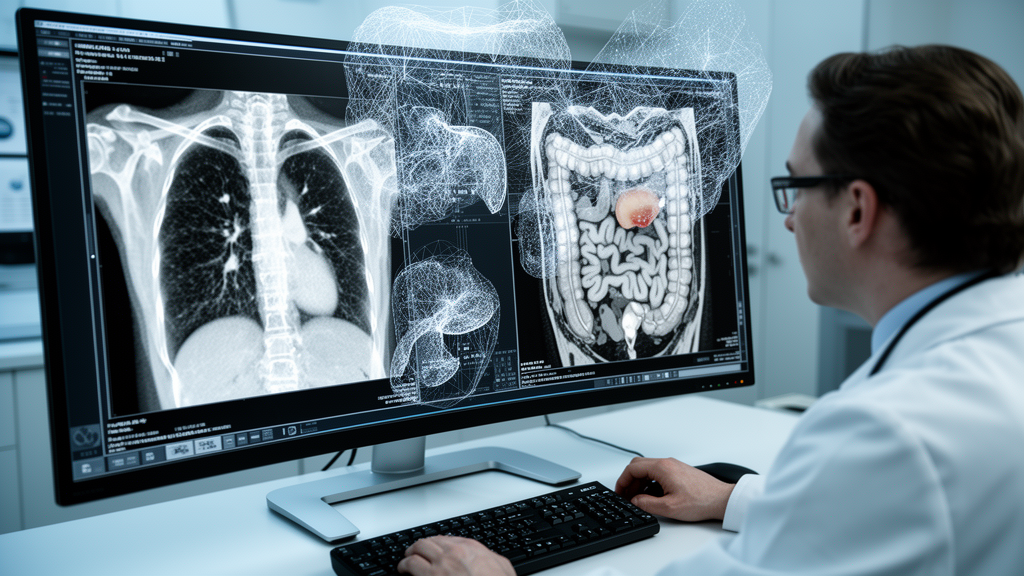
An interpretable hierarchical deep-learning framework classified lung and colon histopathological images with 98.50% accuracy on the LC25000 benchmark and 82.01% accuracy on the independent LungHist700 dataset, according to a study published in Scientific Reports. The computational study addressed a five-class problem involving normal tissue and multiple cancer subtypes, using a coarse-to-fine structure rather than a single flat multiclass model.
Conventional deep-learning approaches face challenges in histopathology because normal and cancerous tissue can share similar features, while cancer morphology can vary substantially within a class. A single model must also distinguish normal tissue from several cancer categories at once, producing a prediction without an explicit breakdown of the decisions involved. The proposed framework first separated normal tissue from cancerous tissue, then directed each image to a specialized classifier for normal-tissue categorization or cancer-subtype identification.
The researchers independently evaluated candidate deep-learning architectures at each stage and selected the model suited to each particular classification task. This design allowed different stages to focus on narrower decisions. The framework was developed and evaluated on LC25000 before being assessed on LungHist700, an independent dataset with different image characteristics and class distributions. The difference between the two accuracy results shows that performance measured on one benchmark did not fully transfer to the separate evaluation setting.
The study also used four interpretability techniques—Grad-CAM, Grad-CAM++, LIME and occlusion sensitivity—to identify image regions contributing to the hierarchical predictions. These tools provided complementary views of the model’s decision process while the framework retained its staged classification structure. The reported results support the combination of strong benchmark performance, task-specific model selection and complementary explanation methods, but the analysis concerns computational image classification rather than patient diagnosis.
The findings remain bounded by the available data and evaluated setting. The study used two histopathology datasets and addressed five tissue categories, and its abstract reports overall accuracy without establishing equivalent performance across broader clinical conditions or patient populations. It also does not show that the highlighted image regions represent medically valid biological features or that the framework would improve diagnostic outcomes. Accordingly, the results demonstrate the potential of hierarchical decision decomposition and explainable deep learning for computer-aided histopathology classification, while further validation would be needed to establish performance in clinical use.
Subject of Research: Explainable hierarchical deep learning for computational lung and colon histopathology classification
Article Title: An interpretable hierarchical deep learning framework for lung and colon cancer detection
Article References: Talukder, M. A., Rafeh, R., Chu, N. H., & Uddin, M. A. (2026). An interpretable hierarchical deep learning framework for lung and colon cancer detection. Scientific Reports. https://doi.org/10.1038/s41598-026-75965-4
Image Credits: AI Generated
DOI: 10.1038/s41598-026-75965-4
Keywords: deep learning, histopathology, lung cancer, colon cancer, explainable AI, medical imaging, computer vision, hierarchical classification, artificial intelligence, image classification, interpretable, hierarchical
News Source: Blake Davidson. (October 20, 2026). An interpretable hierarchical deep learning framework for lung and colon cancer detection. Scienmag.