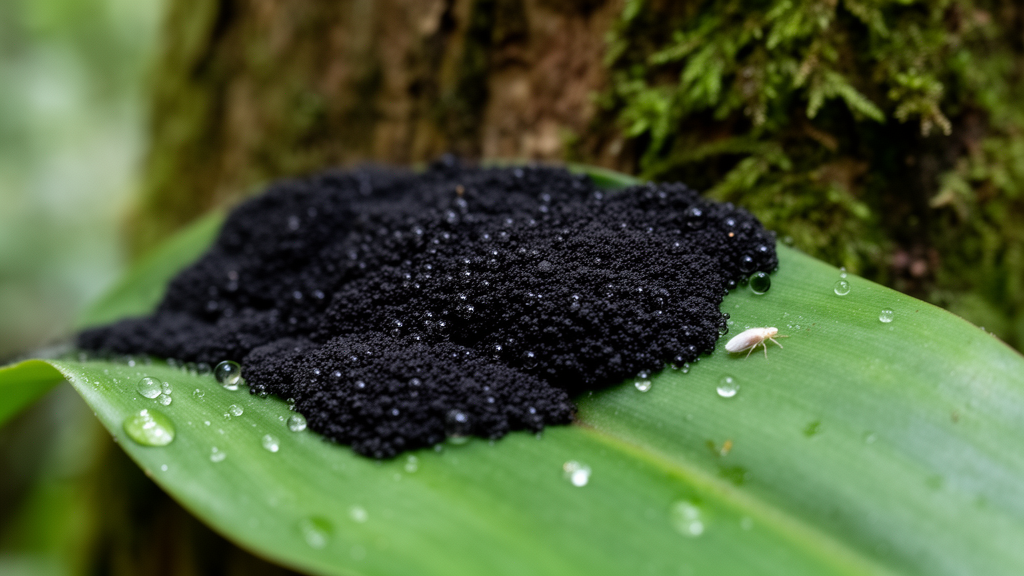
A combined morphological and four-locus phylogenetic study of Capnodiaceae collections from China identified one new genus, eight new species and additional host and geographic records for known taxa. The research focused on sooty mold fungi, an ecological group within Ascomycota whose members commonly form dark, superficial mycelial layers on plant surfaces, often developing on honeydew deposited by sap-sucking insects.
The researchers collected infected leaves from Guizhou, Zhejiang, Guangdong and Fujian provinces between 2022 and 2025, predominantly in Guizhou. Sampling took place in public parks, natural scenic areas, botanical gardens and primeval forests. They examined 38 newly collected strains associated with 36 host plant taxa from 17 genera and 16 families. Single conidia were isolated and maintained on potato dextrose agar, after which colony and microscopic characteristics were recorded.
Molecular analyses used the internal transcribed spacer region including 5.8S rDNA, the large subunit nuclear ribosomal DNA region, the translation elongation factor 1-alpha gene and the RNA polymerase II second largest subunit gene. The aligned loci were concatenated into a 3,002-character dataset containing 93 strains. Maximum-likelihood and Bayesian-inference analyses produced congruent trees that resolved nine represented generic lineages: Conidiocarpus, Phragmocapnias, Hyphopolychaeton, Capnodium, Hyphocapnodia, Polychaeton, Chaetocapnodium, Heteroconium and Leptoxyphium. Hyphocapnodia and Heteroconium were each represented by only one sequence, limiting sampling within those lineages.
The analyses supported the establishment of the genus Hyphopolychaeton as an independent lineage closely related to Conidiocarpus and Phragmocapnias. Its type species, H. duyunense, was accompanied by two additional species, H. cengongense and H. maolanense. The genus has a dark superficial thallus and pycnidial conidiomata with an ellipsoidal conidiogenous region at the apex and no distinct long neck. The three species were separated through their phylogenetic placements and stable morphological differences rather than through a single character.
Three new species were recognized in Conidiocarpus. The type specimen of C. luodianense was collected from Citrus maxima in Luodian County, while additional Iris and Gardenia material was reported from Guizhou without a more specific county location in the collection table. C. bijieense was represented by two strains from Ficus in Bijie City, and C. tainingense was collected from Camellia in Taining County, Fujian Province. The latter lineage included several previously unnamed Conidiocarpus strains that were not re-examined morphologically in the present study.
The study also described Polychaeton citruscola from Citrus maxima in Jiangkou County, Guizhou, and Leptoxyphium chishuiense from two strains, one collected from Alsophila in Chishui City, Guizhou, and the other from Maling bamboo in Zhejiang Province. The two L. chishuiense strains formed a strongly supported lineage, although unnamed Leptoxyphium lineages near the species remained unresolved. Sequence data were unavailable for some strains or individual loci, and repeated attempts to amplify rpb2 in P. citruscola were unsuccessful.
The collections also expanded documented host and geographic records. Conidiocarpus cinnamomi was recorded in Guizhou from Forsythia suspensa, Eriobotrya, an unidentified Lauraceae member, Viburnum and Phyllostachys, while C. caucasicus was newly reported from Guizhou on Viburnum utile, Citrus maxima and Osmanthus. Two Chinese strains of C. guilanensis from Rubus lambertianus and Ficus clustered with the named reference strain and represented a new country record. Capnodium neocoffeicola from Ficus and L. fumago from Maling bamboo likewise represented first records for China.
Host association was documented but not used as the primary criterion for species delimitation. Some taxa occurred on multiple hosts, including C. cinnamomi, C. caucasicus, H. duyunense and H. cengongense. Host identity was assessed from plant morphology and, where possible, partial rbcL sequences; 14 host species yielded reliable rbcL data, while other identifications relied mainly on morphology. The observations therefore describe associations within the sampled material and do not establish the full host range or regional diversity of the family.
The study found that the position and structure of the conidiogenous region were broadly consistent with major phylogenetic lineages: it was typically upper-middle in Conidiocarpus, median to lower in Capnodium, apical and cupulate in Leptoxyphium, and apical and ellipsoidal without a long neck in Hyphopolychaeton. By contrast, small dimensional differences were treated cautiously when they lacked corresponding molecular divergence, and such differences were interpreted as intraspecific variation in C. cinnamomi, C. caucasicus and C. guilanensis. Overall, the four-locus framework improved discrimination among several close lineages, particularly where ribosomal regions were highly conserved, but conclusions still depended on available sequences, authenticated reference material and direct morphological comparisons. The findings expand the recognized taxonomic diversity and reference dataset for Capnodiaceae in China without establishing the family’s full diversity or resolving every closely related lineage.
Subject of Research: Taxonomic and phylogenetic study of Capnodiaceae sooty mold fungi collected in China
Article Title: Morphology and multilocus phylogeny illuminate novel taxa in Capnodiaceae ( Ascomycota , Dothideomycetes , Capnodiales )
Article References: Sun, J., Liu, Y., Chen, T., Tarafder, E., Hongsanan, S., Chen, S., Norphanphoun, C., Deng, X., Feng, Y., Yang, T., Karunarathna, S. C., & Zeng, X. (2026). Morphology and multilocus phylogeny illuminate novel taxa in Capnodiaceae (Ascomycota, Dothideomycetes, Capnodiales). IMA Fungus, 17, Article e188051. https://doi.org/10.3897/imafungus.17.188051
Image Credits: AI Generated
DOI: 10.3897/imafungus.17.188051
Keywords: Capnodiaceae, sooty mold fungi, fungal taxonomy, multilocus phylogeny, morphology, China, new species, Hyphopolychaeton, Conidiocarpus, Leptoxyphium, multilocus, phylogeny
News Source: Roger Howard. (October 20, 2026). Four-locus phylogeny of Chinese sooty molds identifies one new genus and eight species. Scienmag.