Credit: Salk Institute
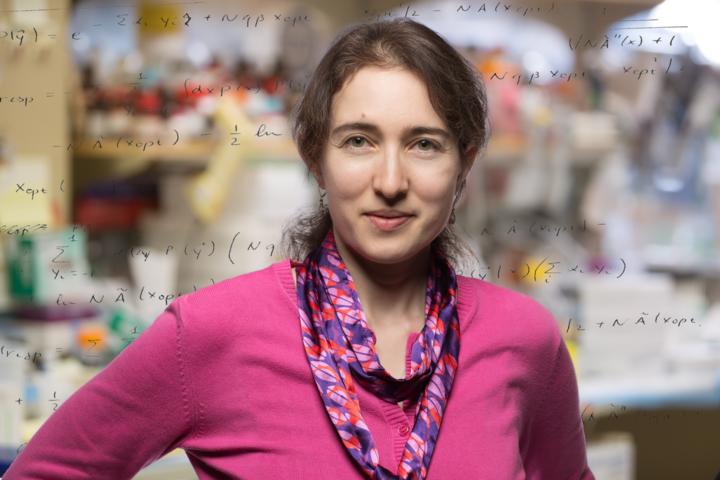
LA JOLLA–(September 6, 2017) Salk Associate Professor Tatyana Sharpee has been awarded a grant of approximately $950,000 over 4 years by the National Science Foundation to study how the brain processes complex sounds. This grant is part of a multi-national project together with groups in France and Israel.
"Tatyana's computational approach and modeling is at the cutting edge of neurobiology research," says Salk President Elizabeth Blackburn. "This award will allow her to continue to make important discoveries about how the brain processes sounds and test theories about how different types of neurons work together. Such work could inform better ways to treat hearing loss or improve speech-recognition technologies."
Sharpee, who is a member of Salk's Computational Neurobiology Laboratory, seeks to develop a unifying theory of "biological control" to understand the universal principles of behavior. Specifically, she is uncovering how animals sense and adapt to their environment as well as make predictions and decisions. To do this, she applies mathematical strategies–like statistics and probability models–to chart the principles by which the brain's billions of neurons exchange energy and information.
"This grant represents a tremendous opportunity to solve the mysteries of auditory processing by combining electrical recordings from the brain, simulations of large scale neural circuits, and statistical analysis of both model and real responses to understand how different types of neurons in the auditory cortex represent naturalistic sounds," says Sharpee. "I could not be more excited about it."
The grant brings together three groups, one experimental and two computational, to develop models based on known properties of neural networks to describe how different types of neurons cooperate to represent sounds. In addition to deepening our understanding of auditory perception, the researchers from Salk, Hebrew University in Jerusalem and Paris-Descartes University hope to gain insights into general principles of cooperation between neurons within a single neural network.
"The work Dr. Sharpee and her colleagues are doing is really exciting and difficult," says Kenneth Whang, NSF program manager, Information & Intelligent Systems division in the directorate for Computer & Information Science & Engineering. "They are bringing together computational models of what a brain network can accomplish with the mechanisms underlying those processes. This is critically important for understanding how large numbers of neurons work together to power our perceptions and other cognitive functions."
The research has implications for understanding representation of signals in other senses (vision, touch) as well as the general principles of neural coding in the brain, and offers a number of potential practical applications, including the design of improved hearing aids and artificial speech recognition systems.
Additionally, because an altered balance between types of neurons has been implicated in a number of attention deficits and psychiatric disorders, including autism and schizophrenia, the project could also reveal new ways of treating those diseases.
The grant also includes an outreach component that will involve music and speech perception demonstrations for K-12 students and exhibitions.
###
About the Salk Institute for Biological Studies:
Every cure has a starting point. The Salk Institute embodies Jonas Salk's mission to dare to make dreams into reality. Its internationally renowned and award-winning scientists explore the very foundations of life, seeking new understandings in neuroscience, genetics, immunology, plant biology and more. The Institute is an independent nonprofit organization and architectural landmark: small by choice, intimate by nature and fearless in the face of any challenge. Be it cancer or Alzheimer's, aging or diabetes, Salk is where cures begin. Learn more at:
Media Contact
Salk Communications
[email protected]
858-453-4100
@salkinstitute
Original Source
https://www.salk.edu/news-release/salk-computational-neurobiologist-receives-nsf-grant-study-brain-processes-sound/