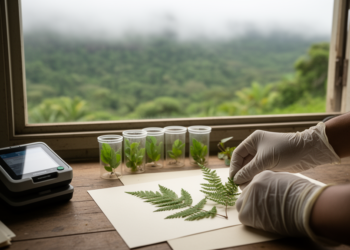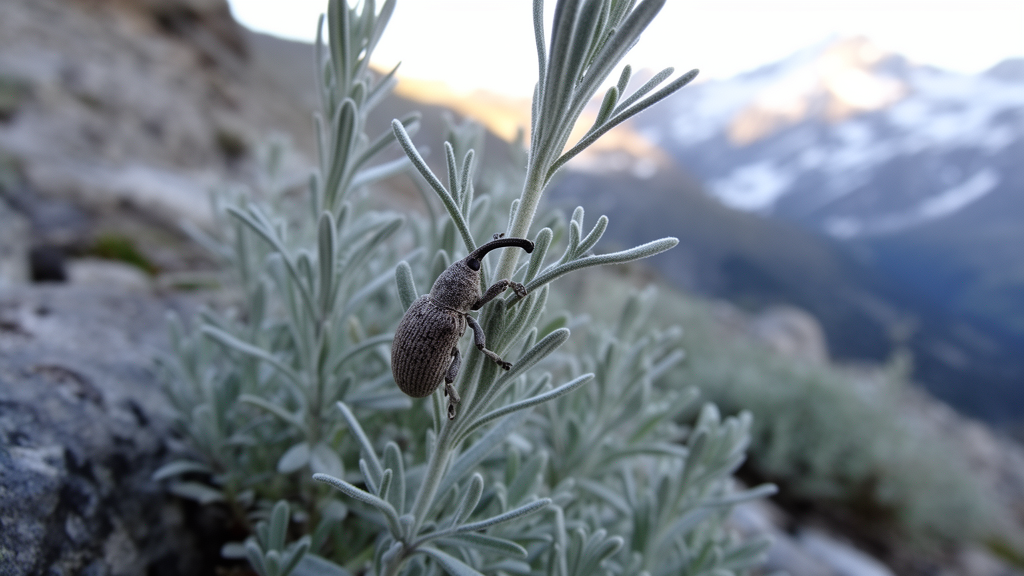
A targeted field study around Zermatt, Switzerland, documented for the first time the development of the rare steppe weevil Adosomus roridus in wormwood, Artemisia absinthium. The observations, made during an expedition on 15 August 2024, included an egg, young larvae, a pupa and newly emerged adults associated with the plant’s roots, confirming a host relationship previously inferred from older records.
This was a field-observation study combined with a review of museum collections and published records. The authors examined specimens held by several Swiss natural-history institutions and private collections, then surveyed two dry, south-facing slopes near Zermatt. The first site, at 1,600 metres above sea level, lay just above the railway station; the second, the Ze Bäche site, was at 1,730 metres. Both slopes were dry, well exposed to sunlight and covered with rock-steppe vegetation.
A. roridus is the only European species in its genus and is regarded as a rare, highly localized steppe element with a range extending from southern Sweden through central Europe to the Caucasus and Kazakhstan. In central Europe it is found only at a small number of local sites, especially in the east. Its biology became clearer only recently: a study published in 2015 documented oligophagy within the daisy family and successful rearing on Tanacetum vulgare, with Artemisia vulgaris considered a less certain host.
The review of historical evidence showed that Swiss records are very sparse. A specimen from Schaffhausen, cited in 1883, is preserved in the Museum zu Allerheiligen, while a specimen collected in Zermatt in August 1884 is held by the Natural History Museum of Bern. Later sources repeatedly listed the insect as very rare. A 1990 record near Bargen, south of Schaffhausen, described a dry, nutrient-poor limestone habitat threatened by scrub encroachment; the exact location was 47°47′06.04″ N, 8°36′44.05″ E.
Zermatt supplied the only continuously supported Swiss records over roughly 140 years. Preserved or documented examples came from 1884, 1916, 1931, 1935, 1938, 1957, 1982 and 2023. Two 1982 specimens recorded the site as 1,670 metres above sea level in “prairie artemisia.” The most recent of these series was collected above the Zermatt railway station at Balmen on 20 July 2023, at 46°01′48.19″ N, 7°45′02.60″ E. Other Swiss records included a single specimen from Mergoscia in Ticino in 1973, a report from the Lötschberg southern ramp without surviving voucher specimens, and a record from the Fully area in 2005.
Wormwood was well represented at both surveyed slopes, especially along paths, around deteriorating dry-stone walls and in areas affected by landslides. Adult weevils were found at these disturbed patches, including 12 in total. Because the insects exceed 15 millimetres in length but conceal themselves within dense vegetation, the authors cautioned that they can readily be overlooked. One pupa collected in the field was kept and produced an adult two days later, allowing the study team to observe its subsequent development and behaviour in captivity.
Excavated wormwood plants provided evidence of the previously unconfirmed developmental stages. The first large plants examined contained egg-laying cavities at the root collar below the soil surface, together with one or two young larvae measuring 6–8 millimetres in each root collar or main root. Later plants contained pupae in the upper section of the main root. One pupa was parasitized: a parasitoid larva, identified only as belonging to either Braconidae or Ichneumonidae, had eaten the beetle from within the fully developed pupa and then formed its own pupal case.
Freshly emerged adults were initially bright orange but developed the species’ typical dark coloration with pale scale spots within hours. The beetle began feeding on offered wormwood leaves four days after emergence. Captured adults showed greater activity during mornings and forenoons than during afternoons, evenings or nights. They fed on the leaves and stems of A. absinthium, and multiple copulations were observed. Three apparently older beetles, identified by sparse scaling and partly missing tarsal segments, died before mid-September; the authors considered them likely to have been previous-year adults.
The observations establish Artemisia absinthium as a confirmed host for A. roridus and document the species in dry rock-steppe habitat at elevations approaching 1,700 metres. Because eggs, larvae and newly emerged adults were found in late summer, the authors inferred that development at Zermatt lasts at least two years. They further proposed that facultative double overwintering can occur, first in the egg stage and then as an adult after late-summer emergence, while egg-laying may extend from autumn into early spring. These are interpretations based on limited field and captive observations rather than a continuous multi-year monitoring study.
Subject of Research: First confirmed field development of Adosomus roridus in Artemisia absinthium in Switzerland
Article Title: Das Steppenelement Adosomus roridus (Pallas, 1781) in der Schweiz und erste Dokumentation der Entwicklung in Artemisia absinthium L. ( Coleoptera , Curculionidae )
Article References: Germann, C., & Wartmann, S. (2024). Das Steppenelement Adosomus roridus (Pallas, 1781) in der Schweiz und erste Dokumentation der Entwicklung in Artemisia absinthium L. (Coleoptera, Curculionidae). Alpine Entomology, 8, 147-151. https://doi.org/10.3897/alpento.8.137395
Image Credits: AI Generated
Keywords: Adosomus roridus, Artemisia absinthium, Swiss weevil, field entomology, host plant, larval development, Zermatt, museum records, rock-steppe habitat, parasitoid, Steppenelement, Adosomus
News Source: Gavin Prescott. (October 20, 2026). Field study documents first confirmed development of a rare weevil in Swiss wormwood. Scienmag.