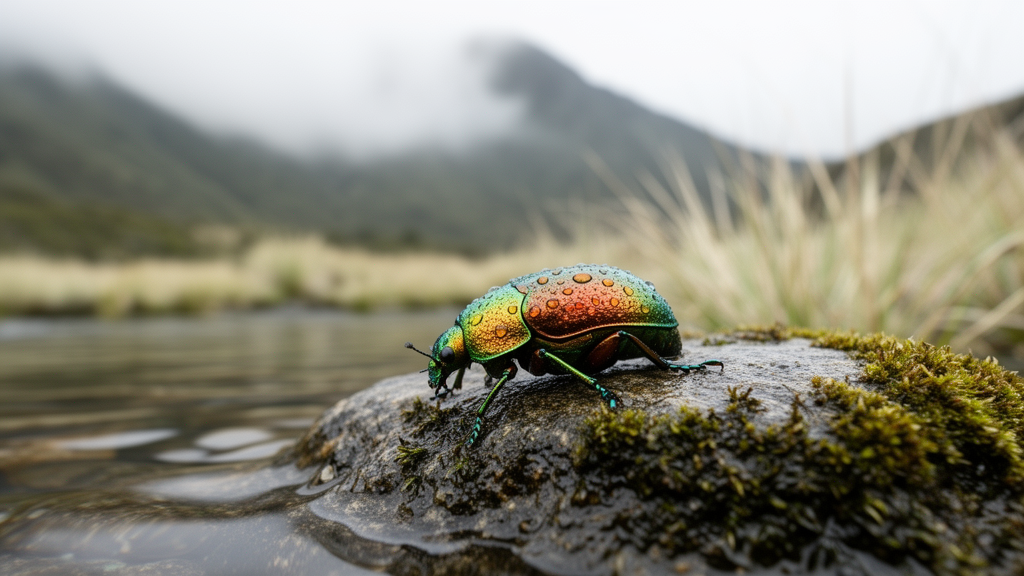
A taxonomic review of the diving beetle genus Limbodessus in New Guinea describes eight new species, bringing the number known from the region to 13. The work revises the genus’s montane-to-alpine fauna, summarizes documented habitats and distributions, and provides a modified identification key. Seven of the new species are associated with high-altitude Central Highlands localities, while L. paniai was described from a lower site at 1,900 metres above sea level.
The genus contains 81 described species, mostly in the Australasian region, with one species also reaching Japan. Earlier studies treated five New Guinean species, and L. moni, described in 2023 from the Grasberg Mine area, represented the highest recorded altitude for a diving beetle in New Guinea, at approximately 3,970 metres above sea level. The review examines surface-dwelling species from Papua, West Papua and Papua New Guinea, including newly collected and previously deposited specimens held in several institutional collections.
Researchers examined specimens with a Leica M205C dissecting microscope at magnifications from 10 to 160 times. Measurements included total body length, total body length without the head and maximum body width. Because the diagnoses rely primarily on male genitalia and female antennomeres, dried specimens were softened in hot water for 10 minutes before the median lobe of the aedeagus and the parameres were extracted, disarticulated and mounted alongside the specimens. Habit and genital structures were photographed with a Canon EOS R camera, and image stacks were assembled with Helicon Focus 4.77.
Among the new species, Limbodessus aipo has a total body length of 1.55–1.70 mm and was described from the Aipomek–Langda area and the valley below Mount Orom, where it inhabits small puddles in alpine meadows. L. aldente is known from three specimens collected in mossy puddles in the Lake Habbema area. L. elit was described from Mount Elit, including its very shallow margins around puddles and pools in alpine grasslands.
The blackish L. habbema measures 2.25–2.8 mm in total length and is known only from the Lake Habbema area, where it occurs in small puddles in alpine meadows. L. juliana was described from the Mount Juliana and Aipomek area, including the type locality in the Sab-me Valley, while L. wilhelmina is known from the Lake Habbema area. The medium-sized L. konoensis, with a total body length of 2.35–2.50 mm, has a documented range that includes the valley below Mount Orom, Mount Elit, Lake Habbema and the Kali Oue Valley around Mount Trikora, also known as Mount Wilhelmina.
Specimen series differed substantially among the new taxa. The largest series of paratypes comprised 722 specimens for L. konoensis, followed by 632 for L. wilhelmina and 573 for L. juliana. These large series do not constitute population estimates, but document the material examined. The smaller alpine species were distinguished through combinations of body size, coloration, surface sculpture, female antennal structure, and the form of the male median lobe and parameres.
L. paniai, based on one male and one female from Enarotali at Lake Paniai, was recorded at 1,900 metres above sea level. Both specimens were collected in very shallow water among sun-exposed floating mats of grasses at the lake’s edge. Like L. baliem, the new species has a yellowish dorsal surface without distinct dark markings on the elytra, but it is smaller: total body length is 2.05–2.10 mm, compared with 2.6–3.0 mm for L. baliem. The two species can also be separated by the form of the median lobe and parameres.
The review also examined five previously described species. L. compactus is widespread in the Australasian realm and occurs especially in the New Guinean lowlands, although it is absent from the Baliem Valley and from elevations above 2,000 metres. L. alexanderi is known from 3,000 metres north of Sugapa, L. baliem from the Baliem Valley, and L. moni from two localities in the Carstenz Pyramid area between 3,555 and 3,970 metres. L. skalei was previously known from Waigeo Island and is newly recorded from the Kebar Valley at 596 metres.
The modified key separates New Guinean species using characters including coloration, body size, elytral plicae, female antennomeres, the median lobe and the parameres. The evidence supports a species-level taxonomic and geographic revision rather than a population study, long-term ecological experiment or climate analysis. Habitat descriptions are based on collection records and observations at particular sites, while several new species remain known only from their type localities or nearby areas. The authors note that extensive, insufficiently sampled highlands, particularly in eastern Papua New Guinea, may contain additional undescribed species and that further fieldwork could improve knowledge of this fauna.
Subject of Research: Taxonomic revision and habitat distribution of New Guinean Limbodessus diving beetles
Article Title: A review of Limbodessus Guignot, 1939 from New Guinea, with description of eight new tropical-alpine species ( Coleoptera , Dytiscidae , Bidessini )
Article References: Balke, M., Villastrigo, A., Hájek, J., Surbakti, S., Panjaitan, R., & Hendrich, L. (2025). A review of Limbodessus Guignot, 1939 from New Guinea, with description of eight new tropical-alpine species (Coleoptera, Dytiscidae, Bidessini). Alpine Entomology, 9, 5-28. https://doi.org/10.3897/alpento.9.147831
Image Credits: AI Generated
Keywords: Limbodessus, Dytiscidae, Bidessini, New Guinea, taxonomic revision, alpine beetles, aquatic insects, species description, high-altitude fauna, review, Guignot, Guinea
News Source: Gavin Prescott. (October 20, 2026). Taxonomic review describes eight new Limbodessus diving beetle species from New Guinea. Scienmag.