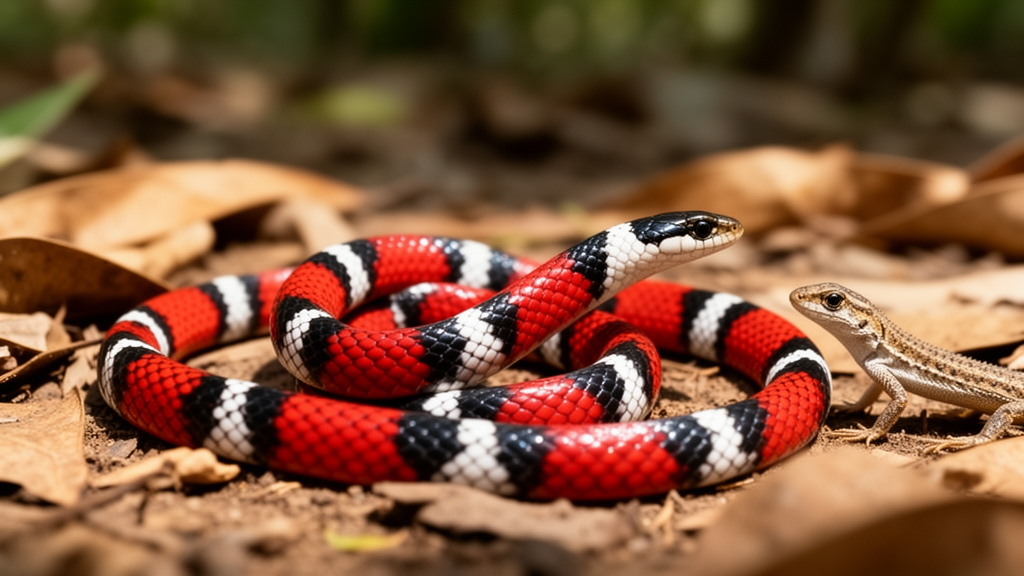
A field study of 48 Brazilian false coral snake specimens, or Oxyrhopus trigeminus, found identifiable prey remains in 10 stomachs and 12 intestines, with all identifiable stomach contents consisting of lizards or lizard parts. The research, combined with a review of 14 published studies, also recorded an incidental 3 mm fragment of blue plastic rope in the intestine of one snake from Rio Grande do Norte.
The study examined the feeding ecology of a terrestrial, generally nocturnal and crepuscular snake in the Caatinga, a semiarid biome in northeastern Brazil. The authors searched Google Scholar, Scopus and SciELO for the exact scientific name and diet-related terms in English, Portuguese and Spanish. No filters were imposed for date, language or document type, and all retrieved records were manually screened for dietary or predation information.
The review identified six studies from the Caatinga, three from the Atlantic Forest, three from the Cerrado and two from transition zones involving more than one biome. The search did not locate dietary studies for populations in the Amazon or Pantanal, although the authors state that O. trigeminus is recorded in states encompassing portions of those biomes. The review therefore documents a gap in available diet data rather than establishing that dietary studies or confirmed biome-level populations are absent throughout those regions.
Across the reviewed records, reptiles accounted for 70% of the diet, mammals for 25% and birds for 5%. Proportions differed among environments. Reviewed Atlantic Forest records included only reptiles, while records from the transition zone between the Atlantic Forest, Cerrado and Caatinga included birds, mammals and reptiles in equal proportions, at 33.3% each. In the Cerrado, reptiles and mammals each represented 50%, whereas the Caatinga records comprised 78% reptiles and 22% mammals in the results table and were described in the discussion as approximately 75% and 25%, respectively. These geographic contrasts do not establish changes over time or causal relationships with habitat conditions.
For the new observations, 41 dead specimens were donated between February 2020 and May 2024 by companies clearing vegetation for wind farms, photovoltaic plants and electrical transmission networks in Rio Grande do Norte. Seven additional animals were roadkills collected during monitoring under a Brazilian environmental collection permit. Roadkills were included only when found within one hour of death, before the onset of livor mortis, and when their condition permitted reliable examination. The researchers measured body size, including snout–vent length, tail length and mass, and dissected the specimens to identify gastrointestinal contents as precisely as possible.
Among the 48 snakes, 15 were classified as females, 17 as males and 16 as juveniles. Ten specimens, or 20.8%, had identifiable stomach contents: eight contained whole lizards and two contained isolated tails. Identified prey included two Tropidurus hispidus, one unidentified Tropidurus tail, two Ameivula ocellifera, one A. ocellifera tail, two Brasiliscincus heathi and two Micrablepharus maximiliani. The M. maximiliani record was the first reported occurrence of that species among the documented prey of O. trigeminus.
Twelve specimens, or 25%, had identifiable intestinal prey remains, including scales, skin, limbs and eggs attributable to the lizard families Teiidae and Tropiduridae. One snake contained three lizard eggs and Tropiduridae scales. The preserved condition and size of the calcareous eggs supported the authors’ interpretation that they had been ingested deliberately. The observed anteroposterior, or head-first, ingestion of lizards was associated with the species’ rear-fanged dentition, which can deliver venom during swallowing and may reduce the likelihood of prey escape. This pattern was also reported in a previously documented case involving the vine snake Oxybelis aeneus.
The plastic finding came from a single female specimen collected in Assu. Its intestine contained a wasp, five ant heads, Tropiduridae limbs and a 3 mm piece of blue rope made from horizontally aligned nylon filaments that was undergoing disintegration. The authors identified two possible routes: the material may have entered through a consumed Tropiduridae lizard, whose gastrointestinal contents can include insects, or the snake may have swallowed it accidentally or deliberately while capturing prey. The observation demonstrates that anthropogenic material was present in this food web, but the single case does not establish how frequently plastic is ingested or its population-level effects.
The authors note that the Caatinga is affected by agricultural and livestock expansion, renewable-energy development and associated habitat fragmentation. They also cite evidence that two frequently recorded prey species, T. hispidus and A. ocellifera, tolerate human-modified environments and can persist in urbanized and semi-natural areas. They suggest that such tolerance may allow the generalist predator to persist where only disturbance-tolerant prey remain, while dominance by a few resilient species may simplify food webs. Because the study was a post-mortem observational analysis combined with a literature review, and the plastic observation involved one specimen, it cannot determine causal effects of habitat change, feeding frequency in living snakes or the conservation status of O. trigeminus.
Subject of Research: Dietary composition and incidental plastic ingestion of the Brazilian false coral snake in the Caatinga
Article Title: Dietary composition of Oxyrhopus trigeminus in the Brazilian semiarid: new records, a literature review, and an incidental case of plastic ingestion
Article References: de Oliveira Cabral, S., dos Santos, R., Queiros, A., Lima, J., & Calabuig, C. (2025). Dietary composition of Oxyrhopus trigeminus in the Brazilian semiarid: new records, a literature review, and an incidental case of plastic ingestion. Neotropical Biology and Conservation, 20(2), 149-164. https://doi.org/10.3897/neotropical.20.e151337
Image Credits: AI Generated
DOI: 10.3897/neotropical.20.e151337
Keywords: Oxyrhopus trigeminus, Caatinga, dietary ecology, lizard predation, plastic ingestion, Rio Grande do Norte, Brazilian semiarid, wildlife feeding, Dietary, composition, Oxyrhopus, trigeminus
News Source: Daisy Hatcher. (October 20, 2026). Caatinga snake study finds lizard-heavy diet and one plastic fragment in Brazilian false coral snake. Scienmag.