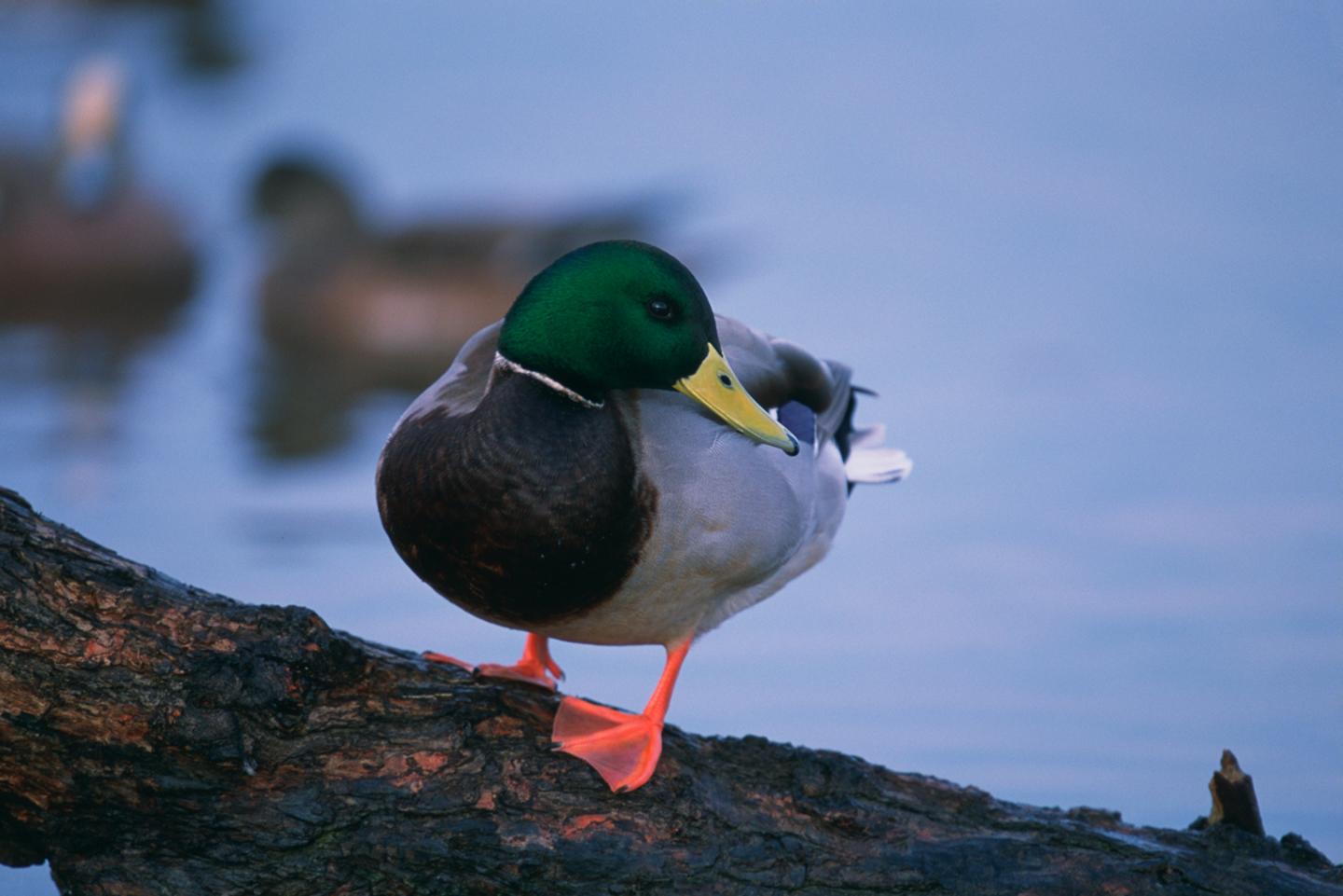
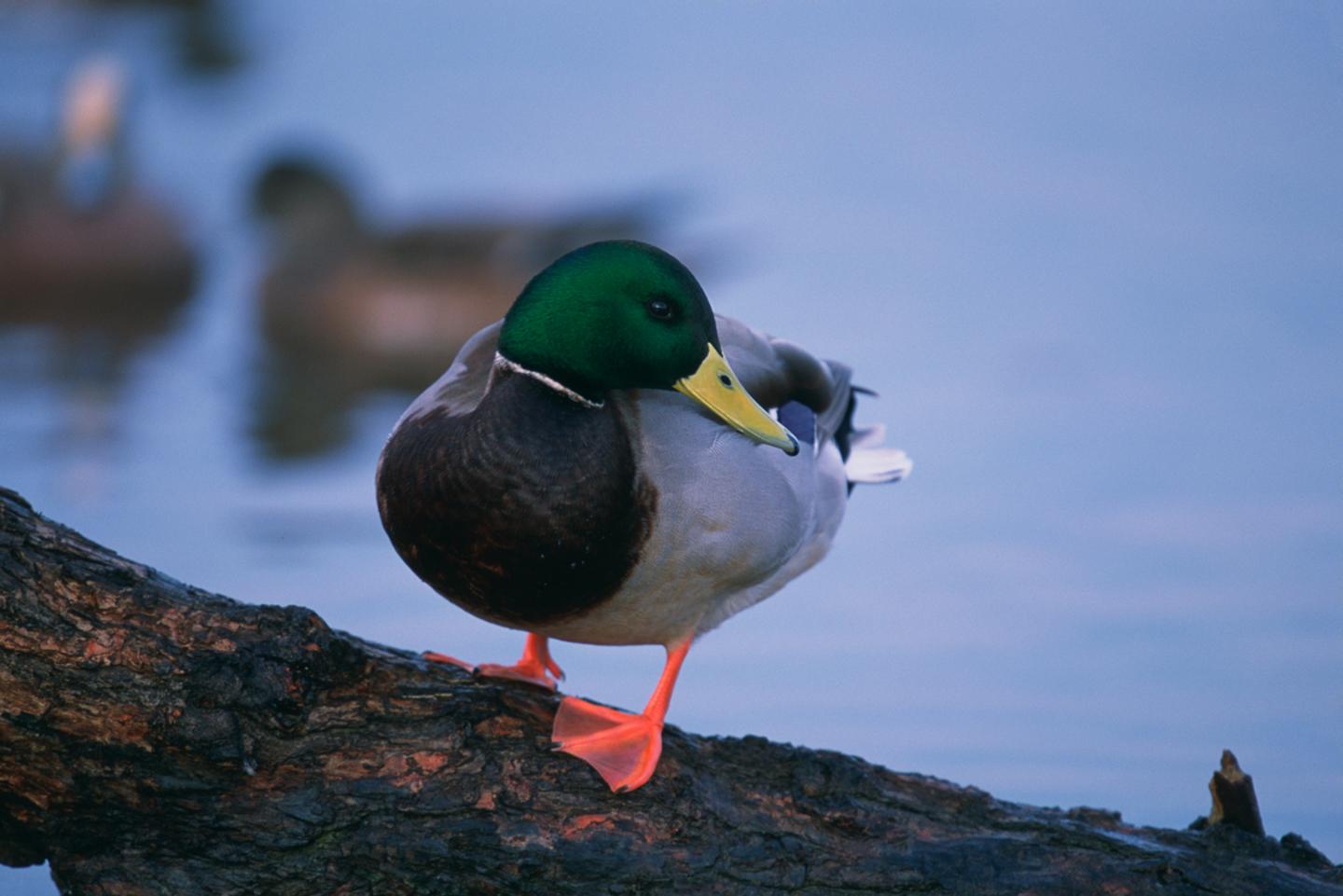
Credit: Gary Kramer/USFWS (public domain)
Mallards — the familiar green-headed ducks of city parks — are one of a group of closely related waterfowl species, many of which are far less common. Interbreeding with Mallards can threaten the genetic distinctiveness of those other species and cause concern for their conservation. A new study from The Condor: Ornithological Applications investigates hybridization between Mallards and Mottled Ducks, a species specially adapted for life in Gulf Coast marshes, and finds that while hybridization rates are currently low, human activity could cause them to rise in the future.
In Florida, hybridization between domesticated Mallards and Mottled Ducks is a cause for concern, but the degree of hybridization in the western Gulf Coast region is less well known. Louisiana State University's Robert Ford and his colleagues took blood samples from Mottled Ducks captured on the coast of Louisiana in 2011-2014, supplementing them with samples from Mottled Ducks and Mallards from Texas, Alabama, and Mississippi. Analyzing the birds' DNA, they found that the hybridization rate in the western Gulf Coast region is currently only 5-8%, a level lower than what's been documented in Florida. However, that doesn't mean the western Gulf population is completely in the clear.
Currently, the two species have little opportunity to interact in the region during the breeding season; Mottled Ducks nest in coastal marshes, while most Mallards are migratory and breed outside the region. However, the ongoing loss of marsh habitat could cause Mottled Ducks to move into urban and suburban areas, where they will be more likely to encounter resident Mallards. To prevent future problems, Ford and his colleagues recommend ongoing monitoring of hybridization in the region and better protection of coastal marsh habitat.
"The biggest challenge in collecting samples was finding molting Mottled Ducks, which we collected during bird banding operations in the summer. Identifying birds as either Mottled Ducks or Mallards in the summer can be difficult, but most of our banders had years of experience and we did not have many problems," says Ford. "In the future, I would like to see improvements in the methods to identify hybrids, such as more precise techniques that could identify gene combinations unique to hybrids."
"Hybridization between Mottled Ducks and Mallards is a significant conservation concern in the southern U.S.," according to waterfowl expert and Auburn University emeritus professor Gary Hepp, who was not involved in the study. "Ford et al. recommend programs to monitor future changes in hybridization, and a proactive management approach similar to Florida's that controls the number of non-migratory Mallards while prohibiting future releases of game farm Mallards may also be prudent."
###
"Hybridization between Mottled Ducks (Anas fulvigula maculosa) and Mallards (A. platyrhynchos) in the western Gulf Coast region" will be available September 6, 2017, at http://www.bioone.org/doi/abs/10.1650/CONDOR-17-18.1 (issue URL http://www.bioone.org/toc/cond/119/4).
About the journal: The Condor: Ornithological Applications is a peer-reviewed, international journal of ornithology. It began in 1899 as the journal of the Cooper Ornithological Club, a group of ornithologists in California that became the Cooper Ornithological Society, which merged with the American Ornithologists' Union in 2016 to become the American Ornithological Society.
Media Contact
Rebecca Heisman
[email protected]
http://americanornithologypubs.org/