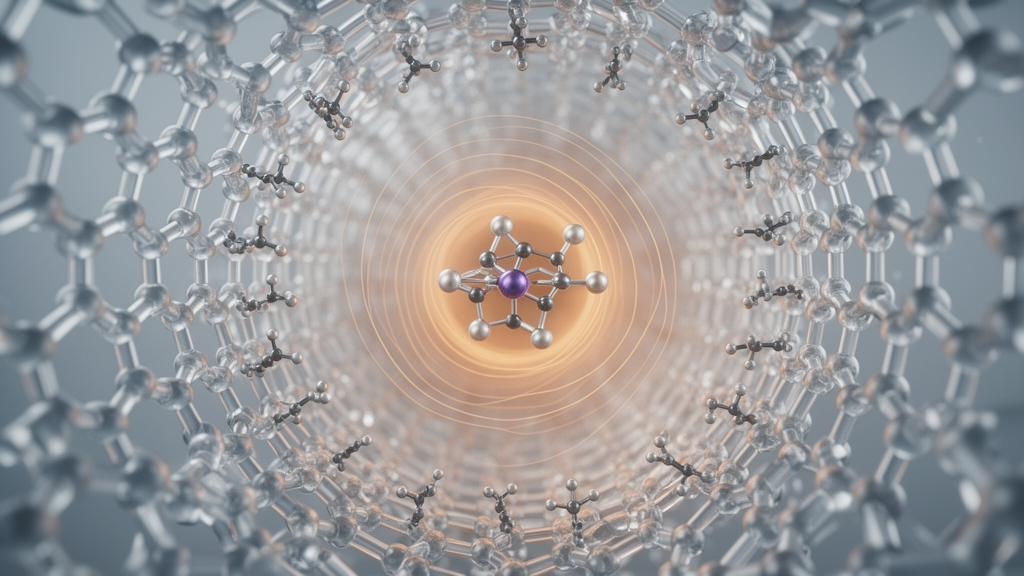
Researchers at Martin Luther University Halle-Wittenberg have developed an analytical method that uses molecular-scale magnetic probes to investigate the chemical forces acting inside the tiny pores of covalent organic frameworks, or COFs. The experimental study, published in the peer-reviewed journal Small, reports that electron spin resonance spectroscopy can distinguish pore environments with different water-attracting and water-repelling properties. The method supplements established techniques by revealing how probes accumulate in the pores, how strongly they are concentrated there, and how they interact with the pore walls.
COFs are porous, crystalline compounds whose regular pores are only a few nanometres across. Their finely structured interiors make them promising for applications such as filtering pollutants from water and supporting chemical reactions, but those applications depend on being able to tune the chemical environment within the pores. Optical methods lack sufficient spatial resolution for such small structures, while conventional nitrogen-adsorption measurements provide limited information about the interactions inside them. The standard nitrogen method measures how much nitrogen is absorbed at approximately minus 196 degrees Celsius. At that temperature, molecular motion is largely frozen, producing a snapshot of uptake without detailed evidence about chemical interactions or pore properties, according to Simona Bassoli and Sebastian Michler of MLU’s Institute of Chemistry.
To test whether a magnetic-probe approach could provide that missing chemical information, the team prepared two COF variants with contrasting pore properties. One contained molecular chains that attract water, while the other carried chains that repel it. Instead of nitrogen, the researchers introduced a special molecular-scale magnetic probe that dissolves in water at room temperature. Within a strong magnetic field, the probes were stimulated with microwaves and transmitted a response signal that could be detected through electron spin resonance spectroscopy. Their basic idea was that interaction with the pore walls would alter this signal, making the probes a sensitive indicator of the surrounding chemical environment.
The measured signals showed not only how many probes became bound inside the pores, but also the concentration at which they accumulated and the type of bond by which they adhered to the pore walls. The probes clearly indicated whether the molecular chains were hydrophilic or hydrophobic and to what extent. This distinction demonstrated that dynamic spin probe exchange can detect meaningful chemical differences between closely related COF structures. The work is an experimental characterization method rather than a demonstration of improved filtration, catalytic performance or another application. The authors also describe the method as complementary to existing analytical approaches because it provides different information about the same material. Further research is needed to determine whether the probes can identify additional material properties and whether the technique can be applied to other porous materials. The study was conducted as part of the BEAM Research Training Group incubator programme, and the research was funded by the German Research Foundation under Graduate Training Group 2670, “BEAM – Beyond Amphiphilicity.”
Subject of Research: Magnetic-probe characterization of chemical environments within covalent organic framework pores
Article Title: New analytical method: What happens inside tiny molecular frameworks?
Article References: New analytical method: What happens inside tiny molecular frameworks?. Original publication (Bibliographic details unavailable.)
Image Credits: AI Generated
DOI: Not provided
Keywords: covalent organic frameworks, electron spin resonance, magnetic probes, porous materials, pore environments, hydrophilic pores, hydrophobic pores, chemical interactions, molecular analysis, materials characterization, analytical, method
News Source: Bethany Barker. (October 20, 2026). Magnetic probes reveal chemical environments inside molecular framework pores. Scienmag.