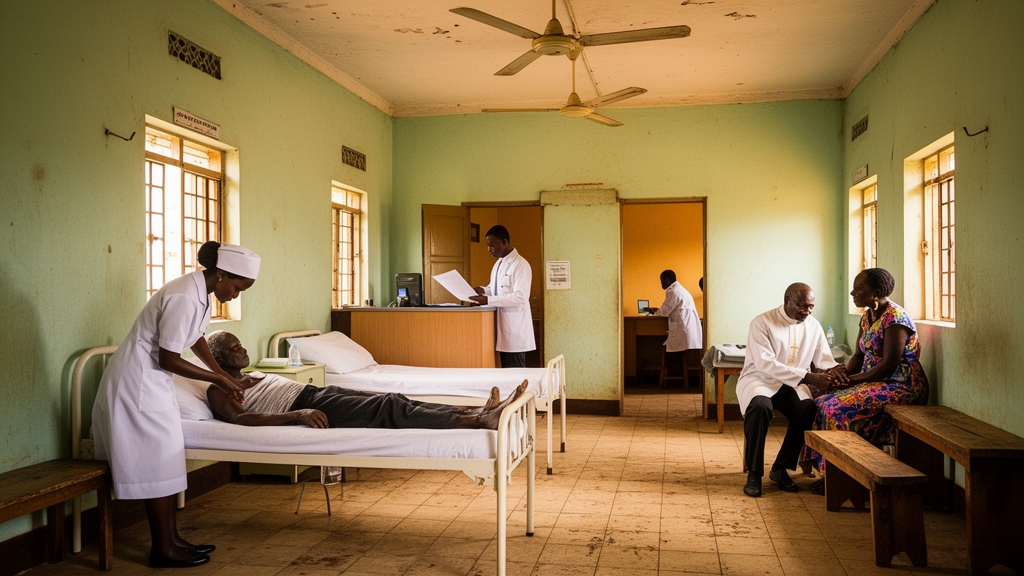
A qualitative study of state–church health partnerships involving the Christian Health Association of Ghana (CHAG) reports that their sustainability depends on both formal government support and locally developed coping and adaptive practices. Participants also described inequities in resource allocation, uncertainty about continued funding and weaknesses in referral coordination as constraints. The study was guided by the Sustainability of Innovation Framework and examined how such partnerships function within Ghana’s public healthcare sector.
Researchers purposively selected CHAG-affiliated facilities in Ghana’s Ashanti, Volta, Bono East and North East regions. They conducted 10 semi-structured interviews with hospital administrators and health service managers. The analysis also drew on policy-relevant documents published from 2013 through 2021, including CHAG annual reports and strategic frameworks, to supplement and triangulate the interview findings. The available abstract does not provide details about participant recruitment procedures, interview questions, analytic coding or measures used to assess triangulation.
The framework organized the analysis around political, organizational, financial, workforce and innovation factors. Participant-reported influences included heavy reliance on government salary support for staff, with 84.6% of CHAG staff reported to be on the government payroll by 2021. Participants expressed insecurity about the possibility of funding withdrawal and identified disparities in resource allocation between CHAG and government facilities. Fragmented referral coordination was another reported constraint. Facility-level responses included contingency funds, revenue-generating innovations and patient-centered care initiatives, which the researchers identified as coping strategies.
One additional theme emerged inductively: faith-based adaptive capacity. Participants described this as mission-driven flexibility used to navigate systemic constraints. The abstract reports that sustainability was shaped not only by formal policy frameworks but also by local responsiveness and adaptive practices at facility level. These findings concern the experiences reported by administrators and managers in the sampled CHAG-affiliated facilities rather than measured changes in service delivery, population health or the durability of partnerships over time.
The abstract concludes that Ghanaian state–church partnerships are sustained through a combination of formal government support and adaptive practices at facility level. It identifies systemic inequities, integration and support for adaptive capacity as areas for strengthening, and presents collaboration as a contribution to debates about health-system strengthening and universal health coverage in resource-constrained settings. Because the evidence summarized here comes from a small qualitative sample in four regions, supported by organization-level documents, the findings do not establish causal effects or population-level outcomes. The publisher’s record describes this as an early version of accepted, open-access research that may undergo further edits before the final Version of Record.
Subject of Research: Qualitative analysis of the sustainability of state–church health partnerships involving CHAG facilities in four regions of Ghana
Article Title: Understanding the enablers, constraints, and sustainability of state–church health partnerships in Ghana: a qualitative study guided by the sustainability of innovation framework
Article References: Amankwah, J. A., Afriyie, E. K., Naab, J. T.-B. M., Egyaim, F., Osafo, E. N. K., Nkansah, R. K. S., Effah-Yeboah, F., Mensah, K. A., & Agyei-Baffour, P. (2026). Understanding the enablers, constraints, and sustainability of state–church health partnerships in Ghana: a qualitative study guided by the sustainability of innovation framework. BMC Health Services Research. https://doi.org/10.1186/s12913-026-15696-4
Image Credits: AI Generated
DOI: 10.1186/s12913-026-15696-4
Keywords: Ghana, state–church health partnerships, Christian Health Association of Ghana, qualitative study, healthcare sustainability, resource allocation, referral coordination, adaptive capacity, government funding, Understanding, enablers, constraints
News Source: Ophelia Keating. (October 20, 2026). Qualitative study identifies enablers and constraints of Ghanaian state–church health partnerships. Scienmag.