• HOME
  • NEWS
  • EXPLORE
    • CAREER
      • Companies
      • Jobs
    • EVENTS
    • iGEM
      • News
      • Team
    • PHOTOS
    • VIDEO
    • WIKI
  • BLOG
  • COMMUNITY
    • FACEBOOK
    • INSTAGRAM
    • TWITTER
Tuesday, October 20, 2026
BIOENGINEER.ORG
No Result
View All Result
  • Login
  • HOME
  • NEWS
  • EXPLORE
    • CAREER
      • Companies
      • Jobs
        • Lecturer
        • PhD Studentship
        • Postdoc
        • Research Assistant
    • EVENTS
    • iGEM
      • News
      • Team
    • PHOTOS
    • VIDEO
    • WIKI
  • BLOG
  • COMMUNITY
    • FACEBOOK
    • INSTAGRAM
    • TWITTER
No Result
View All Result
Bioengineer.org
No Result
View All Result
Home NEWS Science News Technology

Laboratory Fe2O3/Co3O4 particle electrode achieves 93.4% tetracycline removal under optimized conditions

by
October 20, 2026
in Technology
Reading Time: 2 mins read
0
Laboratory Fe2O3/Co3O4 particle electrode achieves 93.4% tetracycline removal under optimized conditions

Alginate Particle Electrode Powers Efficient Tetracycline Breakdown in Water

Share on FacebookShare on TwitterShare on LinkedinShare on RedditShare on Telegram

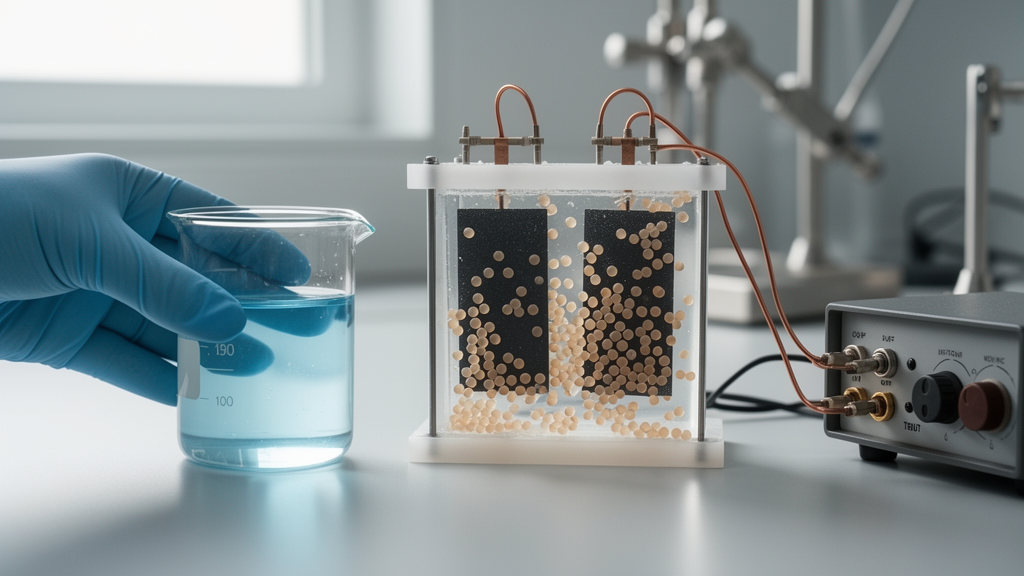
A laboratory study reports that a three-dimensional electrocatalytic system using an Fe2O3/Co3O4-loaded sodium alginate particle electrode removed 93.4% of tetracycline under optimized conditions. The work, summarized in the abstract of a Journal of Materials Science article, focuses on developing an electrode material for treating antibiotic-contaminated water and combines material characterization with mechanistic analysis of tetracycline degradation.

The researchers synthesized the sodium alginate-based particle electrode, designated Fe2O3/Co3O4-PB/SA, and applied it in a three-dimensional electrocatalytic system. According to the abstract, comprehensive characterization confirmed successful fabrication of the material and supported its enhanced electrochemical properties. The reported 93.4% result was obtained under optimized operating conditions, although the available abstract does not identify those conditions or provide the treatment duration, initial tetracycline concentration, reactor configuration, replicate count, or uncertainty estimates.

Mechanistic experiments indicated that hydroxyl radicals played the predominant role in degradation, accounting for 57% of the process. This was a measured contribution within the tested system rather than evidence that hydroxyl radicals act identically under all operating conditions. The researchers also combined liquid chromatography–mass spectrometry with density functional theory calculations to examine degradation pathways. In the abstract, they report that this analysis identified electrophilic hotspots on the tetracycline molecule and helped explain the reaction mechanism at the electronic level.

The available evidence is limited to the article abstract and access preview, so it does not allow assessment of the full experimental protocol or supporting figures. The abstract also does not report comparisons with untreated or alternative particle electrodes, performance in real wastewater matrices, by-product formation, mineralization, electrode durability, repeated-cycle stability, energy consumption, or scale-up performance. Accordingly, the 93.4% removal result demonstrates tetracycline removal in the optimized laboratory system but does not establish equivalent performance across wastewater conditions or establish the complete treatment products and environmental implications of the process.

Subject of Research: Laboratory electrocatalytic tetracycline degradation using an Fe2O3/Co3O4-loaded sodium alginate particle electrode

Article Title: High-efficiency three-dimensional electrocatalytic degradation of tetracycline over a novel Fe2O3/Co3O4-loaded sodium alginate particle electrode

Article References: Sun, Y., Lei, J., Ren, C., Liu, Z., Du, H., Teng, H., & Piao, M. (2026). High-efficiency three-dimensional electrocatalytic degradation of tetracycline over a novel Fe2O3/Co3O4-loaded sodium alginate particle electrode. Journal of Materials Science, 61(43), 33515-33531. https://doi.org/10.1007/s10853-026-13507-z

Image Credits: AI Generated

DOI: 10.1007/s10853-026-13507-z

Keywords: tetracycline degradation, electrocatalysis, particle electrode, sodium alginate, iron oxide, cobalt oxide, hydroxyl radicals, three-dimensional reactor, High-efficiency, three-dimensional, electrocatalytic, degradation

News Source: Denise Maddox. (October 20, 2026). Laboratory Fe2O3/Co3O4 particle electrode achieves 93.4% tetracycline removal under optimized conditions. Scienmag.

Tags: Cobalt oxidedegradationelectrocatalysiselectrocatalytichigh-efficiencyhydroxyl radicalsiron oxideparticle electrodeSodium Alginatetetracycline degradationthree-dimensionalthree-dimensional reactor
Share12Tweet7Share2ShareShareShare1

Related Posts

Laboratory tests map compressive-strength trends in EICP-treated loess

Laboratory tests map compressive-strength trends in EICP-treated loess

October 20, 2026
Scopus bibliometric review maps 2015–2025 growth in AI research for sustainable water management

Scopus bibliometric review maps 2015–2025 growth in AI research for sustainable water management

October 20, 2026

Rank fusion improves malware detection in three longitudinal benchmarks, with threshold drift limiting gains

October 20, 2026

Review maps degradation and property changes in biodegradable polymer mulch films

October 20, 2026

POPULAR NEWS

  • Laboratory tests map compressive-strength trends in EICP-treated loess

    Laboratory tests map compressive-strength trends in EICP-treated loess

    29 shares
    Share 12 Tweet 7
  • Laboratory Fe2O3/Co3O4 particle electrode achieves 93.4% tetracycline removal under optimized conditions

    29 shares
    Share 12 Tweet 7
  • Study finds substantial state differences in U.S. men’s health across racial and ethnic groups

    29 shares
    Share 12 Tweet 7
  • Six-month factorial trial links neem treatment and rack storage to better white yam quality

    29 shares
    Share 12 Tweet 7

About

We bring you the latest biotechnology news from best research centers and universities around the world. Check our website.

Follow us

Recent News

Laboratory tests map compressive-strength trends in EICP-treated loess

Laboratory Fe2O3/Co3O4 particle electrode achieves 93.4% tetracycline removal under optimized conditions

Study finds substantial state differences in U.S. men’s health across racial and ethnic groups

Subscribe to Blog via Email

Enter your email address to subscribe to this blog and receive notifications of new posts by email.

Join 85 other subscribers
  • Contact Us

Bioengineer.org © Copyright 2023 All Rights Reserved.

Welcome Back!

Login to your account below

Forgotten Password?

Retrieve your password

Please enter your username or email address to reset your password.

Log In
No Result
View All Result
  • Homepages
    • Home Page 1
    • Home Page 2
  • News
  • National
  • Business
  • Health
  • Lifestyle
  • Science

Bioengineer.org © Copyright 2023 All Rights Reserved.