A six-month factorial trial involving white yam tubers (Dioscorea rotundata) found that neem leaf or bark treatments combined with rack storage were associated with better preservation and marketability than several other treatment combinations. The study was summarized in the abstract of an accepted BMC Plant Biology article, whose publisher states that the early-access version may still undergo further edits before the final version of record.
For the experiment, researchers obtained yam tubers from farms in Makurdi and selected them according to size, the absence of physical damage, and the absence of visible symptoms of disease and defects. Neem leaves and bark were collected in Makurdi town and taken to the laboratory for the preservative experiment. The researchers used a 3 × 3 completely randomized design combining three treatments—neem leaf, neem bark and an untreated control—with three storage methods: racks, barns and trench silos. Measurements were recorded every 30 days throughout the six-month study.
Weight loss was similar across the three neem-treatment groups: 18.14% for bark-treated tubers, 17.98% for leaf-treated tubers and 18.05% for controls. Storage method showed more variation, with reported weight loss of 18.95% in barns, 15.12% on racks and 17.82% in trench silos. The largest weight loss among the nine combinations was 20.60% for bark-treated yams stored in barns. Marketability was highest for bark-treated yams on racks, at 4.00, while the lowest reported value, 2.50, occurred for controls in trench silos and for leaf- and bark-treated yams in barns.
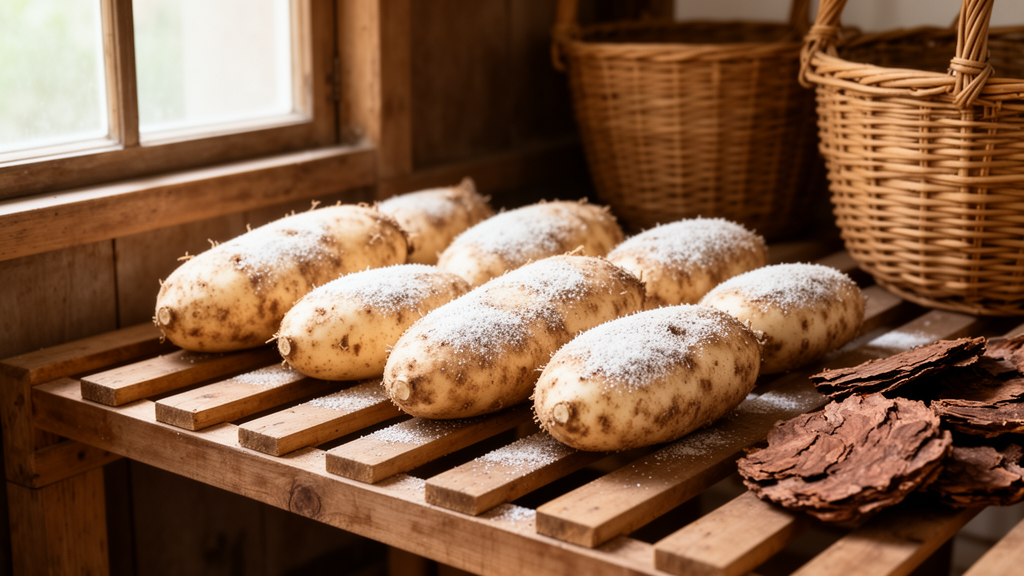
Decay was highest for control yams stored in trench silos, at 32.86%, and lowest for bark-treated yams on racks, at 7.14%. Sprouting was reported as significantly higher in trench silos for both control and bark-treated yams, reaching 15.71%. Bark-treated yams stored on racks had the highest reported shelf life, 98.71%, while the abstract also gives 98.71% as the highest germination value for neem-treated yams on racks. The authors concluded from the abstract that neem leaf and bark could help preserve tuber weight and marketability during storage, with rack storage producing better-quality yams. They further stated that neem bark should be adopted for storage extending beyond four months, based on its reported preservative ability.
The available evidence is limited to the published abstract rather than a full assessment of the article, so it does not provide the numerical basis for every outcome, statistical details beyond the reported significance of sprouting and shelf life, or information about potential mechanisms. The trial also concerned tubers sourced from farms in Makurdi, and the abstract does not establish whether the observed treatment and storage effects would be reproduced elsewhere, over longer periods or under different local conditions.
Subject of Research: Effects of neem extracts and storage methods on post-harvest white yam quality in a six-month factorial trial.
Article Title: Comparative effects of neem extracts and storage methods on the quality of white yam (Dioscorea rotundata)
Article References: Iyaji, A. A., Teryila, S. S., Obasi, M. O., & Otebe, J. A. (2026). Comparative effects of neem extracts and storage methods on the quality of white yam (Dioscorea rotundata). BMC Plant Biology. https://doi.org/10.1186/s12870-026-09977-7
Image Credits: AI Generated
DOI: 10.1186/s12870-026-09977-7
Keywords: white yam, Dioscorea rotundata, neem leaf extract, neem bark, post-harvest storage, rack storage, trench silo, tuber weight loss, tuber decay, marketability, factorial trial, Comparative
News Source: Alan Morgan. (October 20, 2026). Six-month factorial trial links neem treatment and rack storage to better white yam quality. Scienmag.