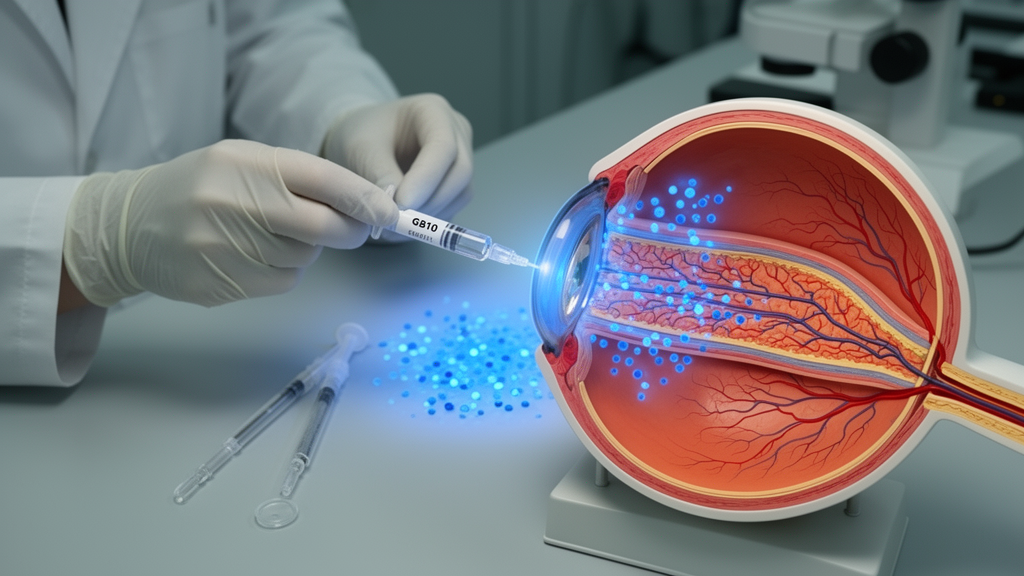
A newly engineered fusion protein called GB10 suppressed abnormal blood-vessel leakage at lower doses and for longer periods than the approved comparator faricimab in two preclinical models of ocular neovascularization, according to a study in cynomolgus monkeys and rabbits. The bispecific protein neutralizes vascular endothelial growth factor and angiopoietin-2, two signaling systems implicated in the growth and destabilization of leaky vessels. In laser-induced choroidal neovascularization, one intravitreal dose of 0.7 mg per eye produced a response comparable to that of 6 mg per eye of faricimab, while in a persistent rabbit model of retinal neovascularization, GB10 maintained measurable suppression of leakage through at least 12 weeks. These findings remain preclinical; direct comparisons between the treatments did not reach statistical significance in the rabbit experiment, and no clinical benefits or safety in patients were established.
The study was designed to test both potency and duration in two complementary animal models. Laser-induced choroidal neovascularization in 20 male cynomolgus monkeys was used to compare single intravitreal doses of GB10 at 0.07, 0.7 or 7 mg per eye with 6 mg per eye of faricimab or vehicle. The investigators induced lesions in both eyes, confirmed successful disruption of Bruch’s membrane by immediate bubble formation and optical coherence tomography, and enrolled only animals whose lesions developed at least one grade 4 leakage spot. Treated monkeys were evaluated by fluorescein fundus angiography at one, two and four weeks after dosing. Measurements were averaged across the two eyes of each animal before statistical analysis, with four animals, representing eight eyes, assigned to each of the five groups.
GB10 produced a dose-dependent reduction in severe leakage during the first week after treatment. The incidence of grade 4 spots was 98.61% with 0.07 mg per eye of GB10, 54.17% with 0.7 mg per eye and 29.16% with 7 mg per eye, compared with 100% in vehicle-treated eyes and 76.39% with 6 mg per eye of faricimab. The corresponding grade 4 leakage areas were 7.82, 4.69 and 2.39 square millimeters for the three GB10 doses, versus 11.43 square millimeters for vehicle and 6.73 square millimeters for faricimab. The difference between the two lowest GB10 doses was statistically significant at one week, while the comparison between 7 mg per eye of GB10 and faricimab approached the threshold for significance but did not cross it, with a p value of 0.059.
By week two, GB10 at 0.7 and 7 mg per eye had reduced both the incidence and area of grade 4 leakage to zero, and that result remained at week four. All active-treatment groups were significantly more effective than vehicle at these later time points, as was faricimab. The investigators therefore described the 0.7 mg per eye GB10 result as similar to that obtained with the 6 mg per eye faricimab regimen, a nine-fold difference in administered dose, rather than as a statistically proven head-to-head superiority. The comparison was also conducted in a model whose lesions can regress spontaneously, limiting its ability to test very long-lasting effects. In addition, the use of only male monkeys was intended to reduce variability associated with cyclic estrogen changes, but it may also narrow how broadly the findings apply.
To examine durability, the researchers used Dutch belted rabbits in a model of retinal neovascularization induced by DL-alpha-aminoadipic acid, a toxin that damages retinal Müller cells and disrupts the blood-retinal barrier. Neovascular vessels appeared within two weeks, leakage increased rapidly, and then stabilized during weeks four to eight without regression through the full 24-week observation period. After three months of induction, eyes received a single intravitreal injection of GB10, faricimab or vehicle, with five eyes per group, and angiography was performed every two weeks for 12 weeks. The primary measures were the change in overall fluorescein angiography score and the change in the area of grade 4 leakage relative to baseline, with observers using predefined criteria and an arbitration procedure for disagreements.
In this rabbit model, both active agents reduced overall leakage scores to zero at week two, but their responses subsequently diverged. Faricimab remained measurably better than vehicle through week four, after which its effect became difficult to distinguish from vehicle; by week six, its overall score had rebounded to 44.95% of baseline on average. GB10 remained at zero on the overall score through week six and was still significantly below vehicle at weeks eight, 10 and 12, although the average score rose to 12.85%, 18.69% and 31.27%, respectively, at those later points. For grade 4 leakage area, faricimab was significantly below vehicle through week eight, whereas GB10 remained significantly below vehicle through week 12. At week 12, GB10 averaged 2.48% of baseline grade 4 leakage area, compared with 37.74% for faricimab and 130.20% for vehicle.
Although the separation between GB10 and faricimab widened as follow-up continued, the direct comparison did not demonstrate statistical significance. The authors attributed this uncertainty to the small sample size and variability, particularly the large standard errors around some faricimab measurements. The defensible conclusion is therefore that GB10 showed numerically longer suppression than faricimab in this rabbit model, not that superiority was proven. The experiment nevertheless offers a relevant preclinical contrast: GB10 reduced both measured forms of pathological leakage through 12 weeks, while faricimab’s detectable effects on the overall score and grade 4 area were reported as lasting four and eight weeks, respectively. Longer follow-up and larger animal cohorts would be needed to characterize the difference more precisely.
Pharmacokinetic testing offered a possible explanation for the sustained activity. After one bilateral 7 mg per eye intravitreal injection in 48 chinchilla rabbits, investigators measured free GB10 in serum and several ocular tissues with a validated enzyme-linked immunosorbent assay. Retinal and choroidal concentrations peaked four hours after dosing. The terminal half-lives were 94.2 hours in retina and 122 hours in choroid, while vitreous humor had a half-life of 93.1 hours. The area under the concentration-time curve was substantially higher in ocular tissues than in serum, with ocular-to-serum ratios ranging from 14 to 4,787. Retina and choroid accounted for 19.7% and 15.2% of total ocular distribution, respectively, or about 35% combined, whereas serum represented only 0.02% of total exposure.
GB10’s molecular design may have contributed to these findings. It combines a VEGF-Trap module with a camelid-derived single-domain antibody against Ang-2 in a symmetric 2+2, tetravalent architecture. The VEGF-Trap can neutralize VEGF-A, VEGF-B and placental growth factor, while the Ang-2-binding domain blocks Ang-2. Faricimab uses a conventional 1+1 bispecific antibody format directed at VEGF-A and Ang-2. In previously reported biochemical assays, GB10 had a VEGF-inhibition IC50 of 0.02 nanomolar, compared with 0.15 nanomolar for faricimab, and an Ang-2-inhibition IC50 of 0.15 nanomolar, compared with 14.17 nanomolar. Those measurements suggest stronger ligand neutralization, but the present study did not directly connect molecular potency to the longer duration observed in animals, and it did not include a side-by-side tissue pharmacokinetic comparison with faricimab.
Several limitations temper the translational promise of the results. The rabbit retinal model is driven by toxin-mediated cell injury and does not reproduce the complex causes of human neovascular eye disease. The study was exploratory, used small groups, and did not apply mixed-effects models because of sample-size constraints. Fluorescein images were not fully masked, leaving possible observer influence despite standardized scoring and review by multiple assessors. The investigators also did not build a formal pharmacokinetic-pharmacodynamic model linking free-drug exposure and receptor occupancy to lesion suppression, and the tissue measurements were insufficient to establish ocular or systemic safety. Long-term toxicology and clinical trials would therefore be required to determine whether the lower dose, longer duration and limited systemic exposure seen in animals translate into safer or more effective treatment for people with neovascular retinal disorders.
Subject of Research: Preclinical assessment of the bispecific VEGF/Ang-2 fusion protein GB10 in animal models of ocular neovascularization.
Article Title: Efficacy and durability of GB10, a novel bispecific VEGF/Ang-2 neutralizing fusion protein, in ocular neovascularization models
Article References: Hao, M., You, Q., Wei, X., & Qin, S. (2026). Efficacy and durability of GB10, a novel bispecific VEGF/Ang-2 neutralizing fusion protein, in ocular neovascularization models. Frontiers in Pharmacology, 17, Article 1974368. https://doi.org/10.3389/fphar.2026.1974368
Image Credits: AI Generated
DOI: 10.3389/fphar.2026.1974368
Keywords: GB10, ocular neovascularization, VEGF, Ang-2, faricimab, anti-leakage efficacy, intravitreal delivery, biodistribution, preclinical research, Efficacy, durability, novel
News Source: Ophelia Keating. (October 20, 2026). GB10 shows durable anti-leakage effects in animal eye models. Scienmag.