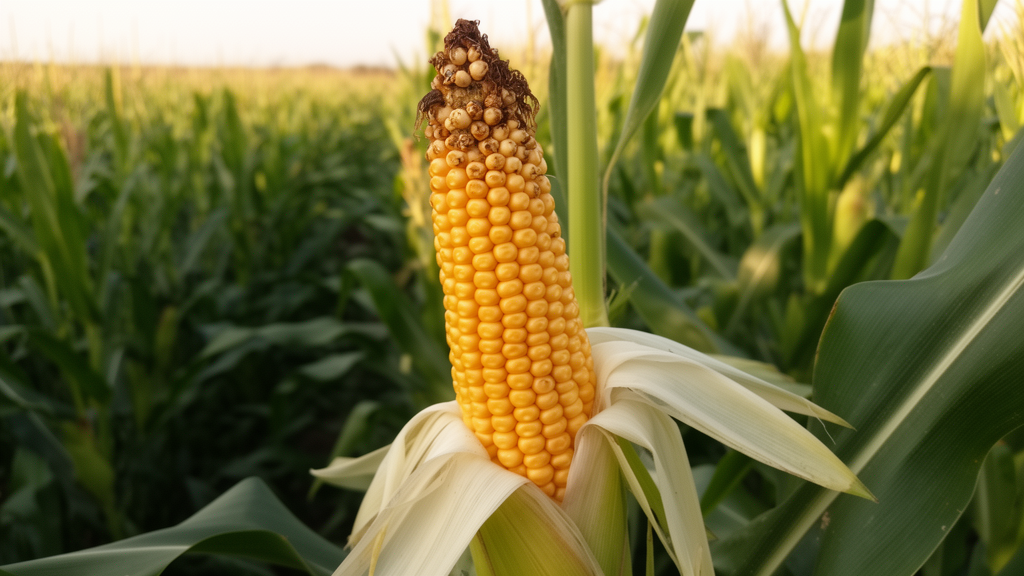
A two-year field trial in Heilongjiang Province, China, found that increasing maize planting density generally reduced early sugar availability, the measured activity of key starch-biosynthetic enzymes, and the potential and rate of starch accumulation during grain filling. The reductions were more pronounced in apical grains—the kernels toward the top of the ear—than in basal-middle grains. The study tested three maize hybrids at three densities: D1, 82,500 plants per hectare; D2, 93,800 plants per hectare; and D3, 105,000 plants per hectare.
Researchers separated grains according to their position on the ear and measured sucrose and soluble-sugar levels during early grain filling. They also assessed the activities of ADP-glucose pyrophosphorylase, starch synthase, and starch branching enzyme, then tracked starch accumulation through the filling period and recorded harvest-stage traits. Across planting densities and cultivars, basal-middle grains consistently had higher early sugar supply, higher activities of these three enzymes, and stronger starch accumulation than apical grains. The results therefore identified a consistent difference in grain-filling physiology between the two ear-position groups.
Planting density mainly changed the intensity of starch accumulation rather than its timing. Logistic analysis indicated that higher density reduced the intensity of the accumulation process without markedly shifting its temporal pattern. In practical terms, the measured starch-accumulation curve was not evidence of a radically different filling schedule; instead, grain-filling strength declined as planting density increased. This distinction came from the statistical analysis of the trial data and does not imply that the tested densities produced identical crop development in every respect.
The trial also linked several stages of the grain-filling process. Piecewise structural equation modeling showed close associations among early sugar supply, starch-biosynthetic enzyme activity, starch-accumulation kinetics, and traits recorded at harvest. Together with the field measurements, these results support a physiological explanation in which dense planting is associated with coordinated reductions in early sugar availability and starch-biosynthetic capacity. The structural model identifies relationships among those variables; it does not by itself establish that every modeled link is causal.
Responses differed among the three hybrids, and the authors associated tolerance to higher planting density with the maintenance of grain-filling physiology across ear positions. The supplied findings do not provide a universal ranking of the hybrids or demonstrate that any one cultivar produced a specific yield advantage. The experiment was a field-based physiological study conducted at one location over two years, with three hybrids and three density levels, so its scope is narrower than a comparison across regions, seasons, or management systems. The activity-based enzyme measurements should also not be read as a direct inventory of every metabolic pathway involved in grain filling. Within this trial, however, the evidence consistently associates higher planting density with lower early sugar supply, reduced starch-biosynthetic enzyme activity, and weaker starch accumulation, with apical grains showing the stronger response.
Subject of Research: Effects of maize planting density on grain filling, starch accumulation, and harvest traits at different ear positions
Article Title: Effects of increased planting density on carbon metabolism, starch accumulation, and yield formation of maize grains at different ear positions
Article References: Kong, D., Kong, L., Zhang, X., Li, X., Zheng, S., Li, W., Duan, Z., Sun, Y., Sun, H., & Guo, W. (2026). Effects of increased planting density on carbon metabolism, starch accumulation, and yield formation of maize grains at different ear positions. BMC Plant Biology. https://doi.org/10.1186/s12870-026-09795-x
Image Credits: AI Generated
DOI: 10.1186/s12870-026-09795-x
Keywords: maize, planting density, grain filling, starch accumulation, ear position, sucrose, starch biosynthesis, field trial, Heilongjiang, maize hybrids, Effects, increased
News Source: Alan Morgan. (October 20, 2026). Higher maize density linked to weaker grain filling in apical grains. Scienmag.