• HOME
  • NEWS
  • EXPLORE
    • CAREER
      • Companies
      • Jobs
    • EVENTS
    • iGEM
      • News
      • Team
    • PHOTOS
    • VIDEO
    • WIKI
  • BLOG
  • COMMUNITY
    • FACEBOOK
    • INSTAGRAM
    • TWITTER
Tuesday, October 20, 2026
BIOENGINEER.ORG
No Result
View All Result
  • Login
  • HOME
  • NEWS
  • EXPLORE
    • CAREER
      • Companies
      • Jobs
        • Lecturer
        • PhD Studentship
        • Postdoc
        • Research Assistant
    • EVENTS
    • iGEM
      • News
      • Team
    • PHOTOS
    • VIDEO
    • WIKI
  • BLOG
  • COMMUNITY
    • FACEBOOK
    • INSTAGRAM
    • TWITTER
No Result
View All Result
Bioengineer.org
No Result
View All Result
Home NEWS Science News Health

Sterile Packaging Damage Linked to Workloads, Material, and Set Size

by
October 20, 2026
in Health
Reading Time: 2 mins read
0
Sterile Packaging Damage Linked to Workloads, Material, and Set Size

Sterile Packaging Damage Linked to Workloads, Material, and Set Size

Share on FacebookShare on TwitterShare on LinkedinShare on RedditShare on Telegram

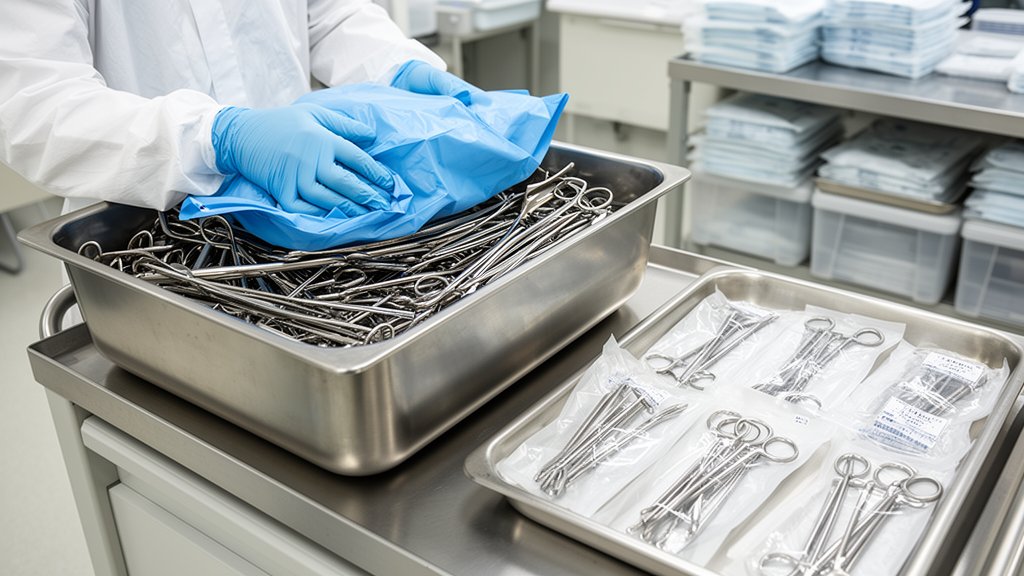
A single-center retrospective case-control study found that non-woven wrapping material, workloads exceeding 500 packs per day, loan medical instruments, larger instrument sets, and a higher number of instruments per set were independently associated with greater odds of physical damage to sterile packaging. Double-layer wrapping was associated with substantially lower odds, while a risk prediction model distinguished damaged from undamaged sets with an area under the receiver operating characteristic curve (AUC) of 0.882.

The study, conducted in a central sterile supply department, included 140 instrument sets with packaging damage and 420 without damage, yielding a 1:3 case-control design. Investigators collected information on packagers and instrument-set characteristics. They used binary logistic regression to identify factors independently associated with packaging damage and assessed the model’s discrimination by calculating AUC. The reported model performance was good, with a 95% confidence interval of 0.847 to 0.918.

Non-woven packaging material had the largest reported association with damage, with an odds ratio of 22.612. Processing more than 500 packs per day was linked to higher odds, with an odds ratio of 5.738, and loan medical instruments were associated with increased odds, with an odds ratio of 5.527. Larger sets had an odds ratio of 2.609, indicating an association between greater set size and damage. Each additional instrument in a set was associated with slightly higher odds, corresponding to an odds ratio of 1.022.

Double-layer wrapping was the only factor reported as protective. Its odds ratio of 0.040 means that sets using this wrapping method had substantially lower odds of packaging damage than the comparison group. The findings identify wrapping configuration as a potentially important variable in models used to recognize high-risk instrument sets, although the study does not establish that double-layer wrapping or any other identified factor directly caused the observed differences.

Because the research was retrospective, observational, and conducted at one center, its estimates show associations rather than causal effects. The results are most directly applicable to instrument sets processed in central sterile supply departments with operating conditions similar to those studied. The model’s AUC indicates that it performed well in distinguishing damaged and undamaged sets in the study population, but the source evidence does not establish whether performance would remain similar in other institutions, under different workflows, or after changes in packaging practices.

Subject of Research: Risk factors and prediction of sterile packaging damage in central sterile supply departments

Article Title: Risk factors for sterile packaging damage in Central sterile supply departments: a retrospective case-control study

Article References: Xiang, S., Liu, J., Zheng, S., & Chen, H. (2026). Risk factors for sterile packaging damage in Central sterile supply departments: a retrospective case-control study. BMC Health Services Research. https://doi.org/10.1186/s12913-026-15870-8

Image Credits: AI Generated

DOI: 10.1186/s12913-026-15870-8

Keywords: sterile packaging, packaging damage, central sterile supply, case-control study, non-woven material, double-layer wrapping, loan instruments, instrument set size, workload, risk prediction, Risk, factors

News Source: Ophelia Keating. (October 20, 2026). Sterile Packaging Damage Linked to Workloads, Material, and Set Size. Scienmag.


Tags: case-control studycentral sterile supplydouble-layer wrappingfactorsinstrument set sizeloan instrumentsnon-woven materialpackaging damageriskrisk predictionsterile packagingworkload
Share12Tweet7Share2ShareShareShare1

Related Posts

Review: Natural products show preclinical promise in vascular dementia

Review: Natural products show preclinical promise in vascular dementia

October 20, 2026
Shear wave elastography tracks earlier exercise responses in type 2 diabetes

Shear wave elastography tracks earlier exercise responses in type 2 diabetes

October 20, 2026

PCP, not bacterial co-infection, linked to pulmonary cryptococcosis mortality

October 20, 2026

CT-measured carotid fat density linked to recent ischemic events

October 20, 2026

POPULAR NEWS

  • Protein–polysaccharide co-assembly stabilizes epicatechin nanoparticles in laboratory study

    Protein–polysaccharide co-assembly stabilizes epicatechin nanoparticles in laboratory study

    29 shares
    Share 12 Tweet 7
  • Sterile Packaging Damage Linked to Workloads, Material, and Set Size

    29 shares
    Share 12 Tweet 7
  • MG53 degrades AMPKα and suppresses bladder cancer in preclinical models

    29 shares
    Share 12 Tweet 7
  • Research report: Modeling the distribution of coprophagous beetle species in the Western Swiss Alps

    29 shares
    Share 12 Tweet 7

About

We bring you the latest biotechnology news from best research centers and universities around the world. Check our website.

Follow us

Recent News

Protein–polysaccharide co-assembly stabilizes epicatechin nanoparticles in laboratory study

Sterile Packaging Damage Linked to Workloads, Material, and Set Size

MG53 degrades AMPKα and suppresses bladder cancer in preclinical models

Subscribe to Blog via Email

Enter your email address to subscribe to this blog and receive notifications of new posts by email.

Join 85 other subscribers
  • Contact Us

Bioengineer.org © Copyright 2023 All Rights Reserved.

Welcome Back!

Login to your account below

Forgotten Password?

Retrieve your password

Please enter your username or email address to reset your password.

Log In
No Result
View All Result
  • Homepages
    • Home Page 1
    • Home Page 2
  • News
  • National
  • Business
  • Health
  • Lifestyle
  • Science

Bioengineer.org © Copyright 2023 All Rights Reserved.