In a single-center retrospective cohort study of patients with digestive system cancers, two body-composition markers extracted automatically from pretreatment abdominal CT scans were associated with overall survival after adjustment for clinical variables, but adding the imaging measures to a clinical model produced little improvement in discriminatory performance during internal validation. The findings indicate that routine scans can contain information associated with survival, although the study did not establish clinical utility and found limited evidence that these automated markers improve prognosis beyond clinical information.
The researchers initially considered 405 patients who had both pretreatment CT imaging and survival follow-up. Automated segmentation with TotalSegmentator identified the L3 vertebra and the bilateral iliopsoas muscles, after which the masks underwent manual quality control. Usable L3 imaging remained for 392 patients. Among these participants, 377 had complete data required for the common primary-analysis cohort and were randomly divided into a training set of 300 patients and an internal-validation set of 77. The retrospective design, single-center setting and selected patient population restrict the conclusions to the cohort studied and do not establish whether the same relationships or predictive performance would occur elsewhere.
Univariable and adjusted Cox proportional-hazards models were used to examine associations between the CT body-composition markers and overall survival. In unadjusted analyses, markers indicating greater muscle quantity were generally associated with lower mortality hazard. Following adjustment, each one-standard-deviation increase in L3 vertebral center-slipse attenuation was associated with a higher hazard of death, with a hazard ratio of 1.155, while each one-standard-deviation increase in whole-iliopsoas volume index was associated with a lower hazard, with a hazard ratio of 0.843. These were observational associations rather than evidence that changing muscle quantity or attenuation would alter survival. The results also apply to the selected CT markers and analytical cohort rather than establishing a clinical effect for CT-based body-composition assessment.
The investigators compared three prediction models: a model containing clinical variables, a model containing CT body-composition variables, and a combined model that fused both groups of information. In the internal-validation set, the combined model achieved a concordance index, or C-index, of 0.772, compared with 0.762 for the clinical model and 0.571 for the CT body-composition model. The difference between the combined and clinical models was 0.009, with a 95% confidence interval of −0.008 to 0.027 and a comparison P value of 0.28. Confidence intervals for differences in time-dependent area under the curve at one, two and three years also included zero. Continuous net reclassification improvement and integrated discrimination improvement were not statistically significant, providing no significant evidence of incremental discrimination from the imaging markers.
The combined model had a lower Brier score at two years than the clinical model, 0.190 versus 0.248, which the authors identified as a secondary finding. That result did not override the weak C-index difference, the nonsignificant time-dependent AUC comparisons or the nonsignificant reclassification measures. The internal-validation set was small, containing 77 patients, and its data came from the same center as the training set, limiting the strength of the validation. Taken together, the study shows that selected automated CT body-composition markers were associated with overall survival in patients with digestive system cancers, while their addition to clinical variables provided little demonstrated improvement in internal validation. Independent external validation is needed, and the findings do not establish clinical utility.
Subject of Research: Associations between automated CT body-composition markers and overall survival in digestive system cancers
Article Title: Automated opportunistic CT body composition markers and overall survival in patients with digestive system cancers: a retrospective cohort study
Article References: Yan, R., Wang, E., Zhu, L., Jin, L., Zhou, Z., & Zheng, L. (2026). Automated opportunistic CT body composition markers and overall survival in patients with digestive system cancers: a retrospective cohort study. BMC Medical Imaging. https://doi.org/10.1186/s12880-026-02972-2
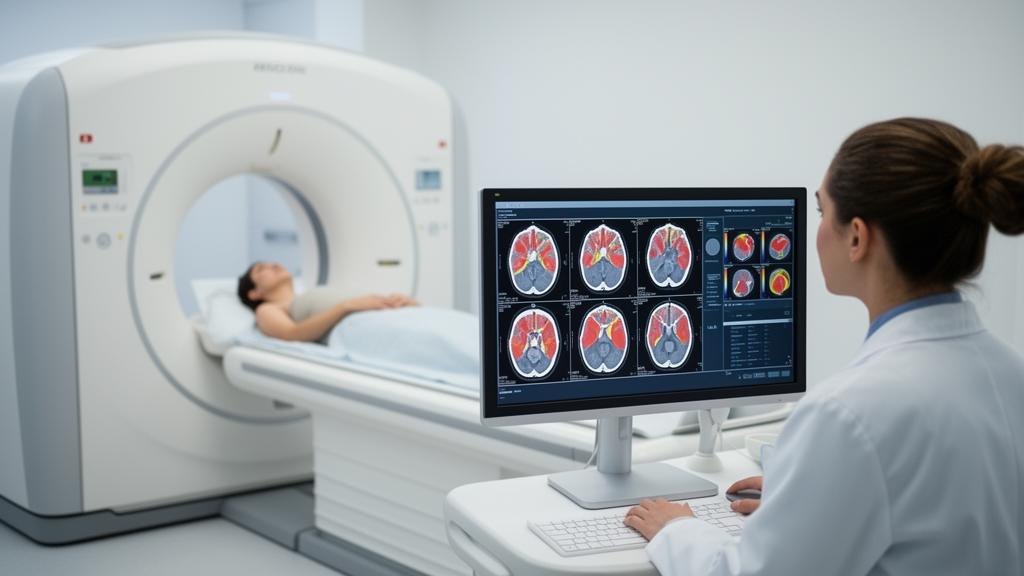
Image Credits: AI Generated
DOI: 10.1186/s12880-026-02972-2
Keywords: digestive system cancers, CT body composition, overall survival, automated segmentation, iliopsoas muscle, vertebral attenuation, Cox models, survival prediction, internal validation, medical imaging, Automated, opportunistic
News Source: Ophelia Keating. (October 20, 2026). Automated CT body composition markers show limited survival-prediction gains. Scienmag.