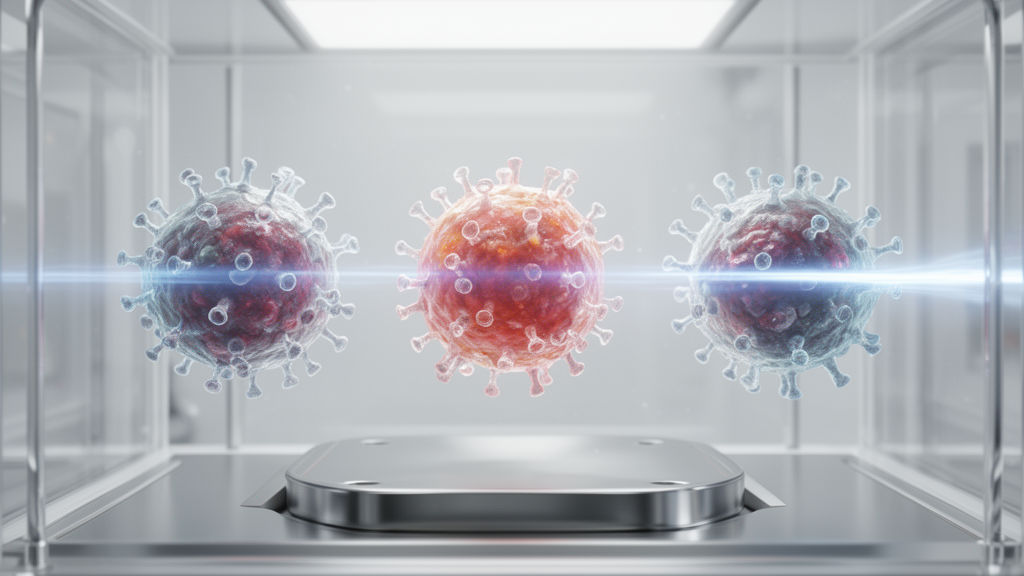
A controlled laboratory study found that 10-megaelectronvolt high-energy electron-beam irradiation and 4.5-megaelectronvolt medium-energy electron-beam treatment inactivated three tested human viruses at broadly comparable efficiency to cobalt-60 gamma irradiation. The study also found that the electron-beam-treated preparations retained major surface-antigen signals and showed stronger functional recognition by susceptible host-cell receptors than heat- or formalin-inactivated preparations. These results apply to the specific viruses, aqueous sample matrix and laboratory conditions tested; they do not establish clinical efficacy in vaccines or other biological products.
The researchers tested human rotavirus, a non-enveloped double-stranded RNA virus; human respiratory syncytial virus type A2, an enveloped negative-sense RNA virus; and influenza A/PR/8/34/H1N1, an enveloped virus with a segmented negative-sense RNA genome. Virus samples were held in phosphate-buffered saline, transported at 4 °C and evaluated with the same alanine/EPR dosimetry system. Two independent trials were conducted for the dose-response experiments, with three replicate samples at each target dose of 0, 2, 4, 6, 8 and 10 kilograys. This design was intended to reduce the matrix, temperature and dosimetry differences that had complicated comparisons among earlier radiation studies.
The high-energy treatment used a 15-kilowatt S-band linear accelerator at the National Center for Electron Beam Research at Texas A&M University, delivering 10 MeV electrons at a dose rate of 3.84 to 4.31 kGy/s. Medium-energy treatment used a 4.5 MeV commercial linear accelerator operating at 0.37 to 0.45 kGy/s. Gamma irradiation was performed with cobalt-60 at a facility where processing took hours, compared with seconds for the electron-beam systems. The treatments could not be conducted at the same facilities, and beam current and dose rate were therefore not normalized between electron-beam modalities. Researchers assessed dose uniformity and used linear regression of infectious-virus survival against absorbed dose to calculate D10, the dose corresponding to a 90% reduction in infectious virus.
All virus-and-radiation combinations followed first-order inactivation kinetics, with coefficients of determination above 0.95. Rotavirus was the most radiosensitive of the three viruses. Its D10 values were 1.23 ± 0.01 kGy for gamma, 1.25 ± 0.25 kGy for high-energy electron beam and 1.29 ± 0.22 kGy for medium-energy electron beam, with no significant differences among the modalities. Respiratory syncytial virus had D10 values of 1.03 ± 0.07 kGy for gamma, 1.45 ± 0.02 kGy for high-energy electron beam and 1.73 ± 0.23 kGy for medium-energy electron beam; these values likewise did not differ significantly at the study’s conservative p < 0.01 threshold. Influenza A was the most radioresistant and showed significant modality differences, with D10 values of 1.62 ± 0.03 kGy for gamma, 1.95 ± 0.04 kGy for high-energy electron beam and 2.27 ± 0.01 kGy for medium-energy electron beam. The ordering of sensitivity was therefore the same under all three treatments: rotavirus was more sensitive than respiratory syncytial virus, which was more sensitive than influenza A.
Complete loss of infectivity was tested separately at target doses from 12 to 20 kGy by transferring samples onto susceptible cell monolayers for three consecutive passages. Complete inactivation required no detectable cytopathic effect in all three passages and all three replicates. The minimum confirmed dose depended on the virus and its starting titer, not simply on the radiation source. High-energy electron beam achieved confirmed inactivation of rotavirus at 18.17 kGy, respiratory syncytial virus at 15.56 kGy and influenza A at 12.31 kGy. Corresponding medium-energy doses were 19.81 kGy, 13.29 kGy and 13.29 kGy. Importantly, some rotavirus samples that appeared inactive after one or two passages still yielded infectious virus in a later passage, while a high-energy-treated respiratory syncytial virus sample first showed infectivity in passage three. The findings therefore show that a single negative culture result was insufficient to establish complete inactivation in this experimental system.
The investigators then compared antigen preservation against untreated virus and against conventional heat and formalin controls. An indirect ELISA quantified the rotavirus VP4 outer-capsid protein, a direct ELISA assessed the respiratory syncytial virus fusion protein, and a hemagglutination assay tested the functional ability of influenza hemagglutinin to agglutinate turkey erythrocytes. At lethal electron-beam doses, none of these measures showed a significant difference from untreated controls. Heat treatment reduced measured antigenicity by 5.09-fold to 6.56-fold for rotavirus, 5.79-fold to 7.89-fold for respiratory syncytial virus and 256-fold for influenza A. Formalin treatment produced smaller reductions of 1.69-fold to 1.72-fold for rotavirus, 1.26-fold to 1.72-fold for respiratory syncytial virus and twofold for influenza A. Under the tested conditions, therefore, the electron-beam treatments preserved the selected antigenic signals while the conventional methods caused measurable losses. Gamma-treated samples were not assessed for antigen preservation in this experiment.
Cell-based assays were used to test whether the preserved viral proteins could still be recognized by their corresponding host-cell receptors. Electron-beam-inactivated rotavirus showed 1.85-fold greater receptor recognition than heat-inactivated rotavirus with high-energy treatment and 1.82-fold greater recognition with medium-energy treatment. Relative to formalin, the corresponding differences were 0.89-fold and 1.14-fold. For respiratory syncytial virus, electron-beam treatment produced about 1.54-fold to 1.58-fold greater fusion-protein recognition than heat treatment and 1.63-fold to 1.67-fold greater recognition than formalin. Influenza A showed the largest contrast: lethal high- and medium-energy electron-beam treatment yielded approximately 23.03-fold to 23.11-fold greater hemagglutinin-related host interaction than heat treatment and 1.29-fold to 1.31-fold greater interaction than formalin. All reported differences for these comparative assays were statistically significant at p < 0.0001.
The results support electron-beam irradiation as a technically distinct option for viral inactivation. The process combines machine-generated electrons with rapid delivery and avoids reliance on a radioactive isotope, whereas the tested cobalt-60 treatment required prolonged exposure. Irradiation is intended to damage viral genetic material, while heat can unfold and aggregate proteins and formalin can introduce covalent cross-links; in this study, the electron-beam treatments maintained the measured surface-antigen signals more closely than those two controls. Nevertheless, the comparison involved three specific human viruses, one laboratory strain of influenza, defined aqueous samples and three irradiation facilities. Dose-rate differences remained, gamma-treated samples were not evaluated for antigen preservation in this experiment, and low-energy electron beam was excluded because the selected alanine dosimetry was incompatible with it and suitable biological containment was unavailable. The findings therefore demonstrate laboratory performance for 10 and 4.5 MeV electron beam under the tested conditions, rather than universal equivalence across viruses, product matrices, facilities or processing configurations.
Overall, the study found that 10 MeV and 4.5 MeV electron-beam treatments achieved complete inactivation of the three tested viruses at doses confirmed through three serial passages and, for most comparisons, produced D10 values similar to gamma irradiation. The treatments also preserved rotavirus VP4, respiratory syncytial virus fusion protein and influenza hemagglutinin at levels comparable with untreated controls, while retaining functional virus-host receptor recognition. These are inactivation and antigen-preservation findings rather than evidence of clinical efficacy: the study did not test immune responses, protection in people or vaccine products. Its immediate implication is that accelerator-based electron beam can combine rapid viral inactivation with preservation of selected surface antigens in a controlled laboratory setting, a property the researchers identify as relevant to future biopharmaceutical development.
Subject of Research: Comparative laboratory inactivation of human rotavirus, respiratory syncytial virus and influenza A virus using electron-beam and gamma irradiation
Article Title: Comparative viral inactivation kinetics of electron beam and gamma irradiation and functional characterization of electron beam inactivated viruses
Article References: Ali, M., Praveen, C., & Pillai, S. D. (2026). Comparative viral inactivation kinetics of electron beam and gamma irradiation and functional characterization of electron beam inactivated viruses. Frontiers in Microbiology, 17, Article 1963124. https://doi.org/10.3389/fmicb.2026.1963124
Image Credits: AI Generated
DOI: 10.3389/fmicb.2026.1963124
Keywords: viral inactivation, electron beam, gamma radiation, rotavirus, respiratory syncytial virus, influenza A virus, antigen preservation, virus-host interaction, dose-response kinetics, inactivated virus, Comparative, viral
News Source: Kristina Jarvis. (October 20, 2026). Laboratory study finds electron beams inactivate three human viruses with preserved antigens. Scienmag.