• HOME
  • NEWS
  • EXPLORE
    • CAREER
      • Companies
      • Jobs
    • EVENTS
    • iGEM
      • News
      • Team
    • PHOTOS
    • VIDEO
    • WIKI
  • BLOG
  • COMMUNITY
    • FACEBOOK
    • INSTAGRAM
    • TWITTER
Tuesday, October 20, 2026
BIOENGINEER.ORG
No Result
View All Result
  • Login
  • HOME
  • NEWS
  • EXPLORE
    • CAREER
      • Companies
      • Jobs
        • Lecturer
        • PhD Studentship
        • Postdoc
        • Research Assistant
    • EVENTS
    • iGEM
      • News
      • Team
    • PHOTOS
    • VIDEO
    • WIKI
  • BLOG
  • COMMUNITY
    • FACEBOOK
    • INSTAGRAM
    • TWITTER
No Result
View All Result
Bioengineer.org
No Result
View All Result
Home NEWS Science News Technology

NiTe–MoS2/rGO electrode reaches 782 farads per gram in laboratory testing

by
October 20, 2026
in Technology
Reading Time: 2 mins read
0
NiTe–MoS2/rGO electrode reaches 782 farads per gram in laboratory testing

NiTe–MoS2/rGO electrode reaches 782 farads per gram in laboratory testing

Share on FacebookShare on TwitterShare on LinkedinShare on RedditShare on Telegram

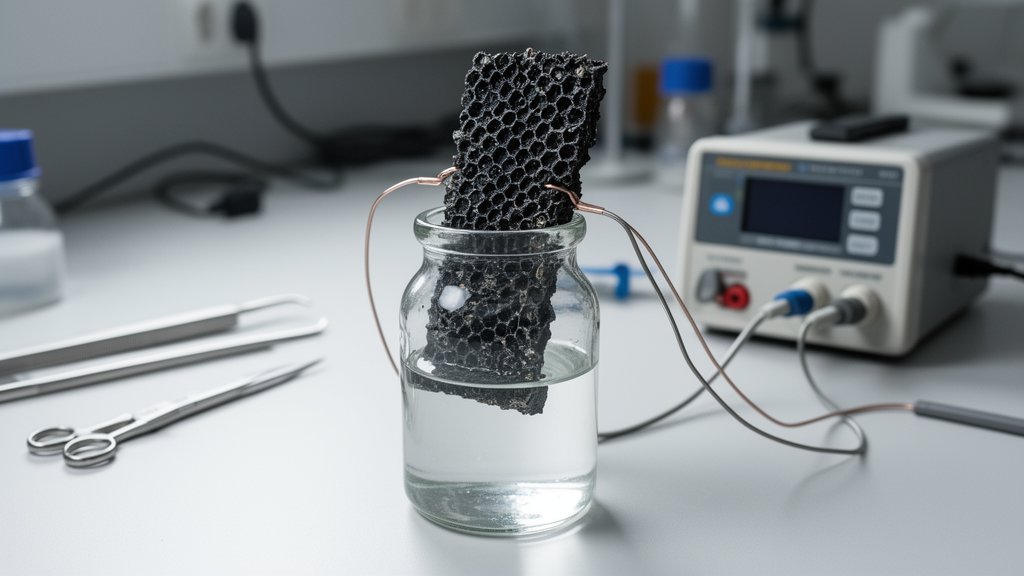
A laboratory study reports that a ternary nickel telluride–molybdenum disulfide/reduced graphene oxide electrode achieved a specific capacitance of 782 farads per gram at a current density of 3 amperes per gram. Tested in an aqueous electrolyte using a three-electrode configuration, the hybrid also delivered an energy density of 27 watt-hours per kilogram and a power density of 758 watts per kilogram. After 5,000 charge–discharge cycles, the electrode retained 87% of its initial capacity, according to the study abstract published in Ionics .

The material was synthesized through a hydrothermal method and characterized as a potential supercapacitor electrode. The reported electrochemical results came from laboratory testing rather than a packaged or commercial supercapacitor device. The authors attributed the enhanced performance of the NiTe–MoS2/rGO composite to a synergistic effect among its components, which increased electrical conductivity, accelerated charge transfer and increased the accessible electroactive surface area.

The available study summary does not assign those individual contributions to a specific component or provide a head-to-head comparison with other electrode materials. Physical analysis indicated changes in crystallite size and optical band gap when nickel telluride was incorporated into the MoS2/rGO material. The researchers determined average crystallite sizes of 47 nanometers for MoS2/rGO and 21 nanometers for the NiTe–MoS2/rGO hybrid composite.

Their reported optical band-gap values were 1.59 electronvolts and 1.43 electronvolts, respectively. Field-emission scanning electron microscopy showed sheet-like and rod-like morphologies within the material. These observations formed part of the study’s broader physicochemical characterization of the synthesized composite.

Elemental and chemical-state information was obtained through energy-dispersive X-ray spectroscopy and X-ray photoelectron spectroscopy. The researchers used energy-dispersive X-ray spectroscopy to examine the composite’s elemental composition, while X-ray photoelectron spectroscopy was used to determine oxidation states. Together with the crystallite, optical and microscopic results, these measurements provided complementary information about the structure and chemistry of the hydrothermal product.

Electrochemical performance was evaluated with cyclic voltammetry, galvanostatic charge–discharge measurements and electrochemical impedance spectroscopy. The reported specific capacitance of 782 farads per gram was obtained at 3 amperes per gram in the three-electrode aqueous system, alongside the energy density of 27 watt-hours per kilogram and power density of 758 watts per kilogram. The 5,000-cycle test produced 87% capacity retention.

Subject of Research: Physicochemical characterization and electrochemical testing of a NiTe–MoS2/rGO supercapacitor electrode

Article Title: Hierarchical physicochemical characterization and electrochemical performance of MoS2/rGO-supported NiTe hybrid nanocomposite material for supercapacitors

Article References: Ramakrishnan, K., Manoharan, I. S. K., Kumar, A., & Saravanan, M. (2026). Hierarchical physicochemical characterization and electrochemical performance of MoS2/rGO-supported NiTe hybrid nanocomposite material for supercapacitors. Ionics. https://doi.org/10.1007/s11581-026-07535-7

Image Credits: AI Generated

DOI: 10.1007/s11581-026-07535-7

Keywords: supercapacitors, NiTe, MoS2, reduced graphene oxide, hybrid nanocomposite, specific capacitance, energy density, power density, cycle stability, electrode materials, Hierarchical, physicochemical

News Source: Denise Maddox. (October 20, 2026). NiTe–MoS2/rGO electrode reaches 782 farads per gram in laboratory testing. Scienmag.


Tags: cycle stabilityElectrode Materialsenergy densityHierarchicalhybrid nanocompositeMoS2NiTephysicochemicalpower densityreduced graphene oxidespecific capacitanceSupercapacitors
Share12Tweet7Share2ShareShareShare1

Related Posts

Voltage-controlled lithium niobate chip advances compact full-color laser displays

Voltage-controlled lithium niobate chip advances compact full-color laser displays

October 20, 2026
Particle Sensor Preceded HCl Detector in One Simulated PVC Trench Test

Particle Sensor Preceded HCl Detector in One Simulated PVC Trench Test

October 20, 2026

Rosario R package tests temporal overlap in British Columbia cervids

October 20, 2026

Persistent Photoluminescence Superlinearity Beyond Static Recombination Physics in Metal Halide Perovskites

October 20, 2026

POPULAR NEWS

  • Association between CISD2 expression and clinicopathological features and prognosis in gastric cancer: a systematic review, meta-analysis, and database validation

    Association between CISD2 expression and clinicopathological features and prognosis in gastric cancer: a systematic review, meta-analysis, and database validation

    29 shares
    Share 12 Tweet 7
  • First stygobiotic Garra rufa found beside Iranian cave fish

    29 shares
    Share 12 Tweet 7
  • Voltage-controlled lithium niobate chip advances compact full-color laser displays

    29 shares
    Share 12 Tweet 7
  • NiTe–MoS2/rGO electrode reaches 782 farads per gram in laboratory testing

    29 shares
    Share 12 Tweet 7

About

We bring you the latest biotechnology news from best research centers and universities around the world. Check our website.

Follow us

Recent News

Association between CISD2 expression and clinicopathological features and prognosis in gastric cancer: a systematic review, meta-analysis, and database validation

First stygobiotic Garra rufa found beside Iranian cave fish

Voltage-controlled lithium niobate chip advances compact full-color laser displays

Subscribe to Blog via Email

Enter your email address to subscribe to this blog and receive notifications of new posts by email.

Join 85 other subscribers
  • Contact Us

Bioengineer.org © Copyright 2023 All Rights Reserved.

Welcome Back!

Login to your account below

Forgotten Password?

Retrieve your password

Please enter your username or email address to reset your password.

Log In
No Result
View All Result
  • Homepages
    • Home Page 1
    • Home Page 2
  • News
  • National
  • Business
  • Health
  • Lifestyle
  • Science

Bioengineer.org © Copyright 2023 All Rights Reserved.